Knee extensor mechanism injuries can involve the quadriceps tendon, patellar tendon, patella, or tibial tubercle. Surgical repair is usually required.
(See also Overview of Sprains and Other Soft-Tissue Injuries.)
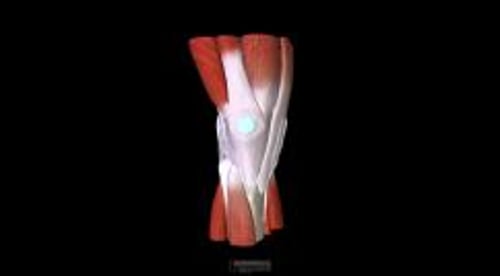
Extension of the knee involves the quadriceps muscles, which are attached to the patella by the quadriceps tendon; the patella is connected to the tibial tubercle by the patellar tendon. Forced flexion at the knee with a contracted quadriceps muscle can damage these structures. Injuries include:
Quadriceps tendon tears
Patellar tendon tears
Patellar fractures
Tibial tubercle fractures
In healthy people, significant force is required to injure these structures; normal tendons are strong enough that the patella often fractures transversely before a tendon tears. However, people with certain conditions are at risk of tendon tears. These conditions include:
Older age
Use of certain medications (eg, fluoroquinolones, glucocorticoids)
In these at-risk people, the injury can result from minor trauma (eg, when descending stairs). The quadriceps tendon is injured more often than the patellar tendon, particularly in older adults (1).
General reference
1. Lee D, Stinner D, Mir H. Quadriceps and patellar tendon ruptures. J Knee Surg. 2013;26(5):301-308. doi:10.1055/s-0033-1353989
Symptoms and Signs of Knee Extensor Mechanism Injuries
The affected area is painful and swollen.
Patients with complete tendon tears cannot stand, perform a straight leg raise while lying on their back, or extend their knee while seated.
Long-term complications (eg, loss of motion, weakness) are common.
Diagnosis of Knee Extensor Mechanism Injuries
Primarily history and physical examination
Radiographs
MRI
Examination of the knee can suggest which structure is injured:
Quadriceps tendon tear: The patella is palpably displaced inferiorly (patella baja).
Patella tendon tear: The patella is displaced superiorly (patella alta).
Transverse patellar fracture: There is often a palpable gap between the two bone fragments.
However, swelling in the area can be significant and mask these findings so that the injury may be misinterpreted as a ligamentous knee joint injury with hemarthrosis. If patients have knee swelling and pain after an injury, clinicians ask patients to sit and try to extend their injured leg to test active knee extension or to lie on their back and raise the injured leg, keeping the leg straight. The patient will not be able to extend the knee if there is a complete tear of the quadriceps or patella tendon or if there is a transverse patella fracture.
Pearls & Pitfalls
|
Routine knee radiographs are taken. Patella alta and patella baja can be seen on knee radiographs. Radiographs often show displacement or fracture of the patella but may appear normal. MRI confirms the diagnosis.

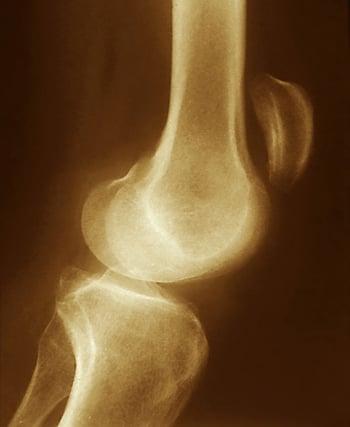
The superior displacement of the patella seen on this radiograph (well above the knee joint) suggests a tear of the patellar tendon, with unopposed contraction of the quadriceps muscle.

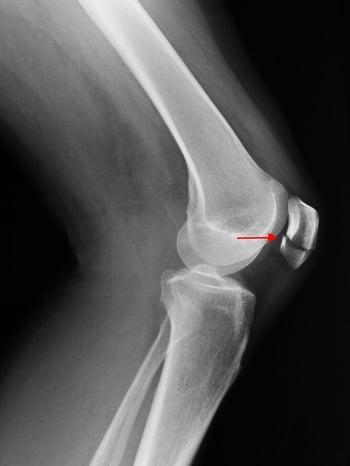
A lateral knee radiograph shows a transverse fracture of the patella (arrow).
Treatment of Knee Extensor Mechanism Injuries
Surgical repair
Treatment of quadriceps or patella tendon tears is surgical repair. Patients should be placed in a knee immobilizer until the tendon is repaired.
For patella fractures, if patients still have an intact extensor mechanism (eg, incomplete transverse fracture), they do not necessarily need surgery but need to be placed in a knee immobilizer to immobilize the fracture segments.