Ulnar collateral ligament sprains of the thumb are common and sometimes disabling.
(See also Overview of Sprains and Other Soft-Tissue Injuries.)
The ulnar collateral ligament connects the base of the thumb's proximal phalanx to the thumb's metacarpal bone on the ulnar aspect of the joint. The usual injury mechanism is radial deviation of the thumb, commonly caused by falling on the hand while holding a ski pole.
Sometimes when the ligament tears, it avulses part of the proximal phalanx at the ligament attachment.
Torn ulnar ligament

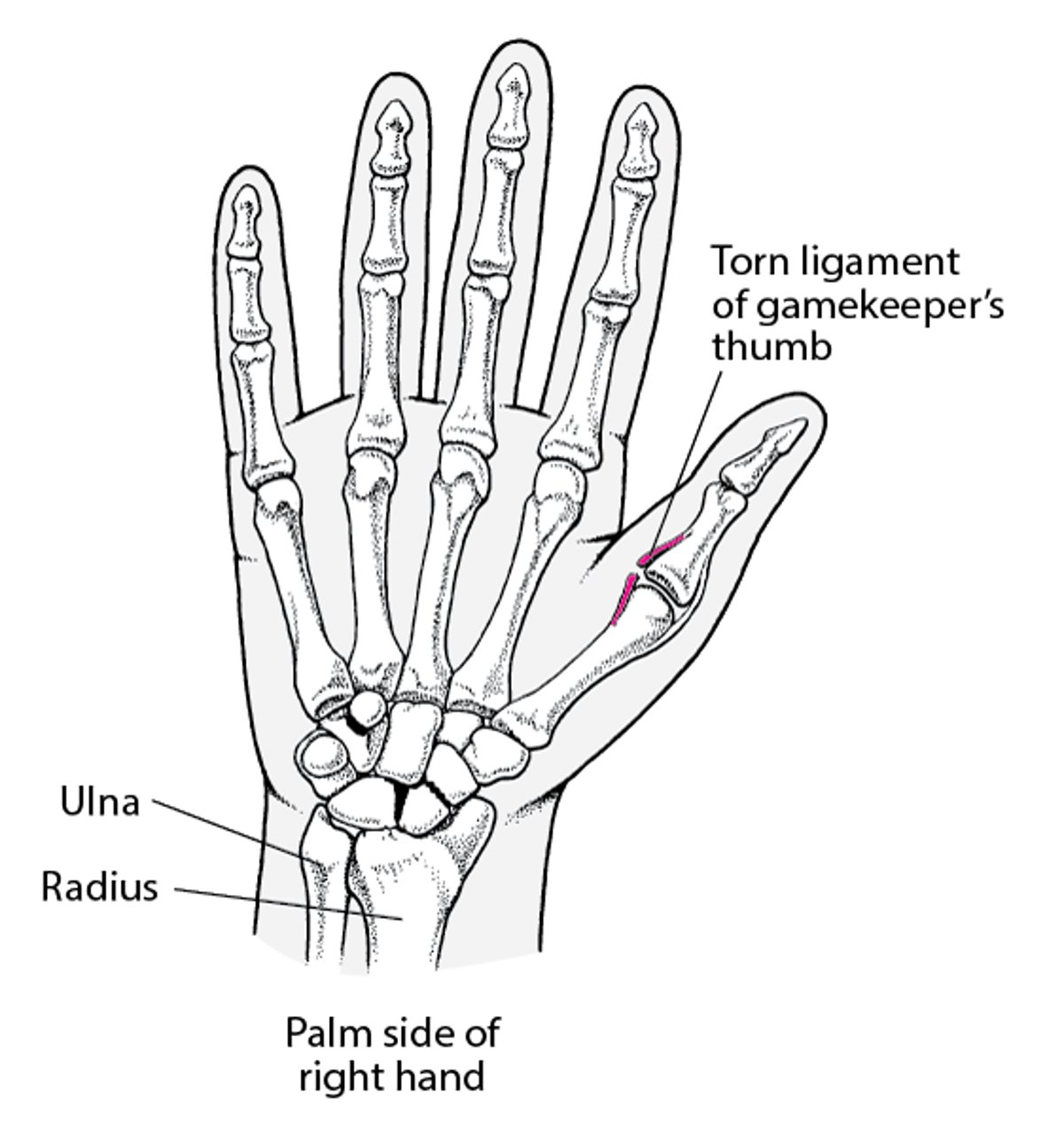
Initially, patients have pain and point tenderness on the ulnar aspect of the thumb metacarpal joint. Long-term complications can include weakness and instability of the joint.
Diagnosis of Ulnar Collateral Ligament Sprains
Stress testing
Radiographs
Stress testing is performed to check for radial deviation of the thumb; before testing, some patients require anesthesia (infiltration of a local anesthetic). The examiner stabilizes the radial side of the metacarpophalangeal joint of the thumb and pulls on the distal thumb in a radial direction. Both thumbs are tested, and the degree of laxity is compared.
Anteroposterior and lateral radiographs are taken to check for an avulsion fracture of the proximal phalanx. Sometimes stress radiographs are taken. Radiographs are usually normal, because there is no underlying fracture.
Treatment of Ulnar Collateral Ligament Sprains
Thumb spica splint
Sometimes surgery
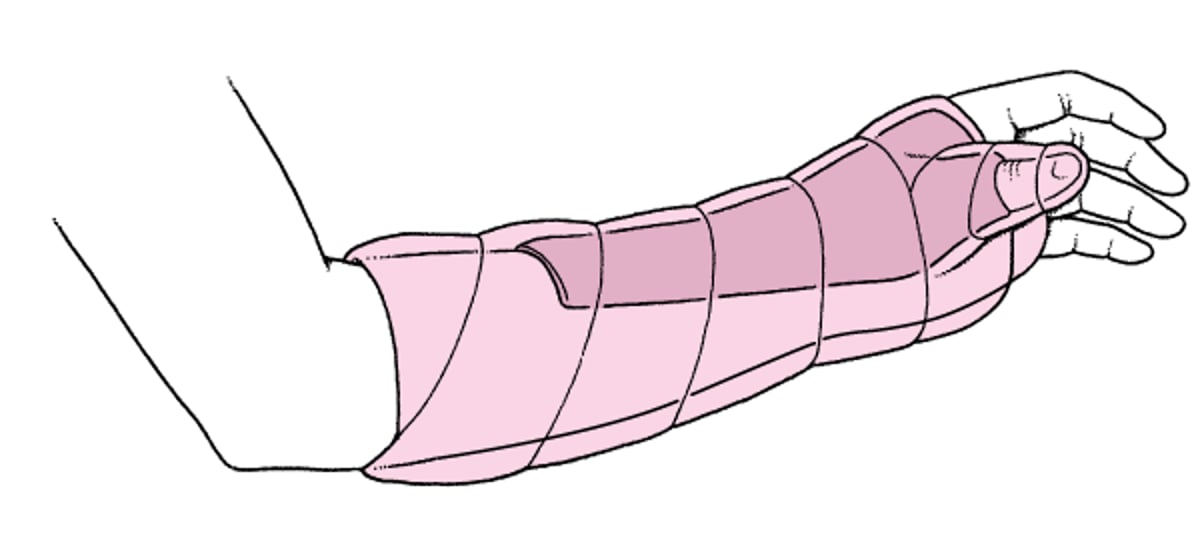
Initial treatment is immobilization with a thumb spica splint (see figure ) for 4 weeks (1). After a few weeks of wearing the splint, patients are instructed to take the splint off and perform strengthening exercises, then put the splint back on. Unrestricted activity is usually allowed after 12 weeks.
Surgical repair is sometimes necessary (eg, if instability persists). After surgery, a thumb spica cast is worn for 4 weeks (1).
Thumb Spica Splint

Treatment reference
1. Avery DM 3rd, Caggiano NM, Matullo KS. Ulnar collateral ligament injuries of the thumb: a comprehensive review. Orthop Clin North Am. 2015;46(2):281-292. doi:10.1016/j.ocl.2014.11.007