PAPA (pyogenic arthritis, pyoderma gangrenosum, and acne) syndrome is an autosomal dominant disorder that affects the skin and joints.
PAPA syndrome is caused by:
Mutations in the proline-serine-threonine phosphatase-interacting protein 1 (PSTPIP1) gene on chromosome 15q
The mutated gene produces a hyperphosphorylated protein that binds excessively to pyrin, thus restricting pyrin’s anti-inflammatory activity, which possibly involves inhibiting neutrophil activation and chemotaxis by blocking activation of inflammasomes. PSTPIP1 variants have been identified in a broad spectrum of phenotypes such as PAPASH (pyoderma gangrenosum, acne, and suppurative hidradenitis with pyogenic arthritis ) and PASH (pyoderma gangrenosum, acne, and suppurative hidradenitis without pyogenic arthritis) (1).
Arthritis usually begins in the first decade of life and is progressively destructive. Episodes of mild trauma may trigger the arthritis. Poorly healing ulcers with undermined edges may appear, often at sites of injury (eg, at vaccination sites). Acne is usually nodulocystic and, if untreated, causes scarring. By puberty, arthritis tends to subside, and cutaneous symptoms predominate.

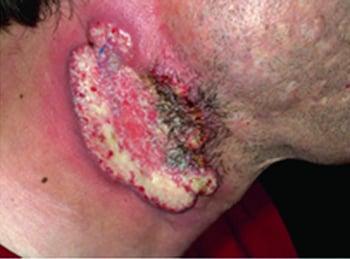
Pyoderma gangrenosum (necrotic tissue with deep ulceration) and nodulocystic acne are characteristic of PAPA syndrome.
The diagnosis of PAPA syndrome is based on clinical findings and a positive family history, but not all patients exhibit the full clinical triad, and phenotypic heterogeneity is common.
The ulcers may be biopsied. Biopsy shows superficial ulceration and neutrophilic inflammation. Genetic testing for mutations in the PSTPIP1 gene may support the diagnosis.
Treatment of PAPA syndrome with tumor necrosis factor (TNF) inhibitors (eg, etanercept, adalimumab, infliximab) or interleukin (IL)-1 inhibitors (eg, anakinra) may be useful (2).
Acne is treated with oral tetracycline or isotretinoin.
General references
1. Boursier G, Piram M, Rittore C, et al: Phenotypic associations of PSTPIP1 sequence variants in PSTPIP1-associated autoinflammatory diseases. J Invest Dermatol 141(5):1141–1147, 2021. doi: 10.1016/j.jid.2020.08.028
2. Cugno M, Borghi A, Marzano AV: PAPA, PASH and PAPASH Syndromes: Pathophysiology, Presentation and Treatment. Am J Clin Dermatol 18(4):555-562, 2017. doi: 10.1007/s40257-017-0265-1
Drug Information for the Topic