Dyslexia is a general term for primary reading disorder. Diagnosis is based on intellectual, educational, speech and language, medical, and psychological evaluations. Treatment is primarily educational management, consisting of instruction in word recognition and component skills.
Dyslexia is a specific type of learning disorder involving reading. Learning disorders involve problems in reading, mathematics, spelling, written expression or handwriting, and understanding or using verbal and nonverbal language (see table ).
No definition of dyslexia is universally accepted; thus, incidence is undetermined. Dyslexia is the most common specific learning disorder, and in fact the majority of specific learning disorders, which affect approximately 5 to 15% of people, involve reading difficulties (1–3). Dyslexia is identified more often in boys than girls (3, 4), but the relationship between gender and reading performance appears to be complex (5).
The inability to learn derivational rules of printed language is often considered part of dyslexia. Affected children may have difficulty determining root words or word stems and determining which letters in words follow others.
Reading problems other than dyslexia are usually caused by difficulties in language comprehension or low cognitive ability. Visual-perceptual problems and abnormal eye movements are not dyslexia. However, these problems can interfere further with word learning.
General references
1. National Center for Educational Statistics. Students with disabilities. In The Condition of Education 2023 U.S. Department of Education, Institute of Education Sciences.
2. Tan ML, Ho JJ, Teh KH. Polyunsaturated fatty acids (PUFAs) for children with specific learning disorders. Cochrane Database Syst Rev. 2016;9(9):CD009398. Published 2016 Sep 28. doi:10.1002/14651858.CD009398.pub3
3. American Psychiatric Association. Diagnostic and Statistical Manual of Mental Disorders. 5th ed, Text Revision. American Psychiatric Association Publishing; 2022.
4. Peterson RL, Pennington BF. Developmental dyslexia. Lancet. 2012;379(9830):1997-2007. doi:10.1016/S0140-6736(12)60198-6
5. Arnett AB, Pennington BF, Peterson RL, Willcutt EG, DeFries JC, Olson RK. Explaining the sex difference in dyslexia. J Child Psychol Psychiatry. 2017;58(6):719-727. doi:10.1111/jcpp.12691
Etiology of Dyslexia
Differences in processing aural information are most often cited as causes of reading disabilities (1), with visual-perceptual problems occurring less frequently. Phonologic processing problems cause deficits in discrimination, blending, memory, and analysis of sounds. Dyslexia may affect both production and understanding of written language, which is often restricted further by problems with auditory memory, speech production, and naming or word finding. Underlying weaknesses in verbal language are often present.
Etiology reference
1. McWeeny S, Norton ES. Auditory Processing and Reading Disability: A Systematic Review and Meta-Analysis, Scientific Studies of Reading. 28(2):167–189, 2024, doi: 10.1080/10888438.2023.2252118
Pathophysiology of Dyslexia
Dyslexia tends to run in families, with heritability reported at 40 to 70% (1, 2). Children with a family history of reading or learning difficulties are at higher risk.
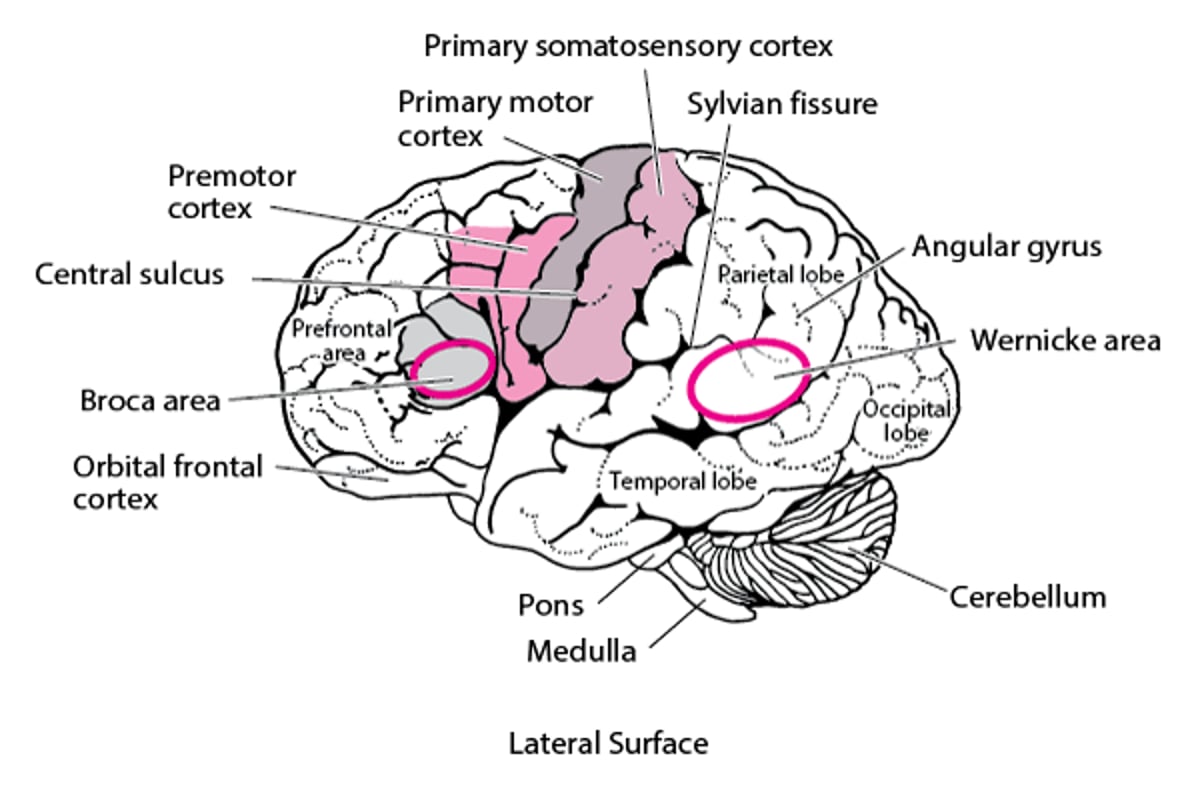
Because changes have been identified in the brains of people with dyslexia, experts believe dyslexia results predominantly from cortical dysfunction stemming from congenital neurodevelopmental abnormalities (3, 4). Lesions affecting the integration or interactions of specific brain functions are suspected. Most researchers concur that dyslexia is left hemisphere–related and linked to dysfunctions in brain areas responsible for language association (Wernicke motor speech area; see figure ) and sound and speech production (Broca motor speech area) and in the interconnection of these areas via the fasciculus arcuatus. Dysfunctions or defects in the angular gyrus, the medial occipital area, and the right hemisphere cause word recognition problems. Research suggests some malleability of brain systems in response to training.
Areas of the Brain

Pathophysiology references
1. Gialluisi A, Andlauer TFM, Mirza-Schreiber N, et al. Genome-wide association study reveals new insights into the heritability and genetic correlates of developmental dyslexia. Mol Psychiatry. 2021;26(7):3004-3017. doi:10.1038/s41380-020-00898-x
2. Doust C, Fontanillas P, Eising E, et al. Discovery of 42 genome-wide significant loci associated with dyslexia. Nat Genet. 2022;54(11):1621-1629. doi:10.1038/s41588-022-01192-y
3. Peterson RL, Pennington BF. Developmental dyslexia. Lancet. 2012;379(9830):1997-2007. doi:10.1016/S0140-6736(12)60198-6
4. Yu X, Ferradal S, Dunstan J, et al. Patterns of Neural Functional Connectivity in Infants at Familial Risk of Developmental Dyslexia. JAMA Netw Open. 2022;5(10):e2236102. doi:10.1001/jamanetworkopen.2022.36102
Symptoms and Signs of Dyslexia
Dyslexia may manifest as
Delayed language production
Speech articulation difficulties
Difficulties remembering the names of letters, numbers, and colors
Difficulties with word problems despite normal math computation skills
Children with phonologic processing problems often have difficulty blending sounds, rhyming words, identifying the positions of sounds in words, and segmenting words into pronounceable components. They may reverse the order of sounds in words. Delay or hesitation in choosing words, substituting words, or naming letters and pictures is often an early sign. Short-term auditory memory and auditory sequencing difficulties are common (1).
A significant minority of children with dyslexia also have difficulties with the visual demands of reading (2). However, some children confuse letters and words with similar configurations or have difficulty visually selecting or identifying letter patterns and clusters (sound–symbol association) in words. Reversals or visual confusions can occur, most often because of retention or retrieval difficulties that cause affected children to forget or confuse the names of letters and words that have similar structures; subsequently, d becomes b, m becomes w, h becomes n, was becomes saw, and on becomes no. However, such reversals are normal in children < 8 years of age and may not represent a problem.
Although dyslexia is a lifelong problem, many children, provided early identification and appropriate support, develop functional reading skills (3). However, some children never reach adequate literacy.
Symptoms and signs references
1. Majerus S, Cowan N. The Nature of Verbal Short-Term Impairment in Dyslexia: The Importance of Serial Order. Front Psychol. 2016;7:1522. Published 2016 Oct 3. doi:10.3389/fpsyg.2016.01522
2. Martinez-Perez C, Oliveira AP, Baltazar I. Visual and Oculomotor Function in Developmental Dyslexia: A Systematic Review and Meta-Analysis. Ophthalmic Physiol Opt. 2026;46(2):152-169. doi:10.1007/s44402-026-00044-0
3. Sanfilippo J, Ness M, Petscher Y, Rappaport L, Zuckerman B, Gaab N. Reintroducing Dyslexia: Early Identification and Implications for Pediatric Practice. Pediatrics. 2020 Jul;146(1):e20193046. doi: 10.1542/peds.2019-3046
Diagnosis of Dyslexia
Reading evaluation
Speech, language, and auditory evaluations
Psychological evaluations
(See also Evaluation of learning disorders.)
According to the Diagnostic and Statistical Manual of Mental Disorders, 5th edition, Text Revision (DSM-5-TR), diagnosis of dyslexia (the specific learning disorder with reading impairment) requires ≥ 6 months of inaccurate or slow reading, or impaired reading comprehension (1).
Most children with dyslexia are not identified until kindergarten or first grade, when they encounter symbolic learning. Children with a history of delayed language acquisition or use, who are not accelerating in word learning by the end of first grade, or who are not reading at the level expected for their verbal or intellectual abilities at any grade level should be evaluated. Often, the best diagnostic indicator is the child’s inability to respond to traditional or typical reading approaches during first grade, although wide variation in reading skills can still be seen at this level. Demonstration of phonologic processing problems is essential for diagnosis.
Children suspected of having dyslexia should undergo reading, speech and language, auditory, cognitive, and psychological evaluations to identify their functional strengths and weaknesses and their preferred learning styles. In the United States, such evaluations can be requested of school staff by the child’s teacher or family based on the Individuals with Disabilities Education Act (IDEA). Evaluation findings then guide the most effective instructional approach.
Comprehensive reading evaluations test word recognition and analysis, fluency, reading or listening comprehension, and level of understanding of vocabulary and the reading process.
Speech, language, and auditory evaluations assess spoken language and deficits in processing phonemes (sound elements) of spoken language. Receptive and expressive language functions are also assessed. Cognitive abilities (eg, attention, memory, reasoning) are tested.
Psychological evaluations address emotional concerns that can exacerbate a reading disability. A complete family history of mental health disorders and emotional problems is obtained.
Physicians should ensure that children have normal vision and hearing, either through office-based screening or referral for formal audiologic and vision testing. Neurologic evaluations may help detect secondary features (eg, neurodevelopmental immaturity or minor neurologic abnormalities) and exclude other disorders (eg, seizures).
Diagnosis reference
1. American Psychiatric Association. Diagnostic and Statistical Manual of Mental Disorders. 5th ed, Text Revision. American Psychiatric Association Publishing; 2022.
Treatment of Dyslexia
Educational interventions
Treatment of dyslexia consists of educational interventions, including instruction in word recognition and component skills. Phonics instruction is the most widely used treatment approach, and one that has evidence of effectiveness in improving reading and spelling (1, 2). Instruction includes direct and indirect methods.
Direct instruction includes teaching specific phonics skills separate from other reading instruction. Indirect instruction includes integrating phonics skills into reading programs. Instruction may teach reading from a whole-word or whole-language approach or by following a hierarchy of skills from the sound unit to the word to the sentence. Multisensory approaches that include whole-word learning and the integration of visual, auditory, and tactual procedures to teach sounds, words, and sentences are then recommended.
Component skills instruction consists of teaching children to blend sounds to form words, segment words into word parts, and identify the positions of sounds in words. Component skills for reading comprehension include identifying the main idea, answering questions, isolating facts and details, and reading inferentially. Many children benefit from using a computer to help isolate words within text samples or for word processing of written work.
Compensatory strategies, such as using audiobooks and taking notes using a digital recorder, can help children in later elementary school grades master content while continuing to build reading skills.
Other treatments (eg, optometric training, perceptual training, auditory integration training) and medication therapies are unproved and not recommended (1, 2).
Treatment references
1. Galuschka K, Ise E, Krick K, Schulte-Körne G. Effectiveness of treatment approaches for children and adolescents with reading disabilities: a meta-analysis of randomized controlled trials. PLoS One. 2014;9(2):e89900. Published 2014 Feb 26. doi:10.1371/journal.pone.0089900
2. Peterson RL, Pennington BF. Developmental dyslexia. Lancet. 2012;379(9830):1997-2007. doi:10.1016/S0140-6736(12)60198-6
Key Points
Dyslexia involves difficulty reading, and producing and understanding written language; there may also be problems with auditory memory, speech production, naming or word finding, and word problems.
Dyslexia probably results from congenital neurodevelopmental abnormalities that affect left hemisphere brain areas responsible for language association, sound and speech production, the interconnections between these areas, or a combination.
Children may have delayed language production, but sometimes the first indicator is inability to respond to typical reading instruction during early elementary grades.
Exclude cognitive, psychological, hearing, and vision disorders.
Various educational interventions are used, but research does not support optometric training, perceptual training, or auditory integration training for most children.
More Information
The following English-language resources may be useful. Please note that The Manual is not responsible for the content of these resources.