Specific phobias consist of persistent, unreasonable, intense fears (phobias) of specific situations, circumstances, or objects. The fears provoke anxiety and avoidance. The causes of phobias are unknown. Phobias are diagnosed based on clinical history. Treatment is mainly with exposure therapy or hypnosis.
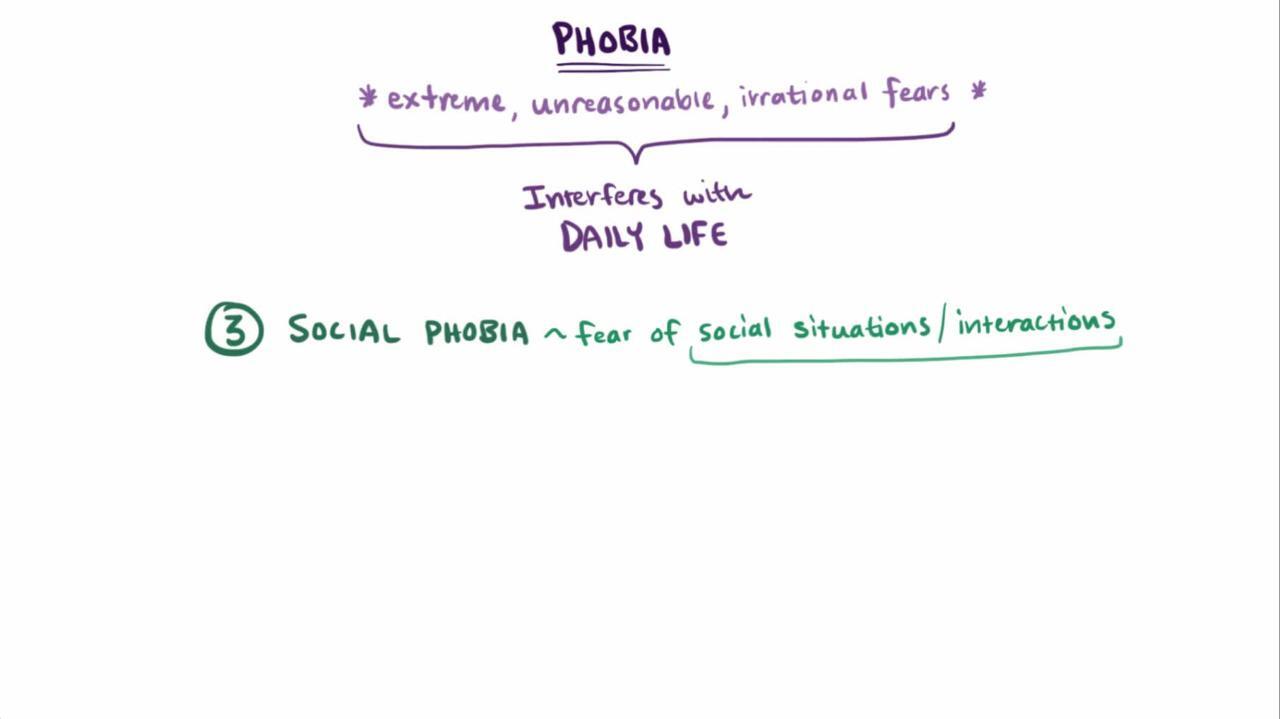
A specific phobia is fear of and anxiety about a particular situation or object to a degree that is out of proportion to the actual danger or risk. The situation or object is usually avoided when possible, but if exposure occurs, anxiety quickly develops. The anxiety may intensify to the level of a panic attack. People with specific phobias typically recognize that their fear is unreasonable and excessive.
Specific phobias can be triggered by animals, the natural environment, blood or injury, and specific situations such as flying on airplanes or using an elevator. Common phobias include fear of animals (zoophobia), heights (acrophobia), and thunderstorms (astraphobia or brontophobia). Specific phobias affect approximately 8% of women and 3% of men during any 12-month period (1). Some cause little inconvenience—as when city dwellers fear snakes (ophidiophobia), unless they are asked to hike in an area where snakes are found. However, other phobias interfere severely with functioning—as when people who work on an upper floor of a skyscraper fear closed, confined places (claustrophobia), such as elevators. Some specific phobias are more heterogeneous and cause difficulties within the medical system. For example, a fear of needles is problematic if the anxiety leads to psychological discomfort and/or refusal of necessary medical procedures. Such anxiety could be "psychological," but it could also have developed as a consequence of an excessive vasovagal reflex, leading to bradycardia, diaphoresis, trembling, and orthostatic hypotension.
Approximately 75% of people with a specific phobia fear another situation or object (2).
General references
1. Wardenaar KJ, Lim CCW, Al-Hamzawi AO, et al. The cross-national epidemiology of specific phobia in the World Mental Health Surveys. Psychol Med. 47(10):1744-1760, 2017. doi: 10.1017/S0033291717000174
2. American Psychiatric Association. Diagnostic and Statistical Manual of Mental Disorders. 5th ed, Text Revision. American Psychiatric Association Publishing; 2022.
Symptoms and Signs of Specific Phobias
Patients with a specific phobia develop marked fear or anxiety in response to a specific object or situation, which can then lead to avoidance.
Diagnosis of Specific Phobias
Psychiatric assessment
Diagnosis of specific phobias is based on history. Clinical criteria for diagnosis of specific phobias from the Diagnostic and Statistical Manual of Mental Disorders, 5th edition, Text Revision (DSM-5-TR) include all of the following (1):
There is marked, persistent (≥ 6 months) fear of or anxiety about a specific situation or object.
The situation or object nearly always triggers immediate fear or anxiety.
Patients actively avoid the situation or object.
The fear or anxiety is out of proportion to the actual danger (taking into account sociocultural norms).
The fear, anxiety, and/or avoidance cause significant distress and/or significantly impair social or occupational functioning.
The diagnosis of a specific phobia should not be made if the clinical situation is better described by another diagnosis. Of note, a specific phobia is commonly comorbid with a variety of other psychiatric conditions, including other anxiety disorders, depressive and bipolar disorders, substance-related disorders, somatic symptom and related disorders, and personality disorders (particularly dependent personality disorder).

Diagnosis reference
1. American Psychiatric Association. Diagnostic and Statistical Manual of Mental Disorders. 5th ed, Text Revision. American Psychiatric Association Publishing; 2022.
Treatment of Specific Phobias
Exposure therapy
Relaxation and/or breathing techniques (eg, hypnosis)
Sometimes limited use of a benzodiazepine or beta-blocker
The prognosis for untreated specific phobias varies because certain uncommon situations or objects (eg, snakes, caves) are easy to avoid, whereas other situations or objects (eg, bridges, thunderstorms) are common and difficult to avoid.
Exposure therapy
The most extensively studied and most effective psychotherapy for specific phobia is exposure therapy, a form of cognitive-behavioral therapy that aims to reverse the cycle of anxiety and avoidance (1–3).
As part of exposure therapy, the patient and therapist develop a list of "exposures" that might arouse anxiety. For example, someone with a specific phobia related to flying might develop a list in which flying in a small plane might be the biggest fear, but there might be a dozen other, less anxiety-provoking activities that are related to the fear of flying. These might include walking into an airport with no intention of getting on a plane, driving by an airport without stopping, and looking at a photograph of an airplane. The clinician and patient might then rank-order the list. Instruction in relaxation, mindfulness, breathing, and/or other relaxation techniques (eg, hypnosis) are also a component of exposure therapy. While using some newly learned relaxation techniques, the patient might then start with the least anxiety-provoking item on the list (eg, looking at the photograph of a plane), and then proceed through the list, in an effort to reverse avoidance. Through this process of exposure and gradual desensitization, the patient becomes habituated to the anxiety-provoking trigger.
Exposure therapy is more effective than no treatment for treatment-specific phobias in approximately 85% of patients; even single-session therapy has significant benefit (3, 4). It is often the only therapy necessary.
An alternative treatment approach involves using hypnosis to help patients feel physically calm by visualizing being in a comfortable place, and then restructuring their view of the feared situation based on hypnotic suggestions (eg, "feel yourself floating with the plane," "think of the plane as an extension of your body like a bicycle," "consider the difference between a possibility and a probability") (5).
Pharmacotherapy
Short-term therapy with a benzodiazepine (eg, lorazepam) or a beta-blocker (eg, propranolol) can be helpful when exposure to an object or situation cannot be avoided (6). For example, a person with a specific phobia of flying might take a medication 1 to 2 hours before getting on an airplane.
Treatment references
1. de Vries, YA Harris, MG, Vigo D, et al. Perceived helpfulness of treatment for specific phobia: Findings from the World Mental Health Surveys. J Affective Disorders. 288(6):199-209, 2021
2. Walter HJ, Bukstein OG, Abright AR, et al. Clinical Practice Guideline for the Assessment and Treatment of Children and Adolescents With Anxiety Disorders. J Am Acad Child Adolesc Psychiatry. 2020;59(10):1107-1124. doi:10.1016/j.jaac.2020.05.005
3. Odgers K, Kershaw KA, Li SH, Graham BM. The relative efficacy and efficiency of single- and multi-session exposure therapies for specific phobia: A meta-analysis. Behav Res Ther. 2022;159:104203. doi:10.1016/j.brat.2022.104203
4. Wolitzky-Taylor KB, Horowitz JD, Powers MB, Telch MJ. Psychological approaches in the treatment of specific phobias: a meta-analysis. Clin Psychol Rev. 2008;28(6):1021-1037. doi:10.1016/j.cpr.2008.02.007
5. Spiegel H, Maruffi BL, Spiegel D, et al. Hypnotic responsivity and the treatment of flying phobia. Am J Clin Hypn. 23(4):239-247, 1982. https://pubmed.ncbi.nlm.nih.gov/25928602/
6. Wilhelm FH, Roth WT. Acute and delayed effects of alprazolam on flight phobics during exposure. Behav Res Ther. 35(9):831-841, 1997. doi: 10.1016/s0005-7967(97)00033-8
Drug Information for the Topic