


A panic attack is the sudden onset of a discrete, brief period of intense discomfort, anxiety, or fear accompanied by somatic and/or cognitive symptoms. Panic disorder is the occurrence of repeated panic attacks typically accompanied by fears about future attacks or changes in behavior to avoid situations that might predispose to attacks. Diagnosis is based on clinical criteria. Isolated panic attacks may not require treatment. Panic disorder is treated with pharmacotherapy, psychotherapy (eg, exposure therapy, cognitive-behavioral therapy), or both.
Panic attacks are common, with lifetime prevalence estimates ranging from 8 to 23% (1, 2). Most people recover without treatment; some develop panic disorder. Panic attacks may also occur in people with other anxiety disorders, depression, or as a result of a specific phobia.
Panic disorder affects 2 to 3% of the population in a 12-month period (3). Panic disorder usually begins in late adolescence or early adulthood and affects women about 2 times more often than men.
General references
1. Olaya B, Moneta MV, Miret M, Ayuso-Mateos JL, Haro JM. Epidemiology of panic attacks, panic disorder and the moderating role of age: Results from a population-based study. J Affect Disord. 2018;241:627-633. doi:10.1016/j.jad.2018.08.069
2. Kessler RC,WT Chiu, Jin R, et al. The epidemiology of panic attacks, panic disorder, and agoraphobia in the National Comorbidity Survey Replication. Arch Gen Psychiatry. 63(4):415-424, 2006. doi: 10.1001/archpsyc.63.4.415
3. American Psychiatric Association. Diagnostic and Statistical Manual of Mental Disorders. 5th ed,Text Revision. American Psychiatric Association Publishing; 2022.
Symptoms and Signs of Panic Attacks and Panic Disorder
A panic attack involves the sudden onset of intense fear or discomfort accompanied by at least 4 of the 13 symptoms listed in the table . The panic symptoms may last minutes to an hour. Although uncomfortable—at times extremely so—panic attacks are not medically dangerous.
Symptoms of a Panic Attack
Cognitive |
Fear of dying Fear of going crazy or of losing control Feelings of unreality, strangeness (derealization), or detachment from the self (depersonalization) |
Somatic |
Chest pain or discomfort Dizziness, unsteady feelings, or faintness Feeling of choking Flushes or chills Nausea or abdominal distress Numbness or tingling sensations Palpitations or accelerated heart rate Sensations of shortness of breath or smothering Sweating Trembling or shaking |
Panic can include emotional, cognitive, and somatic elements. This complexity can complicate the diagnosis. For example, in addition to anxiety, the patient might experience chest pain, shortness of breath, sweats, and shakes. Such a cluster of symptoms can and often should lead to a general medical evaluation, especially in people with preexisting medical conditions or in those who have not been previously evaluated for this symptom cluster.
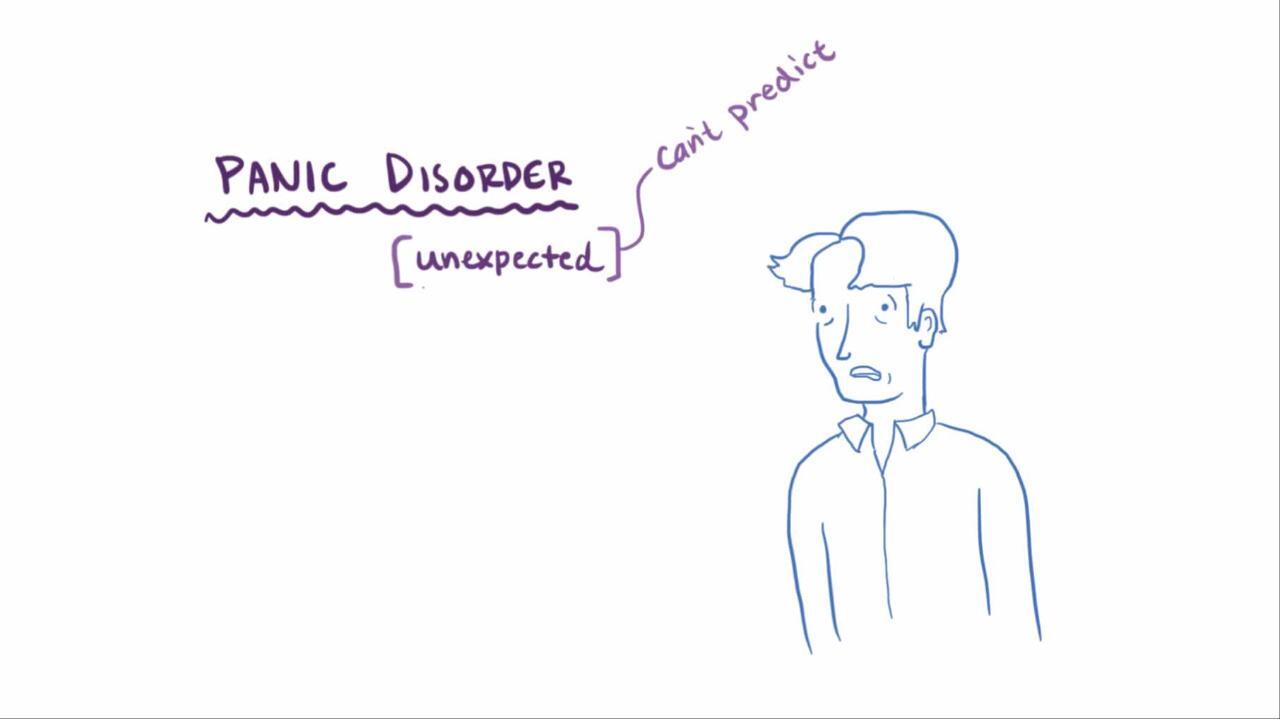
Panic attacks may occur in any psychiatric disorder, usually in situations tied to the core features of the disorder (eg, a person with a phobia of snakes may panic at seeing a snake). Such panic attacks are called "expected." Unexpected panic attacks are those that occur spontaneously, without any apparent trigger.
Most people with panic disorder anticipate and worry about another attack (anticipatory anxiety) and avoid places or situations in which they have previously panicked. People with panic disorder often worry that they have a dangerous heart, lung, or neurologic disorder and repeatedly visit their primary care clinician or an emergency department seeking help. Unfortunately, in these settings, attention is often focused on general medical symptoms, and the correct diagnosis sometimes is not made.
Panic disorder is often accompanied by at least 1 other comorbid condition. Other anxiety disorders, major depression, bipolar disorder, and mild alcohol use disorder are the most common psychiatric comorbidities. Common comorbid medical conditions include cardiac arrhythmias, hyperthyroidism, asthma, and chronic obstructive pulmonary disease (COPD).

Diagnosis of Panic Attacks and Panic Disorder
Psychiatric assessment
General medical evaluation to exclude physiologic effects of a substance or a general medical condition
Panic disorder is diagnosed after general medical disorders that can mimic or cause anxiety are eliminated and when symptoms meet diagnostic criteria stipulated in the Diagnostic and Statistical Manual of Mental Disorders, 5th edition, Text Revision (DSM-5-TR) (1):
Patients have recurrent and unexpected panic attacks (frequency is not specified). At least 4 of the following symptoms must be present:
Palpitations
Diaphoresis
Trembling
Sensation of shortness of breath
Sensation of choking
Nausea or abdominal pain
Dizziness
Chills or heat
Paresthesias
Derealization or depersonalization
Fear of losing control
Fear of death
In addition,≥ 1 attack has been followed by one or both of the following for ≥ 1 month (1) by:
Persistent worry about having additional panic attacks or worry about their consequences (eg, losing control, going crazy) and/or
Maladaptive behavioral response to the panic attacks (eg, avoiding common activities such as exercise or social situations to try to prevent further attacks)
Finally, the symptoms must not be better explained by a general medical condition (such as hyperthyroidism or an acute coronary syndrome) or by substance use or withdrawal, or by another psychiatric disorder; the symptoms must not only occur in circumstances better explained by another psychiatric disorder (such as a specific phobia).
Diagnosis reference
1. American Psychiatric Association. Diagnostic and Statistical Manual of Mental Disorders. 5th ed, Text Revision. American Psychiatric Association Publishing; 2022.
Treatment of Panic Attacks and Panic Disorder
Antidepressants, benzodiazepines, or both
Psychotherapy (cognitive-behavioral therapy, including exposure therapy and interpersonal psychotherapy)
Some patients recover without treatment, particularly if they continue to be exposed to situations in which attacks have occurred. For others, especially without treatment, panic disorder follows a chronic waxing and waning course.
Patients should be informed that treatment usually helps control symptoms. If avoidance behaviors have not developed, reassurance, education about anxiety, and encouragement to continue to return to and remain in places where panic attacks have occurred may be all that is needed. However, with a long-standing disorder that involves frequent attacks and avoidance behaviors, treatment is likely to require pharmacotherapy combined with more intensive psychotherapy.
Pharmacotherapy
Many medications can prevent or greatly reduce anticipatory anxiety, phobic avoidance, and the number and intensity of panic attacks (1):
Antidepressants: The different classes—selective serotonin reuptake inhibitors (SSRIs), serotonin-norepinephrine reuptake inhibitors (SNRIs), serotonin modulators, tricyclics (TCAs), and monoamine oxidase inhibitors (MAOIs)—are all effective (2). However, SSRIs and SNRIs offer the advantage of fewer potential adverse effects in comparison with other antidepressants.
Benzodiazepines: These anxiolytics work more rapidly than antidepressants but are more likely to cause physical dependence and such adverse effects as somnolence, ataxia, and memory problems. For some patients, long-term use of benzodiazepines is successful without significant adverse effects.
Antidepressants plus benzodiazepines: These medications are sometimes used in combination initially; the benzodiazepine is slowly tapered after the antidepressant becomes effective (although some patients respond only to the combination treatment).
Panic attacks often recur when medications are discontinued.
Psychotherapy
Most psychotherapies that target anxiety disorders, including panic disorder, involve teaching techniques that promote relaxation. These strategies are an important component of therapy since they both reduce the anxiety and allow for the continuation of a psychotherapy that may be anxiety provoking. Relaxation strategies include mindfulness, meditation, hypnosis, exercise, and slow, steady breathing.
Cognitive-behavioral therapy (CBT) is a general term that refers to talk therapies that focus on dysfunctional thinking (cognition) and/or dysfunctional behaviors. CBT has been shown to be effective for panic disorder (3). Interoceptive exposure is a form of therapy that exposes and desensitizes patients to the specific physical symptoms of panic attacks, such as dyspnea and palpitations (4).
Patients may have their own distinct but dysfunctional cycle of thinking that can induce anxiety and/or panic. For example, a person might have a baseline worry about having a heart attack, and they might spend an inordinate amount of time scanning their bodies for signs of a heart attack. If they feel a twinge in their chest, they might then begin a cycle that quickly leads to a panicky, mistaken belief that they are about to die. CBT involves clarifying these cycles and then teaching patients to recognize and control their distorted thinking and false beliefs. They are then better able to modify their behavior so that it is more adaptive. In addition, the treatment encourages them to gradually expose themselves to situations that might be likely to induce the panic, thereby desensitizing their assumed association between the setting and the symptoms.
Treatment references
1. Quagliato LA, Freire RC, Nardi AE. Risks and benefits of medications for panic disorder: A comparison of SSRIs and benzodiazepines. Expert Opin Drug Saf.17(3):315-324, 2018. doi: 10.1080/14740338.2018.1429403
2. Guaiana G, Meader N, Barbui C, et al. Pharmacological treatments in panic disorder in adults: a network meta-analysis. Cochrane Database Syst Rev. 2023;11(11):CD012729. Published 2023 Nov 28. doi:10.1002/14651858.CD012729.pub3
3. Papola D, Ostuzzi G, Tedeschi F, et al. Comparative efficacy and acceptability of psychotherapies for panic disorder with or without agoraphobia: Systematic review and network meta-analysis of randomised controlled trials. Br J Psychiatry. 221(3):507-519, 2022. doi: 10.1192/bjp.2021.148
4. Ito LM, de Araujo LA, Tess VL, de Barros-Neto TP, Asbahr FR, Marks I. Self-exposure therapy for panic disorder with agoraphobia: randomised controlled study of external v. interoceptive self-exposure. Br J Psychiatry. 2001;178:331-336. doi:10.1192/bjp.178.4.331
Drug Information for the Topic







