Common skin disorders and infections can cause cutaneous penile lesions (see table ).
Causes of Cutaneous Penile Lesions
Category | Cause |
|---|---|
Common skin disorders | Allergic or irritant contact dermatitis Balanitis xerotica obliterans (lichen sclerosus et atrophicus) Carcinoma in situ (erythroplasia of Queyrat, Bowen disease) Fixed drug eruptions Papulosquamous disorders, including psoriasis and lichen planus |
Sexually transmitted infections* | Genital warts (condylomata acuminata) |
Other infectious causes | Fungal infections |
* See also Sexually Transmitted Infections: Introduction. | |
Balanitis xerotica obliterans
This lesion, another name for lichen sclerosus et atrophicus in males, is an indurated, blanched area near the tip of the glans surrounding and often constricting the meatus. It results from chronic inflammation and may lead to phimosis, paraphimosis, or urethral stricture. In uncircumcised patients, cleansing the penis twice daily with saline solution may be effective treatment. Topical medications, including glucocorticoids, tacrolimus, antibiotics, and anti-inflammatory medications (eg, clobetasol), may be used, but their efficacy is limited. Surgery (circumcision) is required in refractory severe cases.

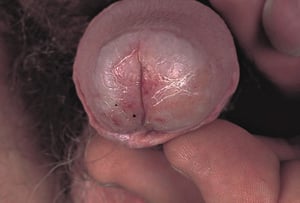
The area around the urethral meatus is indurated and blanched. Scratching and rubbing have resulted in irritation and petechiae.
The area around the urethral meatus is indurated and blanched. Scratching and rubbing have resulted in irritation and p
© Springer Science+Business Media
© Springer Science+Business Media

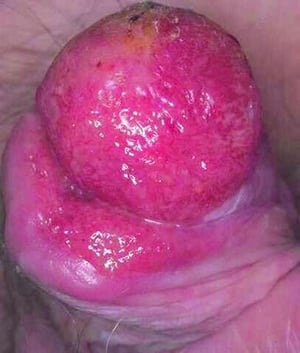
This photo shows erythroplasia of Queyrat.
This photo shows erythroplasia of Queyrat.
© Springer Science+Business Media

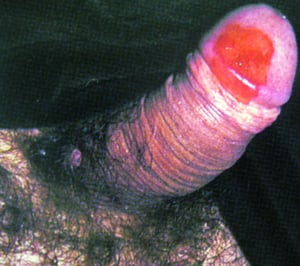
This photo shows squamous cell carcinoma in situ of the glans penis with a sharply demarcated, bright red, velvety plaque.
This photo shows squamous cell carcinoma in situ of the glans penis with a sharply demarcated, bright red, velvety plaq
© Springer Science+Business Media

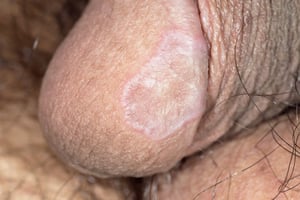
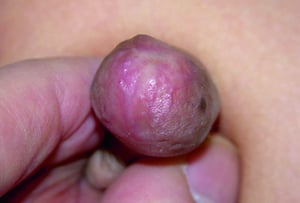
Annular lesion on the glans of the penis is consistent with lichen planus.
Annular lesion on the glans of the penis is consistent with lichen planus.
DR P. MARAZZI/SCIENCE PHOTO LIBRARY

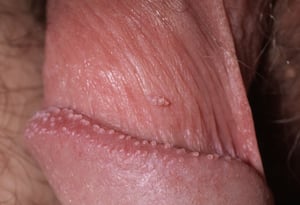
This patient has a ring of pearly lesions along the corona of the glans (from left to lower right) consistent with pearly penile papules. He also has penile warts (center) caused by human papillomavirus (HPV).
This patient has a ring of pearly lesions along the corona of the glans (from left to lower right) consistent with pear
DR P. MARAZZI/SCIENCE PHOTO LIBRARY
The area around the urethral meatus is indurated and blanched. Scratching and rubbing have resulted in irritation and petechiae.
The area around the urethral meatus is indurated and blanched. Scratching and rubbing have resulted in irritation and p
© Springer Science+Business Media
© Springer Science+Business Media
This photo shows erythroplasia of Queyrat.
This photo shows erythroplasia of Queyrat.
© Springer Science+Business Media
This photo shows squamous cell carcinoma in situ of the glans penis with a sharply demarcated, bright red, velvety plaque.
This photo shows squamous cell carcinoma in situ of the glans penis with a sharply demarcated, bright red, velvety plaq
© Springer Science+Business Media
Annular lesion on the glans of the penis is consistent with lichen planus.
Annular lesion on the glans of the penis is consistent with lichen planus.
DR P. MARAZZI/SCIENCE PHOTO LIBRARY
This patient has a ring of pearly lesions along the corona of the glans (from left to lower right) consistent with pearly penile papules. He also has penile warts (center) caused by human papillomavirus (HPV).
This patient has a ring of pearly lesions along the corona of the glans (from left to lower right) consistent with pear
DR P. MARAZZI/SCIENCE PHOTO LIBRARY
Carcinoma in situ
Carcinoma in situ can include:
Erythroplasia of Queyrat: Squamous cell carcinoma in situ of the glans or prepuce
Bowen disease of the penis: Squamous cell carcinoma in situ of the penile skin
Extramammary Paget disease
Bowenoid papulosis: Associated with human papillomavirus (particularly HPV types 16 and 18)
Erythroplasia of Queyrat and Bowen disease of the penis are well-circumscribed areas of reddish, velvety pigmentation in the genital area, usually on the glans or at the corona, primarily in uncircumcised males.
Extramammary Paget disease (not to be confused with Paget disease of bone) is a rare intraepithelial adenocarcinoma that can occur in extramammary locations, including the penis, scrotum, and groin.
Bowenoid papulosis involves smaller, often multiple papules on the shaft of the penis.
These conditions are considered intraepithelial neoplasia or carcinoma in situ and should be biopsied.
Treatment consists of 5% fluorouracil cream, local excision, cryotherapy, or laser therapy. Close follow-up is indicated due to the risk of progression to invasive squamous cell carcinoma.
Penile lichen planus
This lesion occurs as small plaques, papules or macules, sometimes annular, on the glans or shaft and may be mistaken for pemphigoid or erythema multiforme. Pruritus is common.
Penogingival syndrome in males (and vulvovaginal gingival syndrome in females) is a more severe form of erosive lichen planus. It occurs on both oral and genital mucosa. Ulcers may develop and cause pain.
Lichen planus usually resolves spontaneously. If asymptomatic, it may not require treatment. Topical glucocorticoids may help relieve symptoms.
Pearly penile papules
These papules are small, harmless angiofibromas that appear on the corona of the penis as dome-shaped or hairlike projections and tend to match the tone of the patient's skin. They may also appear on the distal shaft. They are common, occurring in 15 to 50% of males, depending on the population (1). They are not associated with human papillomavirus, although they may be mistaken for genital warts. Treatment is not required.
Contact dermatitis of the penis
Contact dermatitis of the penis may occur with the use of latex condoms. Dermatitis appears as red, pruritic lesions, sometimes with weeping or fissures. Treatment is with topical glucocorticoids and use of nonlatex condoms (but not natural condoms, which do not provide adequate protection against HIV). Mild over-the-counter glucocorticoids can be tried first, with use of middle- or high-potency prescription preparations as needed.
Reference
1. Aldahan AS, Brah TK, Nouri K. Diagnosis and Management of Pearly Penile Papules. Am J Mens Health. 2018;12(3):624-627. doi:10.1177/1557988316654138
Drug Information for the Topic