One or more ribs can be fractured due to blunt chest injury. Symptoms are chest pain with movement of the trunk (including coughing or deep breathing) and tenderness over the injured rib is found on examination. Diagnosis is based on chest radiograph. Treatment is with analgesics, respiratory physiotherapy, and sometimes surgery.
Typically, rib fractures result from blunt injury to the chest wall, usually involving a strong force (eg, due to high-speed deceleration, a baseball bat, a major fall, child maltreatment); however, sometimes in older patients, only mild or moderate force (eg, in a minor fall) is required. Rib fractures may also occur during cardiopulmonary resuscitation or as a pathologic fracture caused by malignant metastases to the ribs or by osteoporosis. In children, rib fractures are among the injuries highly indicative of physical abuse.
If ≥ 3 adjacent ribs fracture in 2 separate places, the broken segment results in a flail segment. If paradoxical chest wall movement is present, this is considered a flail chest.
Pearls & Pitfalls
|
Concomitant chest injuries may occur, including
Aortic, subclavian, or cardiac injuries (uncommon but can occur with high-speed deceleration, particularly if rib 1 or 2 is fractured)
Splenic or abdominal injuries (with fractures of any of ribs 7 through 12)
Pulmonary laceration or pulmonary contusion
Pneumothorax (see Pneumothorax [Traumatic] and Pneumothorax [Tension])
Tracheobronchial injuries (uncommon)


Rib fractures may involve the osseous rib (simple transverse or oblique fractures), costal cartilage (chondral fracture), or the rib-cartilage junction (costochondral fracture). High-energy blunt trauma may also cause costovertebral dislocation or sternal fracture. These injuries can be complicated by pleural and pulmonary injury with pneumothorax and associated vascular injury and cardiac injury.
Oleksandr Pokusai/stock.adobe.com


This radiograph shows rib fractures (highlighted in red) in an infant, suggestive of child abuse.
PHOTOSTOCK-ISRAEL/SCIENCE PHOTO LIBRARY
Complications
Complications from rib fractures can be due to pain associated with the rib fractures or result from concomitant injuries. Inspiratory splinting (incomplete inspiration due to pain) can cause atelectasis and pneumonia, especially in older patients or patients with multiple fractures. As a result, older patients have high mortality rates (up to 20%) when presenting with multiple rib fractures (1). Young healthy patients and those with 1 or 2 rib fractures are less likely to develop these complications.
Rib fractures can fail to heal, resulting in bony non-union and subsequent symptoms (eg, chronic pain, clicking sensation, dyspnea on exertion) that sometime impact patients' daily activities (2).
General references
1. Bulger EM, Arneson MA, Mock CN, et al. Rib fractures in the elderly. J Trauma. 2000;48(6):1040-1047. doi:10.1097/00005373-200006000-00007
2. Adams-McGavin RC, Naveed A, Kishibe T, et al. Management of non-union of rib fractures secondary to trauma: A scoping review. Injury. 2024;55(7):111553. doi:10.1016/j.injury.2024.111553
Symptoms and Signs of Rib Fracture
Pain is severe, is aggravated by movement of the trunk (including coughing or deep breathing), and lasts for several weeks to months. The affected ribs are quite tender to palpation and sometimes the clinician can detect crepitance over the affected rib as the fracture segment moves during palpation.
Diagnosis of Rib Fracture
Chest radiograph
For suspected intrathoracic injury, CT
Some clinicians consider a diagnosis based solely on history and physical examination to be adequate in healthy patients with minor trauma. Usually, chest radiographs are also performed sometimes with specific rib views. However, chest radiograph has only a 50% sensitivity for detecting rib fracture (1). For a patient with possible multiple rib fractures, appropriate care can usually be provided without identifying all rib fractures.

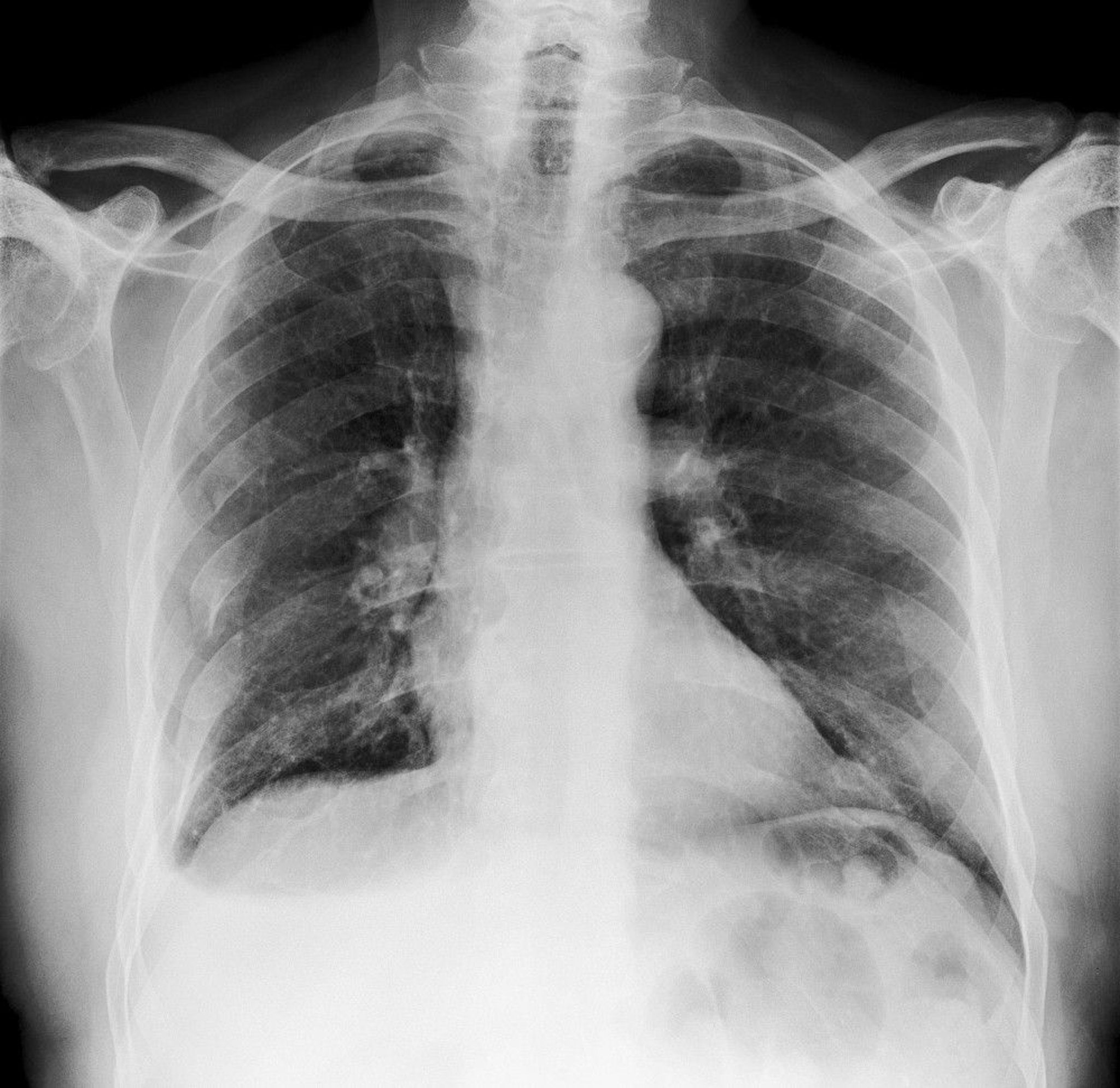
This cheat radiograph shows multiple fractures to the right ribs (seen on left).
SCIENCE PHOTO LIBRARY
In patients with significant blunt trauma, chest radiograph is typically performed as an initial study to check for concomitant injuries (eg, pneumothorax, pulmonary contusion). Chest CT is more sensitive than chest radiograph for detecting rib fractures and is performed if rib fracture is suspected and chest radiograph is normal or if additional injuries are suspected. Additional imaging modalities may be required if pathologic rib fracture is possible.
Diagnosis reference
1. Expert Panel on Thoracic Imaging:, Henry TS, Donnelly EF, et al. ACR Appropriateness Criteria® Rib Fractures. J Am Coll Radiol. 2019;16(5S):S227-S234. doi:10.1016/j.jacr.2019.02.019
Treatment of Rib Fracture
Analgesia
Respiratory physiotherapy
Surgical stabilization
Treatment of rib fractures usually requires adequate analgesia to ensure effective inspiratory effort and lung expansion to prevent complications such as atelectasis and pneumonia. Nonsteroidal anti-inflammatory drugs (NSAIDs) are first-line treatment; acetaminophen may be taken concurrently if needed. Muscle relaxants may also be helpful. Immobilization of the ribs that constricts respiration should be avoided. If patients cannot cough or breathe deeply despite oral or IV analgesics, epidural administration or intercostal nerve blocks can be considered. Opioids are used only if pain is not controlled with nonopioid medications; doses should be titrated to avoid respiratory suppression or increasing atelectasis.
Patients are hospitalized if they have ≥ 3 fractures or underlying cardiopulmonary insufficiency. In a large retrospective cohort study, risk factors for requiring intensive care unit admission in patients ≥ 65 years old included: chronic renal failure, simple pneumothorax, sternal fracture, drug use disorder, and emergency department oxygen requirement or oxygen saturation < 95% (1).
To minimize pulmonary complications, respiratory physiotherapy after rib fracture includes early mobilization, deep breathing exercises, incentive spirometry, supported coughing, and frequent position changes (2). Holding (essentially splinting) the affected area with the flat palm of the hand or a pillow can minimize the pain during deep breathing or coughing.
Select patients may benefit from surgical stabilization of rib fractures, particularly for flail chest with respiratory failure or ongoing chest wall instability, deformity, or pain due to nonunion or malunion (3, 4.
Treatment references
1. Naar L, El Hechi MW, van Erp IA, et al. Isolated rib cage fractures in the elderly: Do all patients belong to the intensive care unit? A retrospective nationwide analysis. J Trauma Acute Care Surg. 2020;89(6):1039-1045. doi:10.1097/TA.0000000000002891
2. Battle C, Pelo C, Hsu J, et al. Expert consensus guidance on respiratory physiotherapy and rehabilitation of patients with rib fractures: An international, multidisciplinary e-Delphi study. J Trauma Acute Care Surg. 2023;94(4):578-583. doi:10.1097/TA.0000000000003875
3. Kwon J, Zakhary B, Coimbra BC, et al. Early surgical stabilization of multiple rib fractures and flail chest is associated with better outcomes compared with nonoperative management. J Trauma Acute Care Surg. 2025;99(6):859-867. doi:10.1097/TA.0000000000004770
4. Bauman ZM, Tian Y, Doben AR, et al. Chest Wall Injury Society guidelines for surgical stabilization of rib fractures: Indications, contraindications, and timing. J Trauma Acute Care Surg. 2025;99(4):522-532. doi:10.1097/TA.0000000000004750
Key Points
Morbidity may result from rib fractures or underlying injuries to other structures.
CT scan of the chest, with or without contrast, is the imaging test of choice to evaluate rib fractures.
Pain can be severe and last for weeks, requiring analgesics and possibly requiring surgery.
Strapping or taping should not be used because it constricts respiration and may predispose to atelectasis and pneumonia.
Drug Information for the Topic