Bacterial tracheitis is a potentially life-threatening bacterial infection of the trachea, typically causing dyspnea and stridor. It occurs primarily in young children. Diagnosis is by direct laryngoscopy in a controlled setting and radiographs. Treatment is with airway control and antibiotics effective against Staphylococcus aureus and streptococcal species.
Bacterial tracheitis is an uncommon infection that can affect children of any age. In one study of data from 4 pediatric intensive care units at tertiary care centers, the incidence of bacterial tracheitis was approximately 0.1 case per 100,000 children per year (1).
Bacterial tracheitis typically occurs as a secondary infection after a viral upper respiratory infection, especially influenza (2). Occasionally, it can develop as a complication of viral croup or endotracheal intubation.Staphylococcus aureus and group A beta-hemolytic streptococci are involved most frequently. Tracheitis due to Streptococcus pneumoniae or Haemophilus influenzae has declined because of childhood vaccines targeting these organisms.
General references
1. Tebruegge M, Pantazidou A, Thorburn K, et al. Bacterial tracheitis: a multi-centre perspective. Scand J Infect Dis. 2009;41(8):548-557. doi:10.1080/00365540902913478
2. Dawood FS, Chaves SS, Pérez A, et al. Complications and associated bacterial coinfections among children hospitalized with seasonal or pandemic influenza, United States, 2003-2010. J Infect Dis. 2014;209(5):686-694. doi:10.1093/infdis/jit473
Symptoms and Signs of Bacterial Tracheitis
Most children have symptoms of viral respiratory infection for 1 to 3 days before the onset of severe symptoms of stridor and dyspnea. In a few children, onset is acute and is characterized by cough, respiratory stridor, high fever, and often copious purulent secretions that can cause choking or life-threatening airway obstruction.


As in patients with epiglottitis, children with bacterial tracheitis may have a markedly toxic appearance and respiratory distress that may progress rapidly and require intubation. The clinical presentation appears to have evolved over time and is characterized by older average age at diagnosis and a reduced incidence of marked toxicity and need for intensive care unit (ICU) admission (1). However, there is still a high frequency of ICU admission, and intensive monitoring and aggressive management are required in many cases. Drooling is less common in children with tracheitis than in those with epiglottitis.
Complications of bacterial tracheitis include hypotension, cardiorespiratory arrest, bronchopneumonia, and sepsis. Subglottic stenosis secondary to prolonged intubation and subsequent postinflammatory fibrosis is uncommon. Most children treated appropriately recover without sequelae.
Symptoms and signs reference
1. Barengo JH, Redmann AJ, Kennedy P, Rutter MJ, Smith MM. Demographic Characteristics of Children Diagnosed with Bacterial Tracheitis. Ann Otol Rhinol Laryngol. 2021;130(12):1378-1382. doi:10.1177/00034894211007250
Diagnosis of Bacterial Tracheitis
Direct laryngoscopy
Characteristic radiographic findings
The diagnosis of bacterial tracheitis is suspected clinically in patients with stridor, a markedly toxic appearance, and acute worsening after a viral infection (1). A lack of clinical response to nebulized epinephrine should immediately alert the clinician to the possibility of tracheitis.
The diagnosis can be confirmed by direct laryngoscopy, which reveals purulent secretions and inflammation in the subglottic area with a shaggy, purulent membrane, or by lateral neck radiograph, which reveals the characteristic finding of subglottic narrowing that may be irregular as opposed to the symmetric tapering (steeple sign) typical of croup. Direct laryngoscopy should be done in controlled circumstances where an artificial airway can be rapidly established if necessary.

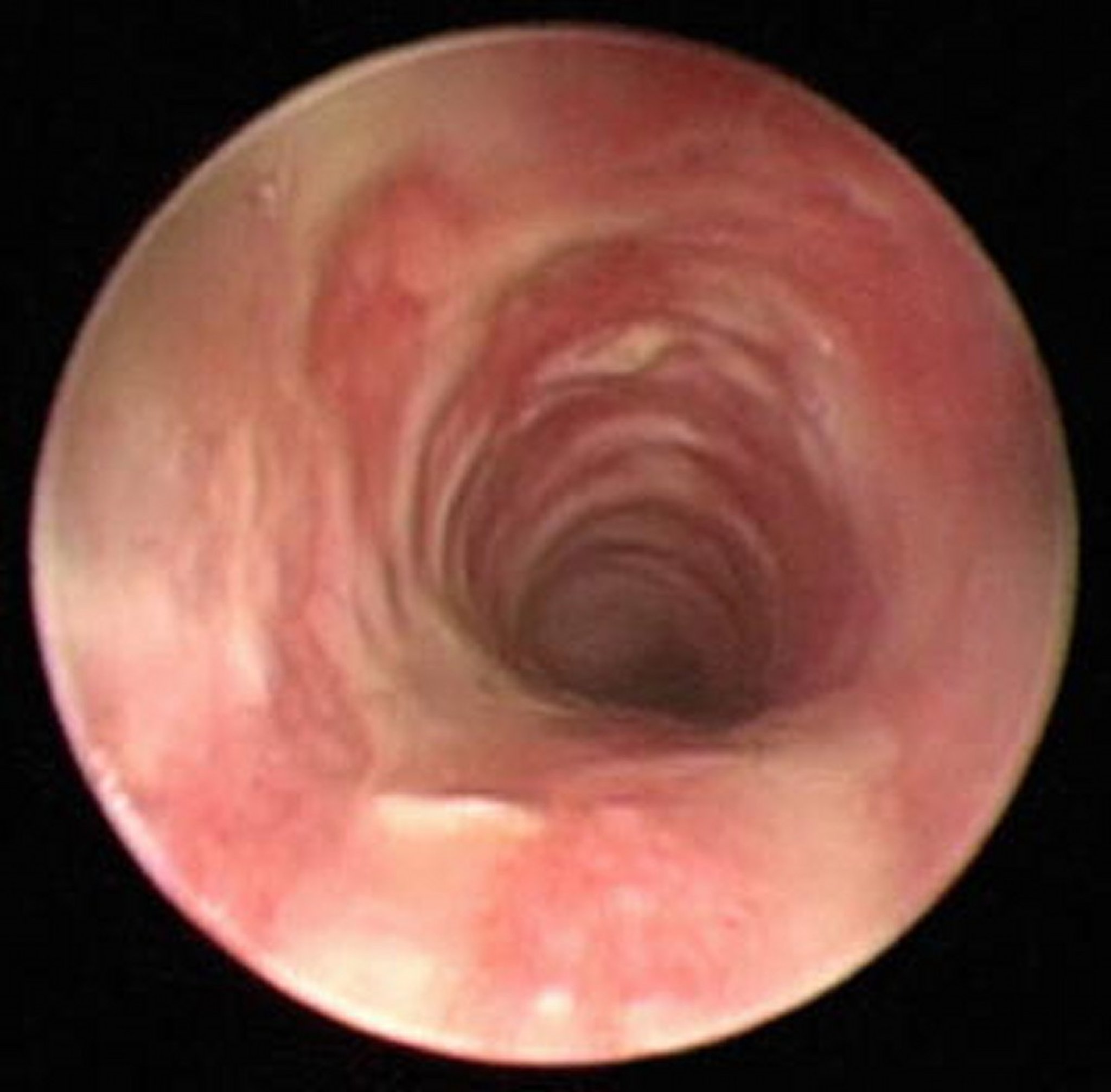
This image shows an endoscopic view of the trachea that shows inflammatory exudate characteristic of bacterial tracheitis.
© Springer Science+Business Media

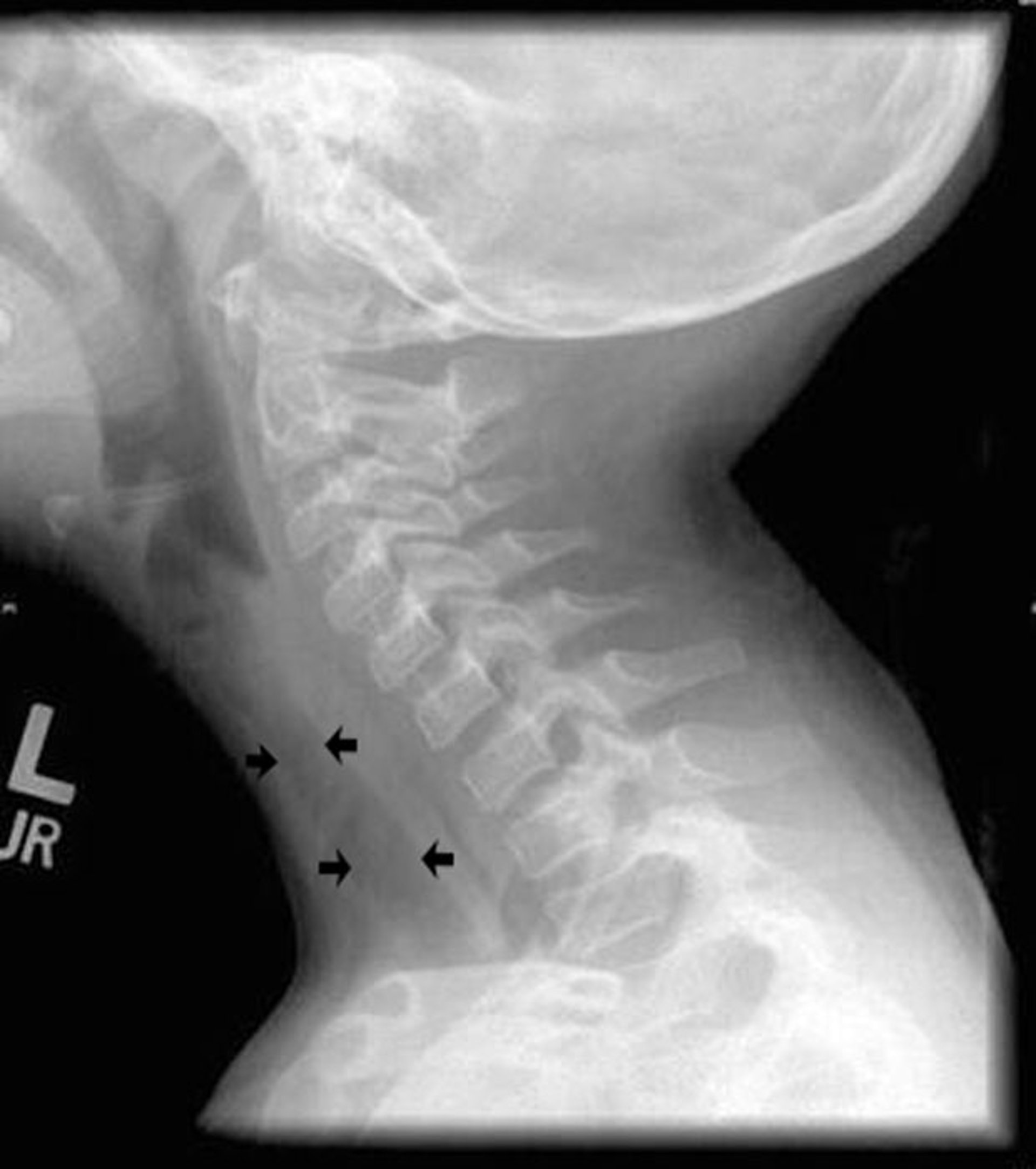
This lateral radiograph of the neck shows diffuse irregularity of the trachea (arrows) characteristic of bacterial tracheitis.
The esophagus is the tubular structure posterior to the trachea.
© Springer Science+Business Media
Diagnosis reference
1. Casazza G, Graham ME, Nelson D, Chaulk D, Sandweiss D, Meier J. Pediatric Bacterial Tracheitis-A Variable Entity: Case Series with Literature Review. Otolaryngol Head Neck Surg. 2019;160(3):546-549. doi:10.1177/0194599818808774
Treatment of Bacterial Tracheitis
Adequate airway management
Antibiotics effective against S. aureus and streptococcal species
The treatment of bacterial tracheitis in severe cases is the same as that for epiglottitis; whenever possible, endotracheal intubation should be performed in a controlled environment by a clinician skilled in managing a pediatric airway (1). Cardiopulmonary monitoring may be required for 2 to 3 days immediately after diagnosis (2).
Broad-spectrum parenteral antibiotics that are effective against S. aureus (including methicillin-resistant S. aureus [MRSA]) and streptococcal species should be initiated; IV vancomycin and ceftriaxone may be appropriate empirically. Ceftaroline, as monotherapy, is a reasonable alternative to this combination regimen. Therapy for critically ill children should be guided by a consultant knowledgeable in local antimicrobial susceptibility patterns. Once definitive microbial diagnosis is made, coverage is narrowed and continued for ≥ 10 days. Patients can be transitioned to oral antibiotics for 10 to 14 days after discharge (2).
Treatment references
1. Tebruegge M, Pantazidou A, Thorburn K, et al. Bacterial tracheitis: a multi-centre perspective. Scand J Infect Dis. 2009;41(8):548-557. doi:10.1080/00365540902913478
2. Shargorodsky J, Whittemore KR, Lee GS. Bacterial tracheitis: a therapeutic approach. Laryngoscope. 2010;120(12):2498-2501. doi:10.1002/lary.21105
Key Points
Bacterial tracheitis is uncommon and can affect children of any age.
Most children have symptoms of respiratory infection for 1 to 3 days before developing stridor and dyspnea.
Clinical suspicion of bacterial tracheitis can be confirmed with a lateral neck radiograph or direct laryngoscopy; however, direct laryngoscopy should be done in a controlled environment where an artificial airway can be rapidly established if necessary.
Adequate airway management is essential.
Give initial antibiotics effective against S. aureus and streptococcal species, but narrow coverage once the specific pathogen is identified.
Drug Information for the Topic