Croup is acute inflammation of the upper and lower respiratory tracts most commonly caused by parainfluenza virus type 1 infection. It is characterized by a brassy, barking cough and inspiratory stridor. Diagnosis is usually obvious clinically but can be confirmed by subepiglottic narrowing (steeple sign) visualized on an anteroposterior neck radiograph. Treatment is antipyretics, hydration, nebulized racemic epinephrine, and glucocorticoids. Prognosis is generally excellent.
Croup is a predominantly viral respiratory tract infection that affects mainly children aged 6 months to 3 years (1). Boys are more susceptible to croup than girls, and the reasons for this are unclear. In the United States, croup leads to approximately 7% of hospital admissions annually for fever or respiratory issues in children < 5 years of age (2).
Seasonal outbreaks are common. Croup caused by parainfluenza viruses typically occurs in the fall, and croup caused by respiratory syncytial virus (RSV) or an influenza virus typically occurs in the winter and spring.
Spread is usually airborne or by contact with infected secretions.
General references
1. Bjornson CL, Johnson DW. Croup. Lancet. 2008;371(9609):329-339. doi:10.1016/S0140-6736(08)60170-1
2. Smith DK, McDermott AJ, Sullivan JF. Croup: Diagnosis and Management. Am Fam Physician. 2018;97(9):575-580.
Etiology of Croup
The most common pathogens are:
Parainfluenza viruses, especially type 1
Less common causes are respiratory syncytial virus (RSV) and adenovirus followed by influenza viruses A and B, enterovirus, rhinovirus, measles virus, and Mycoplasma pneumoniae. Croup caused by influenza may be particularly severe and may occur in a broader age range of children.
Pathophysiology of Croup
The infection causes inflammation of the larynx, trachea, bronchi, bronchioles, and sometimes lung parenchyma. Obstruction caused by swelling and inflammatory exudates develops and becomes pronounced in the subglottic region. Obstruction increases the work of breathing; rarely, tiring results in hypercapnia. Atelectasis may occur concurrently if the bronchioles become obstructed.
Symptoms and Signs of Croup
Croup is usually preceded by upper respiratory infection symptoms. A barking (sometimes described as seal-like), often spasmodic cough and hoarseness then occur, commonly at night; inspiratory stridor may be present as well. The child may awaken at night with respiratory distress, tachypnea, and retractions.
In severe cases, cyanosis with increasingly shallow respirations may develop as the child tires.


The obvious respiratory distress and harsh inspiratory stridor are the most dramatic physical findings. Auscultation reveals prolonged inspiration and stridor. Crackles also may be present, indicating lower airway involvement. Breath sounds may be diminished with atelectasis.
Fever is present in many children. The child’s condition may seem to improve in the morning but worsen again at night.
Recurrent episodes are often called spasmodic croup. Allergy or airway reactivity may play a role in spasmodic croup, but the clinical manifestations cannot be differentiated from those of viral croup. Also, spasmodic croup usually is initiated by a viral infection; however, fever is typically absent.
Diagnosis of Croup
Clinical presentation (eg, barking cough, inspiratory stridor)
Anteroposterior (AP) and lateral neck radiographs as needed
Croup is a clinical diagnosis based on the characteristic presentation of acute onset of a barking (seal-like) cough, inspiratory stridor, hoarseness, and respiratory distress (1). Laboratory studies and imaging are not routinely recommended. Microbiologic confirmation with viral cultures or rapid antigen testing have minimal impact on acute management and are not typically indicated. Differential diagnoses must be excluded.

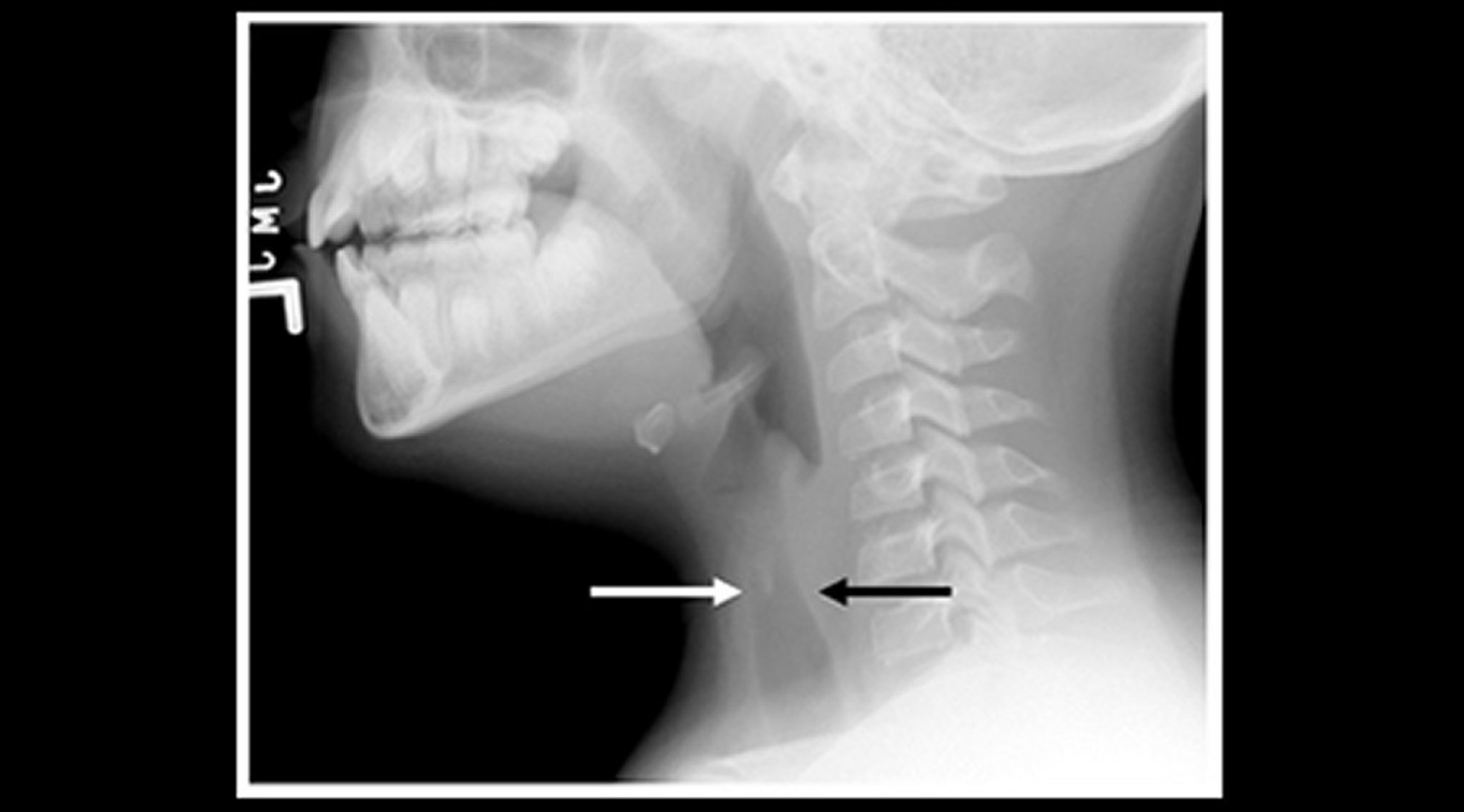
Soft-tissue neck radiograph of a child with croup shows luminal narrowing of the subglottic tracheal air shadow (arrows) and dilation of the pharyngeal air spaces.
Image courtesy of John McBride, MD.
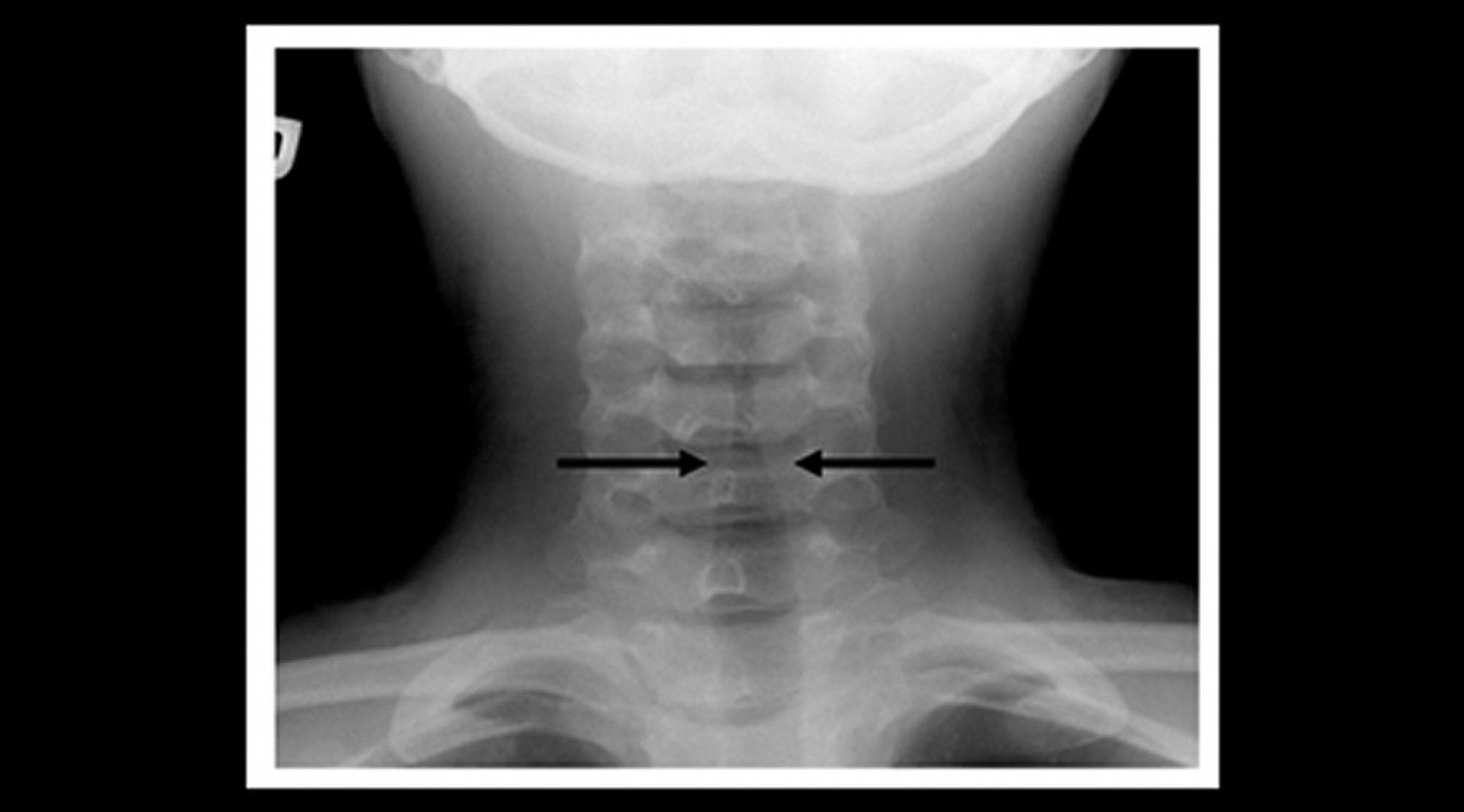
Soft-tissue neck radiograph of a child with croup shows gradual narrowing of the subglottic tracheal lumen and its air shadow (steeple sign—arrows) and dilation of the pharyngeal air spaces.
Image courtesy of John McBride, MD.
If there is diagnostic uncertainty, patients should have AP and lateral radiographs of the neck and chest; subepiglottic narrowing () seen on AP neck radiographs supports the diagnosis (1).
After the diagnosis of croup is established, disease severity should be assessed to help guide treatment.
Cardiorespiratory monitoring with continuous pulse oximetry is indicated only in children with severe croup. Seriously ill patients, in whom epiglottitis is a concern, should be examined in the operating room by appropriate specialists able to establish an airway (see Treatment of Epiglottitis).
Pearls & Pitfalls
|
Assessment of disease severity
After the diagnosis is established, an assessment of disease severity should be performed to help guide treatment. The severity of croup is determined clinically, and clinicians typically use a standardized scoring system, most commonly the Westley croup score.
The Westley croup severity score is a validated predictor of need for hospitalization and length of hospital stay and uses 5 clinical factors to calculate a score (2, 3):
Level of consciousness
Cyanosis
Stridor
Air entry
Retractions
Scores range from 0 to 17.


Most children presenting to emergency departments have mild croup (Westley score < 3) (2, 3). Scores ≥ 5 usually indicate the child needs to remain in the emergency department for further treatment, or for hospital admission. High scores (12 to 17) indicate impending respiratory failure and the need for emergent management (eg, intubation or other mechanical ventilation, ICU admission).
Differential diagnosis
Several differential diagnoses must be considered before making the diagnosis of croup. In particular, inspiratory stridor similar to croup can result from all of the following:
Airway foreign body
In contrast to croup, epiglottitis, bacterial tracheitis, and retropharyngeal abscesses typically present with a more rapid onset, a more toxic appearance, odynophagia, and fewer upper respiratory tract symptoms. A foreign body in the airway may also cause respiratory distress and a typical cough due to mechanical obstruction; however, fever and a preceding upper respiratory infection are usually absent. Diphtheria is usually excluded by a history of adequate immunization and is confirmed by identification of the organism in cultures of scrapings from the typical grayish pseudomembrane.
Diagnosis references
1. Smith DK, McDermott AJ, Sullivan JF. Croup: Diagnosis and Management. Am Fam Physician. 2018;97(9):575-580.
2. Westley CR, Cotton EK, Brooks JG. Nebulized racemic epinephrine by IPPB for the treatment of croup: a double-blind study. Am J Dis Child. 1978;132(5):484-487. doi:10.1001/archpedi.1978.02120300044008
3. Yang WC, Lee J, Chen CY, Chang YJ, Wu HP. Westley score and clinical factors in predicting the outcome of croup in the pediatric emergency department. Pediatr Pulmonol. 2017;52(10):1329-1334. doi:10.1002/ppul.23738
Treatment of Croup
For mild disease, cool humidified air and often a single dose of a long-acting glucocorticoid (eg, dexamethasone)
For moderate to severe disease, humidified oxygen, racemic epinephrine, and glucocorticoids
The vast majority of children with croup recover completely.
Mild croup
Mild croup usually lasts 3 to 4 days, resolves spontaneously, and typically requires only limited supportive home care (1). Most children with mild croup (ie, no stridor at rest or signs of respiratory distress) may be cared for at home with hydration and antipyretics. Keeping children comfortable is important because fatigue and crying can aggravate the condition. Humidification devices (eg, cold-steam vaporizers or humidifiers) may ameliorate upper airway drying and are frequently used at home by families but have not been shown to alter the course of the illness (2).
Long-acting glucocorticoids such as high-dose dexamethasone 0.6 mg/kg IM or orally once (maximum dose 16 mg) may also be given to children with mild disease in the outpatient setting (3). Glucocorticoids can rapidly reduce symptoms within 2 hours and can help prevent hospitalization and reduce the length of hospital stays in children with moderate to severe croup. However, hospitalized children who do not respond quickly may require additional doses of systemic glucocorticoids.
The viruses that most commonly cause croup do not usually predispose to secondary bacterial infection, and antibiotics are rarely indicated.
Moderate to severe croup
All children with moderate to severe croup should be evaluated in the emergency department. They should also be given 1 dose of dexamethasone 0.6 mg/kg orally or IV (maximum dose 10 mg). Close monitoring for potential deterioration and need for hospitalization is also necessary.
Hospitalization is typically indicated for:
Increasing or persistent respiratory distress
Tachycardia
Fatigue
Cyanosis or hypoxemia
Dehydration
Pulse oximetry is helpful for assessing and monitoring severe croup. If oxygen saturation falls below 92% in room air, humidified supplemental oxygen should be provided and arterial blood gases should be measured to assess CO2 retention. A 30 to 40% inspired oxygen concentration is usually adequate. CO2 retention (PaCO2 > 45 mm Hg) generally indicates fatigue and the need for endotracheal intubation, as does inability to maintain oxygenation.
Nebulized racemic epinephrine offers symptomatic relief (via reduction of secretions and airway dilation) and relieves fatigue within the first hour of treatment (4). However, the effects are transient; the course of the illness, the underlying viral infection, and the PaO2 are not altered by its use. Tachycardia and other adverse effects may occur. This medication is recommended mainly for patients with moderate to severe croup. Children should be monitored in a medical setting for at least 2 hours after receiving racemic epinephrine.
Treatment references
1. Shlomovich M, Hyatt S, Cassel-Choudhury GN. Croup and Epiglottitis. Pediatr Rev. 2025;46(7):366-372. doi:10.1542/pir.2024-006420
2. Moore M, Little P. Humidified air inhalation for treating croup: a systematic review and meta-analysis. Fam Pract. 2007;24(4):295-301. doi:10.1093/fampra/cmm022
3. Aregbesola A, Tam CM, Kothari A, Le ML, Ragheb M, Klassen TP. Glucocorticoids for croup in children. Cochrane Database Syst Rev. 2023;1(1):CD001955. Published 2023 Jan 10. doi:10.1002/14651858.CD001955.pub5
4. Bjornson C, Russell K, Vandermeer B, Klassen TP, Johnson DW. Nebulized epinephrine for croup in children. Cochrane Database Syst Rev. 2013;2013(10):CD006619. Published 2013 Oct 10. doi:10.1002/14651858.CD006619.pub3
Key Points
Croup is an acute, viral, respiratory tract infection affecting infants age 6 to 36 months and is typically caused by parainfluenza viruses (mainly type 1).
A barking, often spasmodic cough and sometimes inspiratory stridor (caused by subglottic edema) are the most prominent symptoms; symptoms are often worse at night.
Diagnosis is usually clinical, but an anteroposterior radiograph of the neck and chest showing classic subepiglottic narrowing (steeple sign) supports the diagnosis.
Give cool, humidified air or oxygen, and sometimes glucocorticoids and nebulized racemic epinephrine.
Drug Information for the Topic