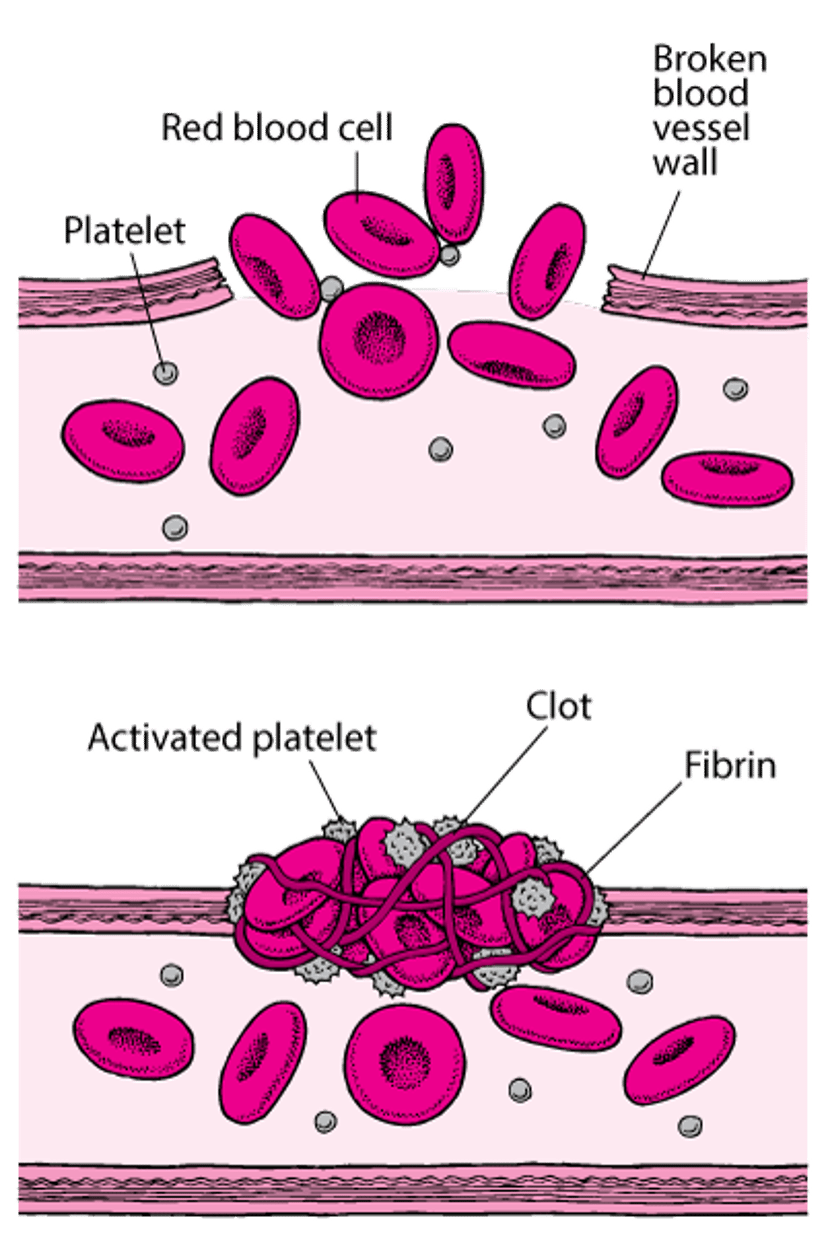
Platelets (sometimes called thrombocytes) are cells produced in the bone marrow that circulate in the bloodstream and help blood to clot. A break in a blood vessel, injury to its inner wall, inflammation, atherosclerotic plaque, turbulent blood flow, or foreign objects like stents or shunts can cause platelets to be activated. They change shape from round to spiny, stick to the vessel walls and each other, and begin to clump. They also interact with other blood proteins to form fibrin. Fibrin strands form a net that entraps more platelets and blood cells, producing a clot.
Thrombopoietin, primarily produced in the liver, stimulates the bone marrow to make large cells (megakaryocytes), which in turn make platelets from material inside their cell body (cytoplasm). Platelets that are not used in clots circulate for 7 to 10 days and are then destroyed. About one-third are always stored in the spleen.
Blood Clots: Plugging the Breaks
When an injury causes a blood vessel wall to break, platelets are activated. They change shape from round to spiny, stick to the broken vessel wall and each other, and begin to plug the break. They also interact with other blood proteins to form fibrin. Fibrin strands form a net that entraps more platelets and blood cells, producing a clot that plugs the break. |

The platelet count (number of platelets circulating in the bloodstream) is usually about 140,000 to 440,000 platelets per microliter (140 to 440 × 109 per liter). The platelet count can vary according to the menstrual cycle. It can decrease near the end of pregnancy (gestational thrombocytopenia) and increase in response to inflammation. Neither of these conditions is serious, and most affected people have no problems resulting from either one.
Platelet disorders include:
An abnormal increase in platelets (thrombocytosis)
A decrease in platelets (thrombocytopenia)
Any of these disorders can cause problems with blood clotting.
Thrombocytosis is a general term defined as an increase in the number of platelets circulating in the bloodstream. Thrombocytosis that is caused by other disorders, many of which are characterized by inflammation, is termed reactive or secondary thrombocytosis. Thrombocytosis caused by proliferation of platelets in the bone marrow is called primary thrombocytosis, thrombocythemia, or essential thrombocythemia.
In essential thrombocythemia, the bone marrow cells that make platelets grow excessively and make too many platelets despite no other disorder being identified. The increased number of platelets may cause excessive bleeding rather than clotting. Doctors sometimes give people aspirin to lower the risk of abnormal clotting if they have certain disorders that affect blood vessels (vascular diseases) or are at increased risk of a heart attack. Medications to lower the platelet count may sometimes be needed.
In reactive thrombocytosis, another medical disorder stimulates the bone marrow to make too many platelets (the platelets are made in reaction to the other disorder). Such disorders include infections, chronic inflammation (such as occurs in rheumatoid arthritis and inflammatory bowel disease), acute blood loss, iron deficiency, trauma, removal of the spleen, and certain cancers. The increased numbers of platelets usually do not cause any increase in clotting or bleeding risk. Specific treatment is not needed for the high number of platelets, but the underlying condition may need to be treated.
In thrombocytopenia, there are many causes of decreased numbers of platelets. Causes are generally divided into those involving decreased production of platelets and those involving increased destruction or loss of platelets.
In platelet dysfunction, people have the correct number of platelets, but the platelets do not function normally.
Symptoms of Platelet Disorders
A low platelet count and platelet dysfunction often cause bleeding in the skin as the first sign. Many tiny red dots (petechiae) often appear in the skin on the lower legs, and minor injuries (including needlesticks) may cause black-and-blue bruises (ecchymoses or purpura). The gums may bleed, and blood may appear in the stool or urine. Menstrual periods or nosebleeds may be unusually heavy. The lower the platelet count, the more severe the symptoms. People who have very few platelets may lose large amounts of blood into their digestive tract or may develop life-threatening bleeding in their brain even though they have not been injured. Once bleeding starts, it can be hard to stop.

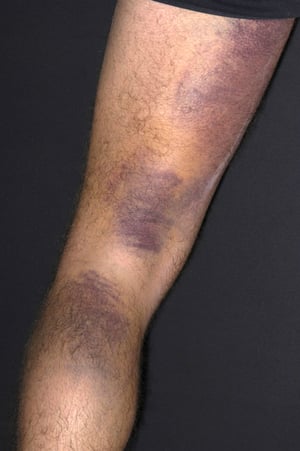
Ecchymoses are large purple bruises seen here on the leg.
Ecchymoses are large purple bruises seen here on the leg.
DR P. MARAZZI/SCIENCE PHOTO LIBRARY

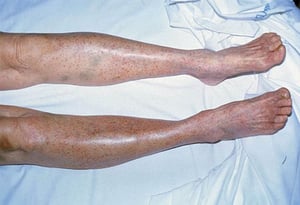
Petechiae are small red, purple, or brown spots as seen here in the skin.
Petechiae are small red, purple, or brown spots as seen here in the skin.
By permission of the publisher. From Deitcher S. In Atlas of Clinical Hematology. Edited by JO Armitage. Philadelphia, Current Medicine, 2004.

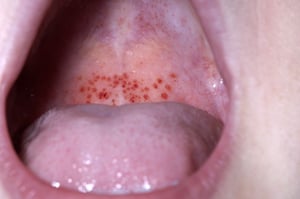
Petechiae are small red spots as seen here in the mouth.
Petechiae are small red spots as seen here in the mouth.
DR P. MARAZZI/SCIENCE PHOTO LIBRARY
Ecchymoses are large purple bruises seen here on the leg.
Ecchymoses are large purple bruises seen here on the leg.
DR P. MARAZZI/SCIENCE PHOTO LIBRARY
Petechiae are small red, purple, or brown spots as seen here in the skin.
Petechiae are small red, purple, or brown spots as seen here in the skin.
By permission of the publisher. From Deitcher S. In Atlas of Clinical Hematology. Edited by JO Armitage. Philadelphia, Current Medicine, 2004.
Petechiae are small red spots as seen here in the mouth.
Petechiae are small red spots as seen here in the mouth.
DR P. MARAZZI/SCIENCE PHOTO LIBRARY
People with too many platelets may have the same signs of bleeding as people with too few platelets because a very high number of platelets may absorb enough of an important clotting factor (a protein found in blood that works with platelets to help the blood clot ) to cause bleeding. However, some people instead have symptoms caused by abnormal blood clots. For example, people may have a swollen leg due to a blood clot in a vein in their leg, or they may have numbness and weakness because of a blood clot in their brain causing a stroke.
Diagnosis of Platelet Disorders
Complete blood count
Doctors can diagnose many platelet disorders by a simple blood test (a complete blood count [CBC]), which includes measurement of the number of platelets.


Special tests may be needed to diagnose platelet dysfunction.
Treatment of Platelet Disorders
Treatment depends on whether the platelet count is too high or too low or whether the count is normal but the platelets do not function normally. Sometimes people with thrombocytopenia are given medications that stimulate the production of platelets or that help reduce bleeding.
People may require platelet transfusion, but transfusions are given only in limited situations, such as when a person with a platelet disorder has active bleeding or needs to undergo an invasive medical procedure (for example, major surgery).
If the platelet count is very high due to a bone marrow disorder, other medications or rarely removing platelets by plateletpheresis may be required.