Undescended testes (cryptorchidism) remain in the abdomen or the groin instead of descending into the scrotum. Retractile testes (hypermobile testes) have descended into the scrotum but can easily move back and forth (retract) from the scrotum into the tunnel that goes from the abdomen into the groin.
The testes (testicles) are 2 oval-shaped organs inside the scrotum. The scrotum is the thick-skinned sac that surrounds and protects the testes. The testes produce sperm and the male sex hormone testosterone.

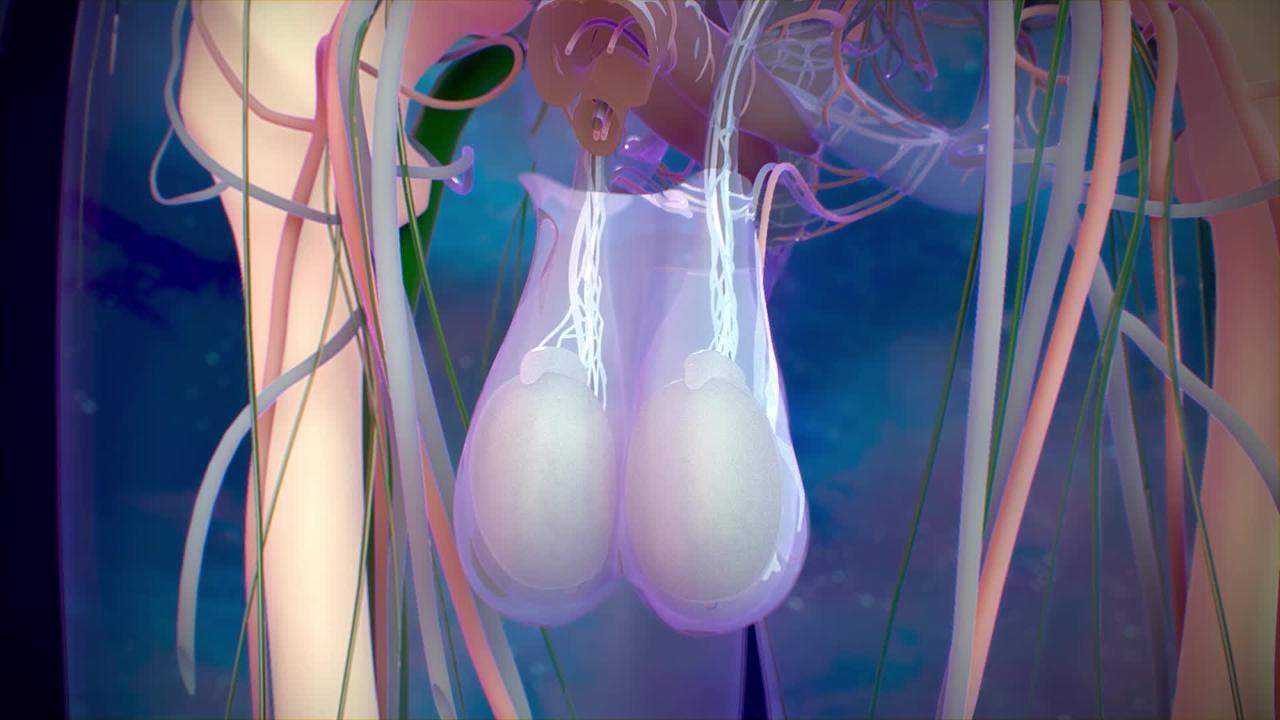
Undescended Testes
In the fetus, the testes develop within the abdomen. Typically before birth (usually in the third trimester), they descend through a tunnel attached to the vas deferens from the abdomen into the groin called the inguinal canal and then down into the scrotum. After the testes descend, the inguinal canal usually closes. However, sometimes the testes do not descend into the scrotum. Most of the time, the cause of undescended testes is not known.
At birth, about 3% of boys who are born at full term (9 months) and about 30% of boys who are born prematurely have an undescended testis. Boys whose family members had undescended testes also are more likely to have the condition. Usually only one testis does not descend, most commonly the right testis, but in some boys both testes do not descend.
Usually the undescended testis is in the inguinal canal but sometimes it is within the abdomen. About 50% of undescended testes descend on their own within the first month of life. Testes that remain in the abdomen at birth are much less likely to descend on their own.
Undescended Testis
In the fetus, the testes (testicles) develop within the abdomen. Typically before birth (usually in the third trimester), they descend through a tunnel attached to the vas deferens from the abdomen into the groin and then down into the scrotum. However, sometimes the testes do not descend into the scrotum. |


Undescended testes rarely cause symptoms. However, undescended testes can impair sperm production later in life and increase the risk of testicular cancer. Undescended testes in the abdomen can become twisted (testicular torsion), causing severe pain. Most newborns who have an undescended testis also have an inguinal hernia. An inguinal hernia rarely causes symptoms, but doctors can often feel it during an examination.


In this photo, less of a bulge is seen on the left side of the scrotum because the testis has not descended into it.
© Springer Science+Business Media
Doctors do a physical examination of the scrotum to detect the testes at birth and at each annual well-child visit. If they cannot feel one or both testes, they make sure that the testes have not moved back into the inguinal canal (see Retractile testes). If doctors are not able to feel both testes in a newborn, they do blood and other tests to determine whether the baby has a disorder that affects normal development of the genitals. If the test results confirm that the baby does not have such a disorder, doctors use a fiberoptic instrument called a laparoscope to look for the testes in the baby's abdomen (laparoscopy).
Most boys are diagnosed with undescended testes in infancy, but some may not be diagnosed until later in childhood usually after a growth spurt. Older children should be seen by a urologist (a doctor who specializes in the urinary tract and male reproductive system).
If the testis has not descended by about 6 to 12 months of age, or by 18 months of age in premature infants, surgery is needed. A surgical procedure is done depending on the location of the testis and on whether doctors can feel it during an examination. If the infant has an inguinal hernia, that is also repaired.
Because children who have had undescended testes are at an increased risk of developing testicular cancer, after puberty, all males should examine their testes for lumps every month.
Hydrocele
Sometimes, fluid from the abdomen accumulates around the testes and becomes trapped in the scrotum (hydrocele). Hydroceles are more common among children with an undescended testis or inguinal hernia because the inguinal canal stays open, making it easier for fluid to collect. In some cases, the fluid remains trapped in the scrotum after the canal closes.
A hydrocele where the canal is closed is painless and usually goes away on its own in the first year of life. (See also Scrotal Swelling.)


This photo shows swelling of the scrotum caused by a hydrocele. A hydrocele is fluid from the abdomen that accumulates around the testes and becomes trapped in the scrotum.
© Springer Science+Business Media
Retractile Testes
Retractile testes (hypermobile testes) are descended testes that easily move back and forth (retract) in the inguinal canal between the scrotum and the abdomen. The testes retract as a reflex response to touch, temperature, fear, or laughter. Such a response is common, particularly in infants and children. Retractile testes do not lead to cancer or other complications.
Doctors examine the testes during well-child visits to confirm they are properly positioned in the scrotum as the child grows. The testes usually stop retracting up into the groin by puberty because they grow larger.
Retractile testes do not require surgery or other treatment.