The muscles that help hold the upper arm in the shoulder joint (the rotator cuff muscles) can get pinched (shoulder impingement syndrome), become inflamed (tendinitis), or can tear partially or completely.
(See also Overview of Sports Injuries.)
The shoulder is painful when the arm is moved over the head and later, even when the arm is not moved.
Exercises may help.
The rotator cuff consists of the muscles that attach the shoulder blade to the head of the humerus. The rotator cuff strengthens the shoulder joint and helps rotate the upper arm.
Anatomy of a Shoulder Joint

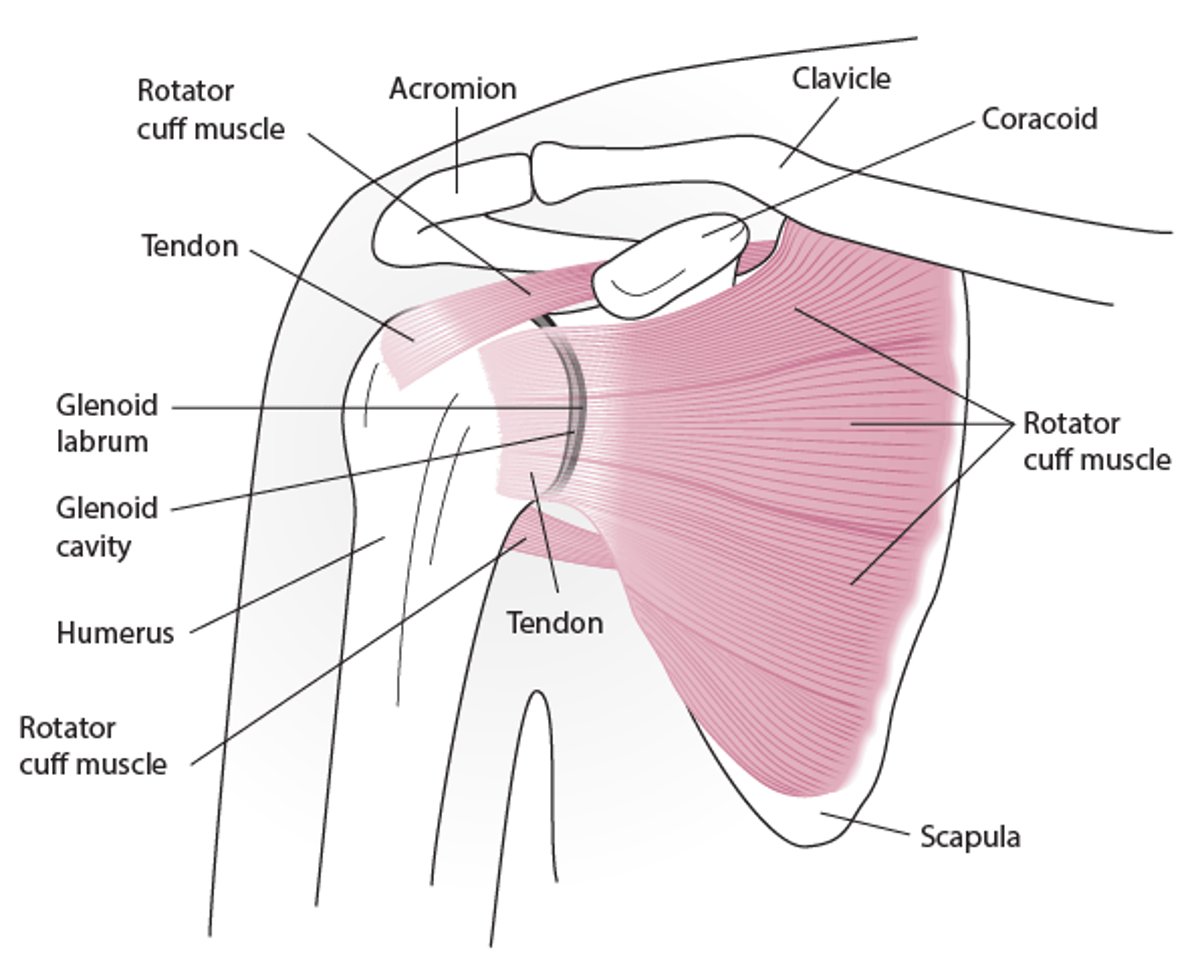
Rotator cuff pinching (impingement) and tendinitis often occur in sports that require the arms to be moved over the head repeatedly, such as pitching in baseball, lifting heavy weights over the shoulder, serving the ball in racket sports, and swimming freestyle, butterfly, or backstroke. Repeatedly moving the arm over the head causes the top of the arm bone to pinch the rotator cuff muscles against the top part of the shoulder blade and can result in inflammation and swelling of the muscles. If the movement is continued despite the inflammation, the tendon can weaken and tear.
Even without overuse and chronic inflammation, the rotator cuff can be torn suddenly by a powerful movement (such as a severe stretch or pull) or a fall.
Symptoms of Rotator Cuff Injury
Shoulder pain is the main symptom of a rotator cuff injury. At first, the pain occurs only during activities that require lifting the arm over the head (impingement syndrome). The pain is worse when lifting the arm between 60 and 120° away from the side. Unless effectively treated, the shoulder may later become painful at rest (tendinitis), often particularly at night, disrupting sleep. If the tendon tears, normal outward turning of the arm at the shoulder is weak or impossible.
Diagnosis of Rotator Cuff Injury
A doctor's evaluation
Sometimes magnetic resonance imaging
Doctors make the diagnosis based on the person’s symptoms and examination findings. Magnetic resonance imaging (MRI) sometimes is needed to rule out a tear of the rotator cuff muscles.
Treatment of Rotator Cuff Injury
Rest
Sometimes anti-inflammatory medications or steroid injections
Sometimes surgery
Rehabilitation
If pain is moderate or severe, the shoulder can be rested by keeping the arm in a sling for a couple of days. Exercises that involve raising the arm above the level of the shoulder, especially against resistance, should be avoided. Once the shoulder can be moved as it previously could be moved without pain, the rotator cuff muscles can then be strengthened. Exercises to strengthen some of the muscles restore strength to all the rotator cuff muscles and decrease impingement during activities that involve reaching overhead. If the pain is severe, doctors may prescribe anti-inflammatory medications or sometimes inject a steroid (sometimes also known as a glucocorticoid or corticosteroid) into the space above the rotator cuff (bursa).
Surgery is sometimes needed when the rotator cuff is torn or tendinitis does not resolve with other treatments. Surgery removes excess bone from the shoulder, creating a larger space for the rotator cuff and thus preventing pinching of the rotator cuff when the arm moves above the head. If the rotator cuff is torn, surgical repair is usually recommended.

1. Lie on stomach with involved arm hanging off edge of bed with thumb pointed out away from body.
2. Keep elbow straig
Courtesy of Tomah Memorial Hospital, Department of Physical Therapy, Tomah, WI; Elizabeth C.K. Bender, MSPT, ATC, CSCS; and Whitney Gnewikow, DPT, ATC.

1. Lie on uninvolved side with pillow between arm and body on the involved side.
2. Bend involved elbow to 90°.
3. Sque
Courtesy of Tomah Memorial Hospital, Department of Physical Therapy, Tomah, WI; Elizabeth C.K. Bender, MSPT, ATC, CSCS; and Whitney Gnewikow, DPT, ATC.

1. Lie on stomach with involved arm down off edge of table and thumb pointed out away from body.
2. Squeeze shoulder bl
Courtesy of Tomah Memorial Hospital, Department of Physical Therapy, Tomah, WI; Elizabeth C.K. Bender, MSPT, ATC, CSCS; and Whitney Gnewikow, DPT, ATC.

1. Lie on stomach on bed with involved arm out to the side, off edge of bed and elbow bent to 90° with thumb toward the
Courtesy of Tomah Memorial Hospital, Department of Physical Therapy, Tomah, WI; Elizabeth C.K. Bender, MSPT, ATC, CSCS; and Whitney Gnewikow, DPT, ATC.

1. Begin with arm at side, keep elbow straight and thumb up.
2. Move arm forward approximately 30°.
3. In this positi
Courtesy of Tomah Memorial Hospital, Department of Physical Therapy, Tomah, WI; Elizabeth C.K. Bender, MSPT, ATC, CSCS; and Whitney Gnewikow, DPT, ATC.

1. Place one end of elastic band to a secure object at waist level.
2. Place pillow or towel roll between elbow and bod
Courtesy of Tomah Memorial Hospital, Department of Physical Therapy, Tomah, WI; Elizabeth C.K. Bender, MSPT, ATC, CSCS; and Whitney Gnewikow, DPT, ATC.

1. Place one end of elastic band to a secure object at waist level.
2. Place pillow or towel roll between elbow and bod
Courtesy of Tomah Memorial Hospital, Department of Physical Therapy, Tomah, WI; Elizabeth C.K. Bender, MSPT, ATC, CSCS; and Whitney Gnewikow, DPT, ATC.

1. Hold weight in hand on involved side.
2. Slightly bend hips and knees and support upper body with other hand placed
Courtesy of Tomah Memorial Hospital, Department of Physical Therapy, Tomah, WI; Elizabeth C.K. Bender, MSPT, ATC, CSCS; and Whitney Gnewikow, DPT, ATC.


1. Lie on stomach with involved arm hanging off edge of bed with thumb pointed out away from body.
2. Keep elbow straight and extend arm to trunk level while squeezing the scapula down and back.
3. Return to starting position.
4. Do 3 sets of 10 repetitions.
5. Add light weight as tolerated.
Courtesy of Tomah Memorial Hospital, Department of Physical Therapy, Tomah, WI; Elizabeth C.K. Bender, MSPT, ATC, CSCS; and Whitney Gnewikow, DPT, ATC.

1. Lie on uninvolved side with pillow between arm and body on the involved side.
2. Bend involved elbow to 90°.
3. Squeeze the shoulder blade toward spine and downward.
4. Move forearm up by rotating at the shoulder, so the back of the hand is up toward the ceiling.
5. Slowly return to start position and repeat.
6. Do 3 sets of 10 repetitions, 1 time a day.
7. Add light weight as tolerated.
Courtesy of Tomah Memorial Hospital, Department of Physical Therapy, Tomah, WI; Elizabeth C.K. Bender, MSPT, ATC, CSCS; and Whitney Gnewikow, DPT, ATC.

1. Lie on stomach with involved arm down off edge of table and thumb pointed out away from body.
2. Squeeze shoulder blade toward spine and downward.
3. Lift arm upward to shoulder level.
4. Lower arm toward the floor and repeat.
5. Do 3 sets of 10 repetitions, 1 time a day.
6. Special instructions
a. Do not let shoulder blade move when lifting arm.
b. Keep thumb facing up toward the ceiling.
Courtesy of Tomah Memorial Hospital, Department of Physical Therapy, Tomah, WI; Elizabeth C.K. Bender, MSPT, ATC, CSCS; and Whitney Gnewikow, DPT, ATC.

1. Lie on stomach on bed with involved arm out to the side, off edge of bed and elbow bent to 90° with thumb toward the body.
2. Squeeze shoulder blade toward spine and downward.
3. Rotate forearm upward.
4. Return to start position and repeat.
5. Do 3 sets of 10 repetitions, 1 time a day.
6. Special instructions
a. Do not let shoulder blade move when lifting forearm.
Courtesy of Tomah Memorial Hospital, Department of Physical Therapy, Tomah, WI; Elizabeth C.K. Bender, MSPT, ATC, CSCS; and Whitney Gnewikow, DPT, ATC.

1. Begin with arm at side, keep elbow straight and thumb up.
2. Move arm forward approximately 30°.
3. In this position raise arm up staying in a pain-free range.
4. Return to starting position.
5. Do 3 sets of 10 repetition, 1 time a day.
6. Add light weight as tolerated.
Courtesy of Tomah Memorial Hospital, Department of Physical Therapy, Tomah, WI; Elizabeth C.K. Bender, MSPT, ATC, CSCS; and Whitney Gnewikow, DPT, ATC.

1. Place one end of elastic band to a secure object at waist level.
2. Place pillow or towel roll between elbow and body on involved side.
3. Grasp band in involved hand, with elbow bent to 90° and thumb up.
4. Externally rotate arm, then slowly return to start position.
5. Do 3 sets of 10 repetitions, 1 time a day.
6. Special instructions
a. Start with least resistance band.
b. Keep arm at side and elbow flexed at 90°.
Courtesy of Tomah Memorial Hospital, Department of Physical Therapy, Tomah, WI; Elizabeth C.K. Bender, MSPT, ATC, CSCS; and Whitney Gnewikow, DPT, ATC.

1. Place one end of elastic band to a secure object at waist level.
2. Place pillow or towel roll between elbow and body on involved side.
3. Grasp band with involved hand, with elbow bent to 90° and thumb up.
4. Internally rotate arm (pull hand inward across body), then slowly return to start position.
5. Do 3 sets of 10 repetitions, 1 time a day.
6. Special instructions
a. Start with least resistance band.
b. Keep arm at side and elbow flexed at 90°.
Courtesy of Tomah Memorial Hospital, Department of Physical Therapy, Tomah, WI; Elizabeth C.K. Bender, MSPT, ATC, CSCS; and Whitney Gnewikow, DPT, ATC.

1. Hold weight in hand on involved side.
2. Slightly bend hips and knees and support upper body with other hand placed on table or bed.
3. Bend elbow to 90° and raise elbow to shoulder height by retracting (squeezing) the scapula.
4. Return to start position.
5. Do 3 sets of 10 repetitions, 1 time a day.
6. Special instructions
a. Start with 1 to 2 pound (0.5 to 1 kg) weight (ie, a soup can).
Courtesy of Tomah Memorial Hospital, Department of Physical Therapy, Tomah, WI; Elizabeth C.K. Bender, MSPT, ATC, CSCS; and Whitney Gnewikow, DPT, ATC.