Generalized anxiety disorder consists of excessive nervousness and worry about a number of activities or events. People have anxiety more days than not over a period of 6 months or longer. The cause is unknown, although it commonly coexists in people who have alcohol use disorder, major depression, or panic disorder.
People are anxious and worried about a variety of issues, activities, and situations..
For this disorder to be diagnosed, several other symptoms (such as a tendency to tire easily, difficulty concentrating, and muscle tension) must accompany the anxiety.
Treatment involves a combination of medications (usually antianxiety medications and sometimes antidepressants) and psychotherapy.
Generalized anxiety disorder is a common type of anxiety disorder. About 2% of adults worldwide and 3 to 4% of the population in the United States have it each year. Women are twice as likely as men to have the disorder. The disorder more commonly begins in adulthood but may start at any age (see Generalized Anxiety Disorder in Children).
For most people, the disorder persists over many years and fluctuates, worsening at times (especially during times of stress).

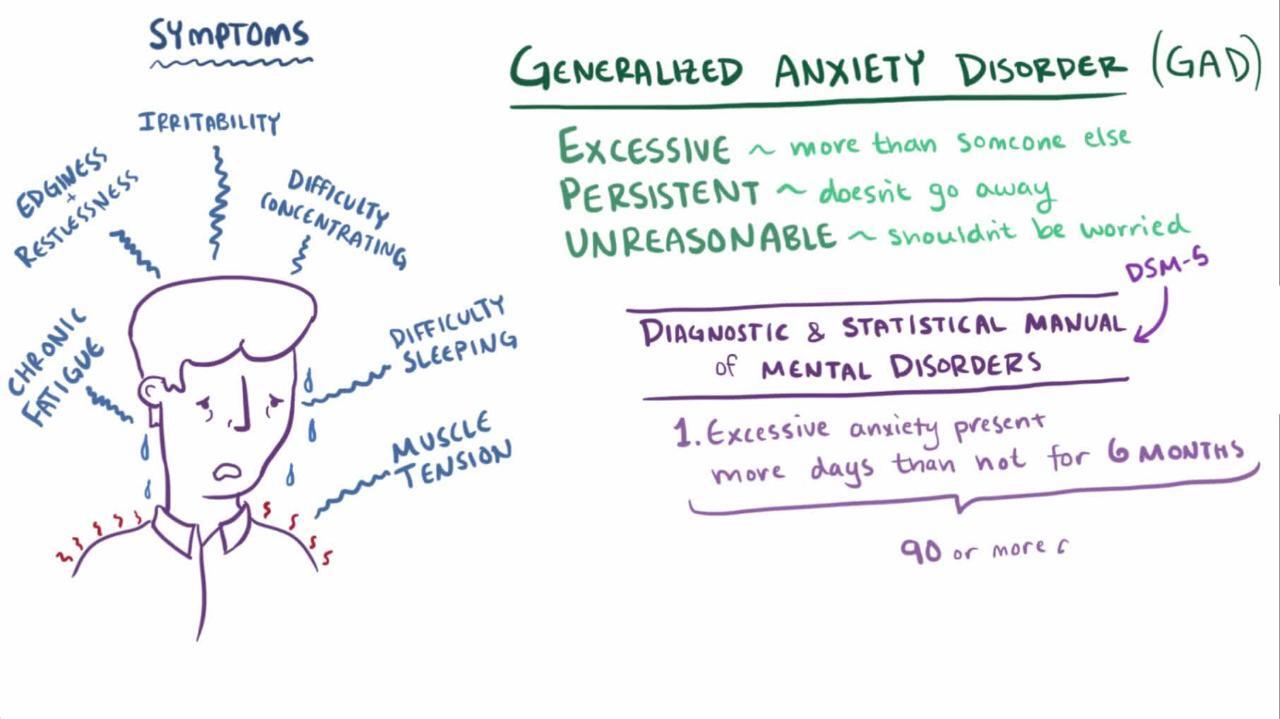
Symptoms of Generalized Anxiety Disorder
People with generalized anxiety disorder constantly feel worried or distressed and have difficulty controlling these feelings. The severity, frequency, or duration of the worries is greater than the situation warrants.
Worries are general in nature, include many topics, and often shift from one topic to another over time. Common worries include work and family responsibilities, money, health, safety, car repairs, and chores.
Most people with generalized anxiety disorder also have another mental health disorder, such as depression, or another anxiety disorder.
Diagnosis of Generalized Anxiety Disorder
A doctor's evaluation, based on standard psychiatric diagnostic criteria
For a doctor to diagnose generalized anxiety disorder, a person must experience worry or anxiety that
Is excessive
Concerns a number of activities and events
Is present more days than not over a period of 6 months or longer
In addition, the person must have 3 or more of the following symptoms:
Restlessness or a keyed-up or on-edge feeling
A tendency to tire easily
Difficulty concentrating
Irritability
Muscle tension
Disturbed sleep
Before diagnosing generalized anxiety disorder, doctors also do a physical examination. They may do blood or other tests to make sure the symptoms are not caused by a physical disorder or use of a drug.
Treatment of Generalized Anxiety Disorder
A combination medications and psychotherapy
The disorder is often managed with a combination of some form of psychotherapy and drug therapy. Psychotherapy can address the causes of anxiety and provide ways to cope.
Antidepressants, particularly selective serotonin reuptake inhibitors (such as escitalopram) and serotonin-norepinephrine reuptake inhibitors (such as venlafaxine), are effective for generalized anxiety disorder. These antidepressants usually take a few weeks to relieve anxiety, so some people are first given a benzodiazepine along with the antidepressant. Benzodiazepines are antianxiety medications that relieve anxiety quickly, typically almost immediately. However, because long-term use of benzodiazepines can lead to medication dependence and addiction (see Misuse of Antianxiety Medications and Sedatives), these medications are usually given for only a relatively short time. Once the antidepressant and psychotherapy becomes effective, the dose of the benzodiazepine may be decreased slowly, then stopped. Benzodiazepines should not be stopped abruptly.
Buspirone, another antianxiety medication, is also effective for some people with generalized anxiety disorder. Buspirone may also take 2 weeks or longer to start working and may require gradual dose increases to be effective.
Herbal products such as kava may have antianxiety effects, although their effectiveness and safety for treating anxiety disorders such as generalized anxiety disorder require further study.
Cognitive-behavioral therapy has been shown to be the most beneficial treatment for generalized anxiety disorder. With this therapy, people learn to do the following:
Recognize where their thinking is distorted
Control their distorted thinking
Modify their behavior accordingly
Relaxation, yoga, meditation, exercise, and biofeedback techniques may also be of some help.
More Information
The following English-language resource may be useful. Please note that The Manual is not responsible for the content of this resource.
Drug Information for the Topic