Erythrasma is an intertriginous infection with Corynebacterium minutissimum that is most common among patients with diabetes and among people living in warmer climates. Diagnosis is clinical. Treatment is with topical antimicrobials or oral clarithromycin.
(See also Overview of Bacterial Skin Infections.)
Erythrasma is a bacterial skin infection often affecting the intertriginous regions (ie, skin folds) of the body. Residence in a warm, humid climate can predispose to its development.
This infection most commonly affects the foot, where it manifests as superficial scaling, fissuring, and maceration typically confined to the third and fourth web spaces. Erythrasma may also involve other intertriginous areas, including the axillae, submammary or abdominal folds, and perineum. Erythrasma in the groin manifests as irregular but sharply marginated pink or brown patches with fine scaling.
Erythrasma may occur in healthy adults, but it is more prevalent among patients with obesity, diabetes mellitus, advanced age, or immunocompromise (1). Hidradenitis suppurativa and hyperhidrosis are also risk factors (2, 3).

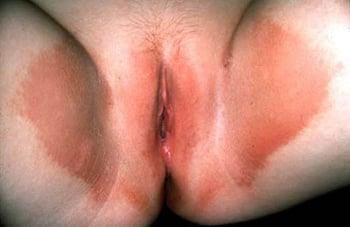
Erythrasma in the groin manifests as irregular but sharply marginated patches with fine scaling.

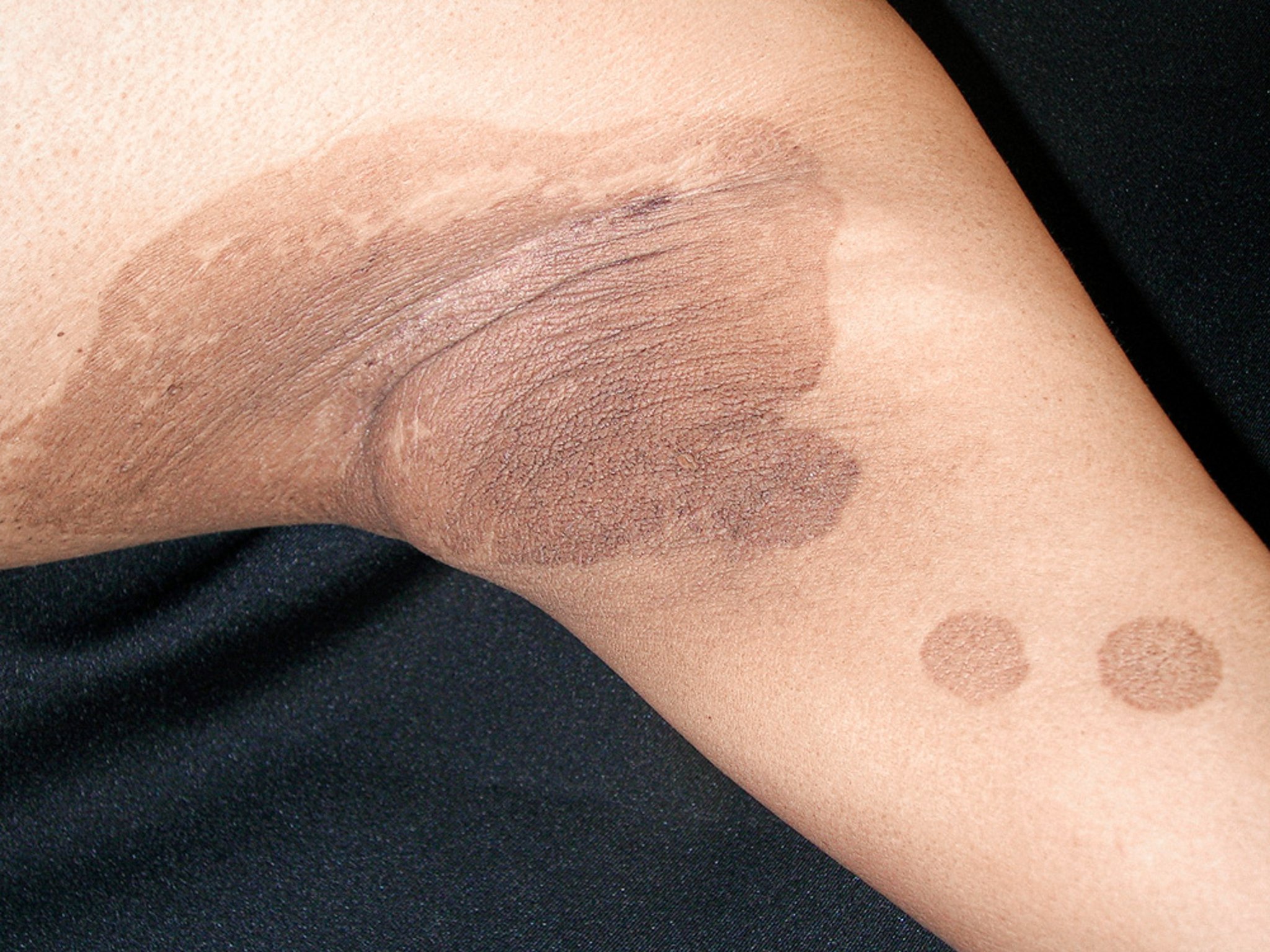
Erythrasma in the axilla manifests as scaling, erythema, or skin discoloration.
RICHARD USATINE MD / SCIENCE PHOTO LIBRARY
General references
1. Holdiness MR. Management of cutaneous erythrasma. Drugs. 2002;62(8):1131-1141. doi:10.2165/00003495-200262080-00002
2. Del Ángel Hernández M, Sánchez Cárdenas CD, López Mena Gómez JC, et al. Hidradenitis suppurativa in patients with and without erythrasma. JAAD Int. 2023;12:99-100. Published 2023 Apr 22. doi:10.1016/j.jdin.2023.04.004
3. Blaise G, Nikkels AF, Hermanns-Lê T, Nikkels-Tassoudji N, Piérard GE. Corynebacterium-associated skin infections. Int J Dermatol. 2008;47(9):884-890. doi:10.1111/j.1365-4632.2008.03773.x
Diagnosis of Erythrasma
History and physical examination
The diagnosis of erythrasma is based on clinical evaluation (1).
Erythrasma fluoresces a characteristic coral-red color under a Wood light due to production of porphyrin by the C. minutissimum bacterium. Laboratory tests (eg, Gram stain, culture) are not typically necessary but may help confirm the diagnosis when performed.

This photo shows erythrasma at the top of a man's thigh viewed under ultraviolet (UV) light. This skin infection is caused by the bacterium Corynebacterium minutissimum, which glows a distinctive coral-red under UV light.
RICHARD USATINE MD / SCIENCE PHOTO LIBRARY
Differential diagnosis
The differential diagnosis of erythrasma includes:
Psoriasis (particularly inverse, small-, or large-plaque)
Cutaneous dermatophyte infections (eg, tinea)
Cellulitis, including perianal streptococcal cellulitis
Perianal streptococcal cellulitis causes pain and bright red erythema solely on perianal skin and lacks fluorescence on Wood light examination. Cultures for group A streptococcus done on skin swabs from affected patients are positive. When a potassium hydroxide (KOH) preparation of skin scrapings is microscopically examined, absence of hyphae can distinguish erythrasma from tinea infections.
Diagnosis reference
1. Masood M, Heath CR, Usatine RP. Erythrasma. J Fam Pract. 2022;71(10):E13-E14. doi:10.12788/jfp.0528
Treatment of Erythrasma
For localized erythrasma, topical antimicrobials
For extensive erythrasma, oral clarithromycin
Localized erythrasma is treated with topical antimicrobials, which include erythromycin, clindamycin, mupirocin, fusidic acid, and benzoyl peroxide (1). If Wood light and KOH wet mount or fungal culture are not available to distinguish between erythrasma and superficial fungal infection, a combination of antibacterial and antifungal topical preparations should be considered. Topical imidazole antifungals (eg, clotrimazole, miconazole) have also been efficacious.
For patients with more extensive erythrasma, oral therapy with a single dose of clarithromycin 1 g (2) or erythromycin 250 mg 4 times a day for 14 days (3) is effective.
Recurrence is common.
Treatment references
1. Radhakrishnan S, Logamoorthy R, Karthikeyan K, Mohan R, Mary J JF. Erythrasma: a systematic review of interventions. Clin Exp Dermatol. 2025;50(11):2139-2146. doi:10.1093/ced/llaf307
2. Chodkiewicz HM, Cohen PR. Erythrasma: successful treatment after single-dose clarithromycin. Int J Dermatol. 2013;52(4):516-518. doi:10.1111/j.1365-4632.2011.05005.x
3. Holdiness MR. Management of cutaneous erythrasma. Drugs. 2002;62(8):1131-1141. doi:10.2165/00003495-200262080-00002
Drug Information for the Topic