Generalized anxiety disorder is characterized by excessive anxiety and worry about a number of activities or events that are present more days than not for ≥ 6 months. The cause is unknown, although it commonly coexists in people who have alcohol use disorder, major depression, or panic disorder. Diagnosis is based on clinical criteria. Treatment includes behavioral interventions, psychotherapy, pharmacotherapy, or a combination.
Generalized anxiety disorder (GAD) is common, affecting about 2% of the worldwide population and 3 to 4% of the population in the United States within a 1-year period (1, 2). Prevalence is twice as high in women as in men (3–5). The disorder more commonly begins in adulthood but may begin at any age. GAD typically has a chronic course and is often associated with significant functional disability and a diminished quality of life.
General references
1. Ruscio AM, Hallion LS, Lim CCW, et al. Cross-sectional Comparison of the Epidemiology of DSM-5 Generalized Anxiety Disorder Across the Globe. JAMA Psychiatry. 2017;74(5):465-475. doi:10.1001/jamapsychiatry.2017.0056
2. Kessler RC, Wang PS. The descriptive epidemiology of commonly occurring mental disorders in the United States. Annu Rev Public Health. 2008;29:115-129. doi:10.1146/annurev.publhealth.29.020907.090847
3. Wittchen HU, Zhao S, Kessler RC, et al: DSM-III-R generalized anxiety disorder in the National Comorbidity Survey. Arch Gen Psychiatry 1994 May;51(5):355-64. doi: 10.1001/archpsyc.1994.03950050015002
4. Lieb R, Becker E, Altamura C. The epidemiology of generalized anxiety disorder in Europe. Eur Neuropsychopharmacol. 2005;15(4):445-452. doi:10.1016/j.euroneuro.2005.04.010
5. Yeretzian ST, Sahakyan Y, Kozloff N, Abrahamyan L. Sex differences in the prevalence and factors associated with anxiety disorders in Canada: A population-based study. J Psychiatr Res. 2023;164:125-132. doi:10.1016/j.jpsychires.2023.06.018
Symptoms and Signs of Generalized Anxiety Disorder
People with GAD have multiple worries, which often shift over time. Common worries include work and family responsibilities, money, health, safety, car repairs, and chores. In GAD, the focus is not a single worry (eg, being embarrassed in public or becoming contaminated).
The course is usually fluctuating and chronic. Most patients with GAD have 1 or more comorbid psychiatric disorders, including major depression, specific phobia, social anxiety disorder, or panic disorder (1).
Symptoms and signs reference
1. American Psychiatric Association. Diagnostic and Statistical Manual of Mental Disorders. 5th ed, Text Revision. American Psychiatric Association Publishing; 2022.
Diagnosis of Generalized Anxiety Disorder
Psychiatric assessment
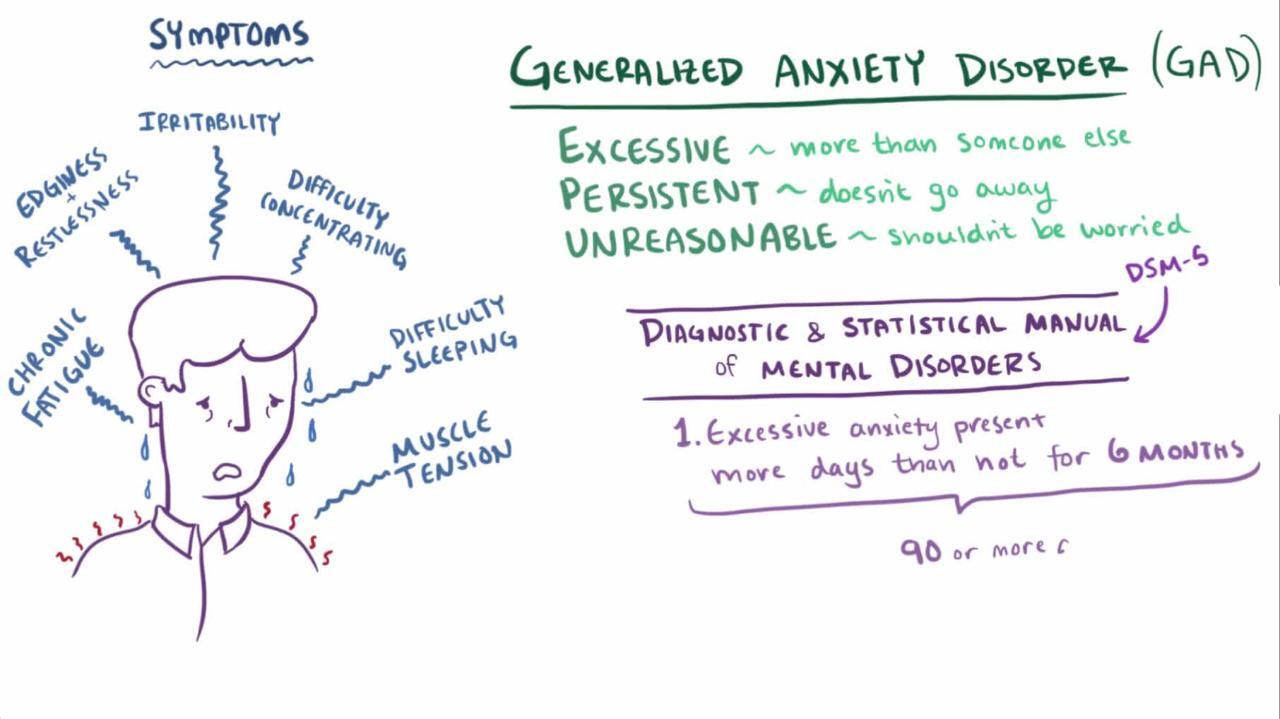
To meet the Diagnostic and Statistical Manual of Mental Disorders, 5th edition, Text Revision (DSM-5-TR) criteria for generalized anxiety disorder, patients must have excessive anxiety and worry about a number of activities or events (eg, work and school performance), occurring more days than not for ≥ 6 months (1).
The worries are difficult to control and must be associated with ≥ 3 of the following:
Restlessness or a keyed-up or on-edge feeling
Easy fatigability
Difficulty concentrating
Irritability
Muscle tension
Disturbed sleep
The psychiatric symptoms must cause significant distress and/or significantly impair social or occupational functioning. Also, the anxiety and worry cannot be accounted for by substance use or a general medical disorder (eg, hyperthyroidism) and not be better accounted for by another psychiatric disorder or substance use.

Diagnosis reference
1. American Psychiatric Association. Diagnostic and Statistical Manual of Mental Disorders. 5th ed,Text Revision. American Psychiatric Association Publishing; 2022.
Treatment of Generalized Anxiety Disorder
Antidepressant medications (eg, selective serotonin reuptake inhibitors, serotonin-norepinephrine reuptake inhibitors)
Anxiolytic medications (eg, benzodiazepines, buspirone)
Psychotherapy
Selective serotonin reuptake inhibitors (eg, escitalopram) and serotonin-norepinephrine reuptake inhibitors (eg, venlafaxine) are the preferred medications for the treatment of GAD; their use typically results in symptom improvement after 3 to 6 weeks (1). Small to moderate doses of benzodiazepines may immediately reduce anxiety, although sustained use may lead to physical dependence as well as a variety of adverse effects, including sedation, forgetfulness, and clumsiness. One strategy for treating GAD involves starting with both a benzodiazepine and an antidepressant medication, as well as an anxiety-focused psychotherapy (see table ). Then, when the GAD symptoms have become manageable, the benzodiazepine can be tapered and continued at a lower dose, or discontinued.
Buspirone may also be effective (2), though typically symptoms do not diminish until the dose is gradually increased to the upper recommended range.
Herbal products such as kava may have antianxiety effects, although their effectiveness and safety for treating anxiety disorders such as generalized anxiety disorder require further study (3, 4).
Psychotherapy, usually cognitive-behavioral therapy, can be both supportive and problem-focused (5). Relaxation techniques, hypnosis, exercise, improved sleep, and mindfulness-based stress reduction are also often helpful. Cognitive-behavioral therapy has been shown to be the most effective psychotherapeutic modality for generalized anxiety disorder (6, 7).
Treatment references
1. Kong W, Deng H, Wan J, et al. Comparative Remission Rates and Tolerability of Drugs for Generalised Anxiety Disorder: A Systematic Review and Network Meta-analysis of Double-Blind Randomized Controlled Trials. Front Pharmacol. 2020;11:580858. Published 2020 Nov 11. doi:10.3389/fphar.2020.580858
2. Szuhany KL, Simon NM. Anxiety Disorders: A Review. JAMA. 2022;328(24):2431-2445. doi:10.1001/jama.2022.22744
3. Zhang W, Yan Y, Wu Y, et al. Medicinal herbs for the treatment of anxiety: A systematic review and network meta-analysis. Pharmacol Res. 2022;179:106204. doi:10.1016/j.phrs.2022.106204
4. Ooi SL, Henderson P, Pak SC. Kava for Generalized Anxiety Disorder: A Review of Current Evidence. J Altern Complement Med. 2018;24(8):770-780. doi:10.1089/acm.2018.0001
5. DeMartini J, Patel G, Fancher TL. Generalized anxiety disorder. Ann Intern Med. 170(7):ITC49-ITC64, 2019. doi: 10.7326/AITC201904020
6. Zech JM, Patel TA, Cougle JR. Correlates of treatment-seeking in DSM-5 generalized anxiety disorder: Findings from the National Epidemiologic Survey on Alcohol and Related Conditions. J Anxiety Disorders. 106:102909-102909, 2024
7. Papola D, Miguel C, Mazzaglia M, et al. Psychotherapies for Generalized Anxiety Disorder in Adults: A Systematic Review and Network Meta-Analysis of Randomized Clinical Trials [published correction appears in JAMA Psychiatry. 2024 Mar 1;81(3):320. doi: 10.1001/jamapsychiatry.2023.5480.]. JAMA Psychiatry. 2024;81(3):250-259. doi:10.1001/jamapsychiatry.2023.3971
Drug Information for the Topic