Periodic well-woman visits may be provided by a gynecologist, other women's health clinician, or primary care clinician. The American College of Obstetricians and Gynecologists recommends that preventive care visits include screening, evaluation, counseling, immunizations, and shared decision-making based on age and risk factors (1). Taking a gynecologic history during a well-woman visit may also be relevant for patients who are gender diverse (2).
Women's health care should be considered an ongoing, longitudinal process of preventive and screening care across the lifespan, rather than a single annual event consisting of unvarying content at every visit. Some patients may benefit from annual visits, but the interval may differ across patients, and the specific services provided should be individualized based on age, risk factors, symptoms, and patient needs or priorities. Social determinants of health, reproductive planning, and sexual health should be addressed as part of preventive gynecologic care (1).
Well-woman visits should include taking a comprehensive medical history, including current symptoms or concerns as well as medical, surgical, gynecologic, obstetric, sexual, family, and social history; medications and allergies should also be tracked. This history should be obtained using inclusive language and a medical interpreter, if the clinician and patient cannot communicate effectively in the same language. Taking a gynecologic history may also be relevant for transgender, nonbinary, and other gender-diverse patients depending on anatomy, hormone use, and individual health needs (1).
During a well-woman visit, patients may be screened for or counseled about
Safer sex practices
Preconception care
Perimenopause and menopause
Osteoporosis screening and prevention
Immunizations, mental health, intimate partner violence, sexual trauma (3), eating disorders, substance use, and general health risks such as obesity, hypertension, diabetes, and dyslipidemia should also be addressed directly or coordinated with the patient's primary care clinician.
Future reproductive planning—including whether the patient desires pregnancy in the next year—should be reviewed periodically; doing so helps guide choice of contraception, preconception counseling, and optimization of care of chronic disease (4).
Sexually active women who use contraceptive methods other than condoms should be counseled about STI-prevention measures. These include HPV vaccination, preexposure prophylaxis (PrEP) for HIV, postexposure prophylaxis (PEP) for HIV and other STIs, limiting the number of sex partners, and the correct and consistent use of condoms.
Depending on history of vaccination for human papillomavirus (HPV) and age of the patient, HPV vaccination should be offered. Catch-up HPV vaccination is routinely recommended through age 26 years; for adults aged 27 through 45 years, vaccination may be offered using shared decision-making (5).
Women's health clinicians should routinely discuss HIV prevention and offer testing. Preexposure prophylaxis with antiretrovirals (PrEP) should be offered within 72 hours to all patients who are not infected with HIV but are at high risk for contracting it (eg, because they have a partner who is living with HIV, engage in high-risk sexual behaviors, or inject illicit drugs) (5). For patients with a nonoccupational (eg, sexual, needle-related) exposure to nonintact skin or mucous membranes, the U.S. Centers for Disease Control and Prevention (CDC) recommends nonoccupational postexposure prophylaxis (nPEP) when the exposure occurred within the past 72 hours, presents a substantial risk for HIV transmission, particularly if the source has HIV without sustained viral suppression or their viral suppression information is not known (6, 7).
In addition, doxycycline postexposure prophylaxis (doxyPEP) to prevent chlamydia, gonorrhea, and syphilis is recommended for selected patient populations (men who have sex with men and transgender women who have had a bacterial STI diagnosed in the past 12 months). The efficacy of doxyPEP in other patient populations has not been proven. Clinicians should use clinical judgment and shared decision-making to guide counseling about and use of doxyPEP with women and other patient populations that are not specifically mentioned in the CDC recommendations.
Pelvic Examination
Pelvic examination is performed if indicated based on symptoms, such as pelvic pain, abnormal vaginal bleeding, vaginal discharge, or vulvovaginal symptoms (eg, pruritus) or the need to perform a gynecologic procedure.
The question of whether to perform pelvic examinations for detection of ovarian cancer, bacterial vaginosis, trichomoniasis, and genital herpes in asymptomatic women has been studied, but data are inadequate to recommend for or against this practice (8). Thus, screening pelvic examinations are not required, but they may be performed if this decision is made based on shared decision-making between the patient and clinician. Also, pelvic examination is not indicated for initiation or renewal of contraception, except for an intrauterine device.
The components of the pelvic examination—including external genital examination, speculum examination, and bimanual examination—should be explained to the patient, who may consent to certain components and refuse others.
Women with risk factors for gynecologic cancer (eg, history of cervical dysplasia, in-utero exposure to diethylstilbestrol [DES]), or prior gynecologic malignancy may require more frequent pelvic examination and should be managed according to current guidelines.

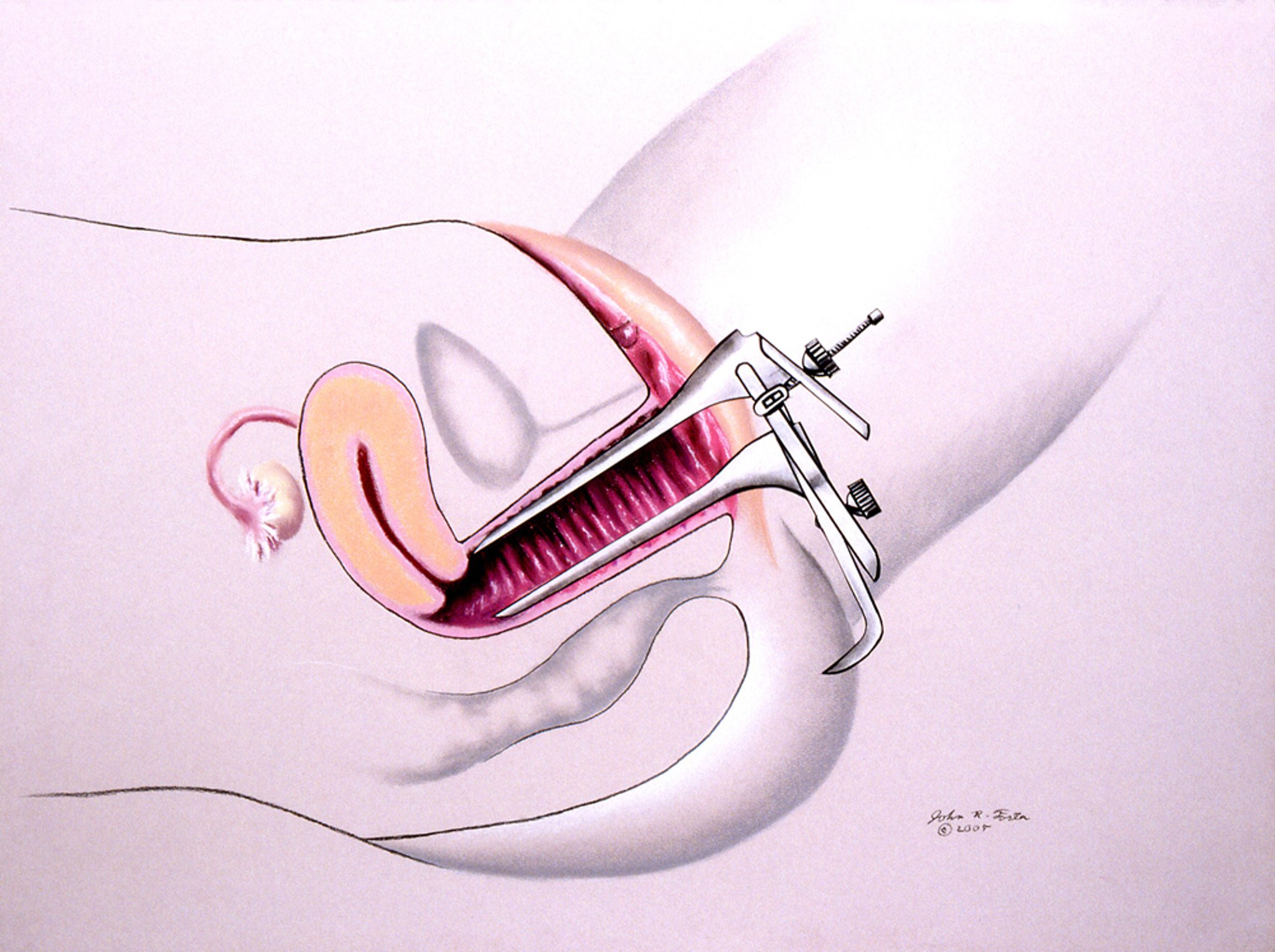
This illustration shows a pelvic examination with a speculum.
JOHN FOSTER/SCIENCE PHOTO LIBRARY
Breast Examination
As with the pelvic examination, the decision to perform a breast examination should be a shared decision between the patient and clinician and performed when indicated by medical history or symptoms, or if the patient expresses a preference for the examination (9). Clinical breast examination (CBE) should not be used as a substitute for mammographic screening and is not recommended as a routine screening test for average-risk, asymptomatic women. However, CBE remains appropriate for evaluation of breast symptoms (eg, palpable mass, focal pain, nipple discharge, skin changes) or when requested by the patient. Patients should be encouraged to practice breast awareness and promptly report new breast masses, persistent focal pain, nipple discharge, skin changes, or nipple inversion rather than performing scheduled breast self-examinations. Breast cancer screening should follow current age- and risk-based guidelines, with individualized recommendations for women at increased hereditary or familial risk (10).
References
1. American College of Obstetricians and Gynecologists’ Committee on Gynecologic Practice. Opinion No. 755: Well-woman visit. Obstet Gynecol. 2018;132(4):p e181-e186. doi: 10.1097/AOG.0000000000002897
2. American College of Obstetricians and Gynecologists’ Committee on Gynecologic Practice. Opinion No. 823: Health care for transgender and gender diverse individuals. Obstet Gynecol. 2021;137(3):e75–e88. doi: 10.1097/AOG.0000000000004294
3. Confidentiality in Adolescent Health Care. ACOG Committee Opinion, Number 803. Obstet Gynecol. 2020;135(4):e171-e177. doi:10.1097/AOG.0000000000003770
4. ACOG Committee Opinion No. 762. Prepregnancy Counseling. Obstet Gynecol. 2019;133(1):e78-e89. doi:10.1097/AOG.0000000000003013
5. American College of Obstetricians and Gynecologists (ACOG). ACOG Practice Advisory: Preexposure Prophylaxis for the Prevention of Human Immunodeficiency Virus, June 2022 (reaffirmed 2024).
6. Tanner MR, O'Shea JG, Byrd KM, et al. Antiretroviral Postexposure Prophylaxis After Sexual, Injection Drug Use, or Other Nonoccupational Exposure to HIV - CDC Recommendations, United States, 2025. MMWR Recomm Rep. 2025;74(1):1-56. Published 2025 May 8. doi:10.15585/mmwr.rr7401a1
7. Bachmann LH, Barbee LA, Chan P, et al. CDC Clinical Guidelines on the Use of Doxycycline Postexposure Prophylaxis for Bacterial Sexually Transmitted Infection Prevention, United States, 2024. MMWR Recomm Rep. 2024;73(2):1-8. Published 2024 Jun 6. doi:10.15585/mmwr.rr7302a1
8. American College of Obstetricians and Gynecologists’ Committee on Gynecologic Practice. Opinion No. 754: The utility of and indications for routine pelvic examination. Obstet Gynecol. 132(4):e174–e180, 2018 (reaffirmed 2020). doi: 10.1097/AOG.0000000000002895
9. American College of Obstetricians and Gynecologists’ Committee on Gynecologic Practice. Practice Bulletin Number 179: Breast Cancer Risk Assessment and Screening in Average-Risk Women. Obstet Gynecol. 2017 (reaffirmed 2021);130(1):e1-e16. doi:10.1097/AOG.0000000000002158
10. U.S. Preventive Services Task Force. Breast Cancer Screening: Final Recommendation Statement. April 30, 2024. Accessed June 16, 2026.
11. Feltner C, Wallace I, Berkman N, et al. Screening for Intimate Partner Violence, Elder Abuse, and Abuse of Vulnerable Adults: An Evidence Review for the U.S. Preventive Services Task Force [Internet]. Rockville (MD): Agency for Healthcare Research and Quality (US); 2018 Oct. (Evidence Synthesis, No. 169.) Appendix F Table 1, IPV Screening Instruments. Available from: https://www.ncbi.nlm.nih.gov/books/NBK533715/table/appf.tab1/
12. Laelago T, Belachew T, Tamrat M. Effect of intimate partner violence on birth outcomes. Afr Health Sci. 2017;17(3):681-689. doi:10.4314/ahs.v17i3.10
Drug Information for the Topic