Lymphadenitis is infection of one or more lymph nodes, which usually become swollen and tender. The skin over the lymph nodes may be red and warm.
(See also Overview of Bacterial Skin Infections.)
Lymph is a fluid that oozes out of the body's tiniest blood vessels and is part of the body’s immune system. The fluid goes between cells and brings nourishment and carries away substances such as damaged cells, cancer cells, and infectious microorganisms. All lymph passes through lymphatic vessels to strategically placed lymph nodes. Lymph nodes and specialized white blood cells in lymph nodes work to remove these substances and foreign particles from the body. (See figure .)
Lymphadenitis almost always results from an infection, which may be caused by bacteria, viruses, parasites, or fungi. Typically, the infection spreads to a lymph node from a skin, ear, nose, or eye infection or from such infections as infectious mononucleosis, cytomegalovirus infection, streptococcal infection, tuberculosis, or syphilis. The infection may affect many lymph nodes or only those in one area of the body.
Symptoms of Lymphadenitis
Infected lymph nodes enlarge and are usually tender and painful. Sometimes, the skin over the infected nodes is inflamed, looks red, and feels warm. Some people may have cellulitis. People commonly have a fever. Pockets of pus (abscesses) may develop.
Enlarged lymph nodes that do not cause pain, tenderness, or redness may indicate a serious, different disorder, such as lymphoma, and should be evaluated by a doctor.

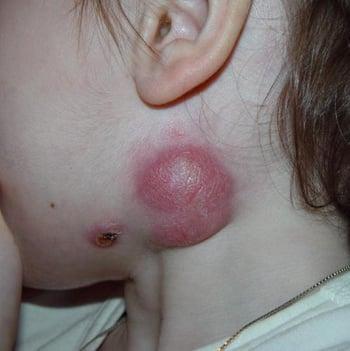
This photo shows swollen lymph nodes (lymphadenitis) in a child.
Diagnosis of Lymphadenitis
A doctor's evaluation
Sometimes aspiration and culture or a tissue biopsy
Usually, doctors diagnose lymphadenitis based on the person's symptoms of pain, tenderness, and redness.
When the cause cannot be identified easily, a doctor inserts a needle into the lymph node and withdraws (aspirates) fluid. The fluid sample is then sent to a laboratory for culture (the sample is placed in a culture medium that allows microorganisms to grow) or another test that can identify the organism causing the infection. Alternatively, the doctor can do a biopsy (removal and examination of a piece of the lymph node under a microscope). Sometimes, doctors may remove the entire lymph node during a procedure called excisional biopsy.


Treatment of Lymphadenitis
Antibiotics
Treatment of lymphadenitis depends on the organism causing the infection. For example, doctors prescribe an antibiotic taken by mouth (orally) for a bacterial infection or other medications for a fungal or parasitic infection.
Warm, wet compresses may help relieve the pain in inflamed lymph nodes. Pain relievers that also reduce inflammation, such as ibuprofen, can be taken. Usually, once the infection has been treated, the lymph nodes slowly shrink, and the pain subsides. Sometimes the enlarged nodes remain firm but do not feel tender.
Many people develop abscesses. Doctors surgically drain them and give people antibiotics by vein (intravenously). In children, intravenous antibiotics are commonly needed, and they are also commonly needed for people who have a severe infection caused by bacteria.
Drug Information for the Topic