Acute vision loss is defined as a rapid reduction in visual acuity occurring over seconds to days. It may affect one or both eyes and all or part of a visual field. Patients with small visual field defects (eg, caused by a small retinal detachment) may describe their symptoms as blurred vision.
Pathophysiology of Acute Vision Loss
Acute loss of vision has 3 general causes:
Opacification of normally transparent structures through which light rays pass to reach the retina (eg, cornea, vitreous)
Retinal abnormalities
Abnormalities affecting the optic nerve or visual pathways
Etiology of Acute Vision Loss
Some of the most important causes of acute loss of vision are:
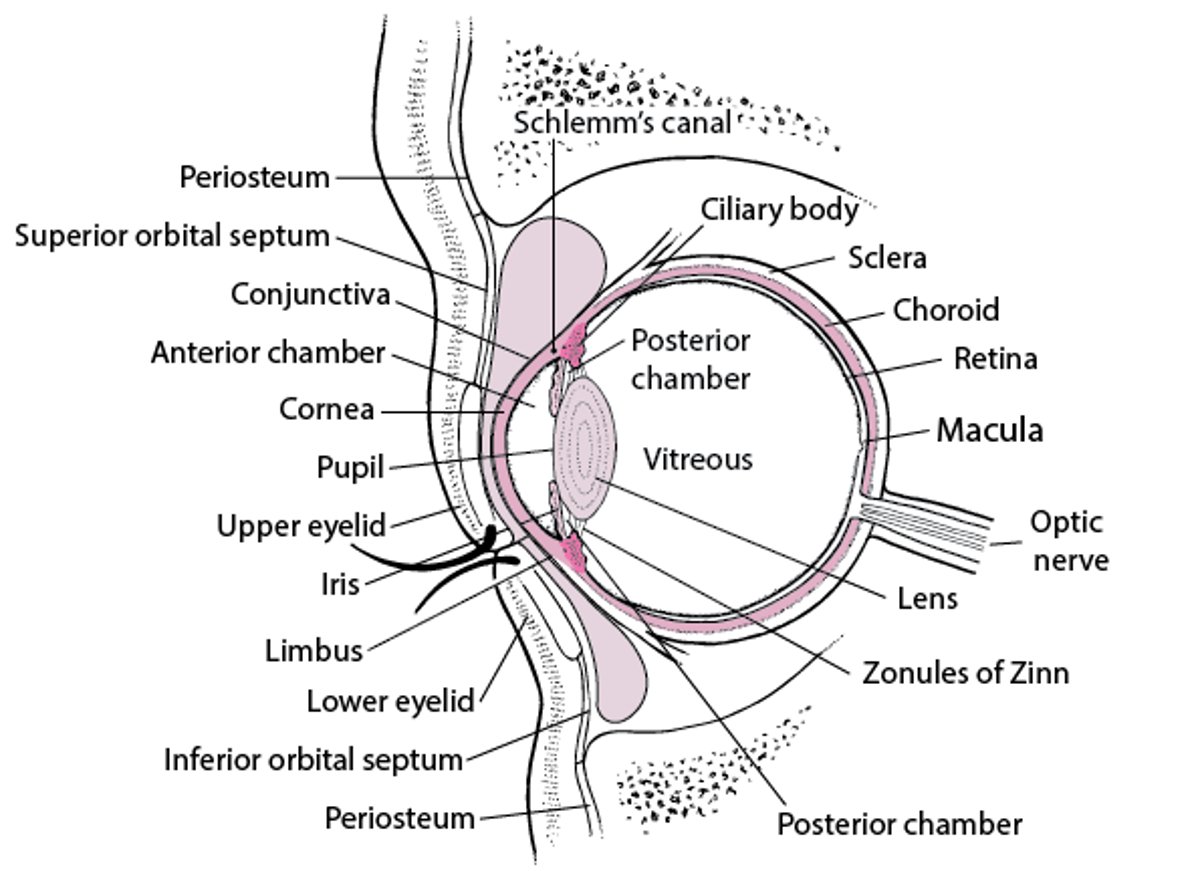
Cross Section of the Eye
The zonules of Zinn keep the lens suspended, and the muscles of the ciliary body focus the lens. The ciliary body also secretes aqueous humor, which fills the anterior and posterior chambers, passes through the pupil into the anterior chamber, and drains primarily via Schlemm’s canal. The iris regulates the amount of light entering the eye by adjusting the size of its central opening, the pupil. Visual images are focused on the retina. The fovea centralis is the area of sharpest visual acuity. The conjunctiva covers the eyeball and lines the upper and lower eyelids; it ends at the limbus. The cornea is covered with epithelium that is more sensitive than and differs from the conjunctival epithelium. |

Vascular occlusions of the retina (central retinal artery occlusion, central retinal vein occlusion)
Ischemic optic neuropathy (often in patients with temporal arteritis)
Vitreous hemorrhage (caused by diabetic retinopathy or trauma)
In addition, sudden recognition of loss of vision (pseudo-sudden loss of vision) may manifest initially as sudden onset. For example, a patient with long-standing reduced vision in one eye (possibly caused by a dense cataract) suddenly is aware of the reduced vision in the affected eye when covering the unaffected eye.
Presence or absence of pain helps categorize loss of vision (see table ).
Most disorders that cause total loss of vision when they affect the entire eye may affect only part of the eye and cause only a visual field defect (eg, branch occlusion of the retinal artery or retinal vein, local retinal detachment).
Less common causes of acute loss of vision include:
Anterior uveitis (a common disorder, but one that usually causes eye pain severe enough to trigger evaluation before vision is lost)
Aggressive retinitis
Certain substances (eg, methanol, pesticides [1])
Some Causes of Acute Vision Loss
Cause | Suggestive Symptoms or Signs | Diagnostic Approach |
|---|---|---|
Acute loss of vision without eye pain | ||
Amaurosis fugax | Monocular blindness lasting minutes to hours (typically < 5 minutes when due to cerebrovascular disease) Sometimes Hollenhorst plaque (refractile object at the site of arterial occlusion) Sometimes normal eye examination |
|
Arteritic ischemic optic neuropathy (usually in patients with giant cell [temporal] arteritis) | Sometimes pale and swollen optic disc with surrounding hemorrhages, occlusion of retinal artery or its branches Sometimes only vision loss Sometimes headache, jaw or tongue claudication, temporal artery tenderness or swelling Sometimes proximal myalgias with stiffness (due to polymyalgia rheumatica) | Erythrocyte sedimentation rate (ESR), C-reactive protein (CRP), platelet count Temporal artery biopsy |
Functional loss of vision (uncommon) | Normal pupillary light reflexes, positive optokinetic nystagmus, no objective abnormalities on eye examination Sometimes exaggerated severity of an organic eye disorder Often inability to write name or bring outstretched hands together Sometimes indifferent affect despite severity of claimed loss of vision | History and physical examination If diagnosis is in doubt, ophthalmic evaluation and visual evoked responses |
Macular hemorrhage due to neovascularization in age-related macular degeneration | Blood within or deep to retina in and around the macula | Funduscopy Optical coherence tomography |
Nonarteritic ischemic optic neuropathy | Optic disc edema and hemorrhages Sometimes loss of inferior and central visual fields Risk factors (eg, diabetes, hypertension, hypotensive episode) | ESR, CRP, and platelet count Consideration of temporal artery biopsy to exclude giant cell arteritis |
Ocular migraine | Scintillating scotomata, mosaic patterns, or complete loss of vision lasting usually 10–60 minutes and often followed by headache Bilateral, but may be seem monocular if the scotoma is off-center (ie, a visual disturbance in the right hemifield of both eyes might be perceived as in the right eye only) Often in young patients | History and physical examination, including ophthalmic examination |
Nearly instantaneous onset, sometimes Hollenhorst plaque (refractile object at the site of arterial occlusion) Pale retina and cherry-red fovea only visible after several hours from onset Sometimes Hollenhorst plaque (refractile object at the site of arterial occlusion) Risk factors for vascular disease |
| |
Recent increase in floaters, photopsias (flashing lights), or both Visual field defect Abnormal retinal examination (eg, detached retina appears as a pale billowing parachute) Risk factors (eg, trauma, eye surgery, severe myopia; in men, advanced age) | Ophthalmic evaluation Sometimes ocular ultrasound | |
Frequent, multiple, widely distributed retinal hemorrhages Risk factors (eg, diabetes, hypertension, hyperviscosity syndrome, sickle cell anemia) | Funduscopy Optical coherence tomography | |
Bilaterally symmetric (homonymous) field defects, no effect on visual acuity in the intact parts of the visual field (bilateral occipital lesions are the exception and are uncommon but can occur due to basilar artery occlusion) Risk factors for atherosclerosis |
| |
Vitreous hemorrhage | Previous floaters or spider web in vision Risk factors (eg, diabetes, retinal tear, sickle cell anemia, trauma) | Ophthalmic evaluation Possible ocular ultrasound to assess retina |
Acute loss of vision with eye pain | ||
Halos around lights, nausea, headache, photophobia, conjunctival injection, corneal edema, shallow anterior chamber, intraocular pressure usually > 30-35 mm Hg | Immediate ophthalmic evaluation Gonioscopy | |
Ulcer visible with fluorescein staining, slit-lamp examination, or both Risk factors (eg, injury, contact lens use) | Ophthalmic evaluation | |
Floaters, conjunctival injection, decreased red reflex, hypopyon, or a combination Risk factors (recent eye surgery or ocular injection, traumatic ruptured globe, intraocular foreign body [eg, after hammering metal on metal], fungemia, or bacteremia) | Immediate ophthalmic evaluation with microbiologic testing (eg, Gram stain and culture of aspirates, blood and urine cultures if suspicion for endogenous endophthalmitis) | |
Usually mild pain with eye movement, afferent pupillary defect (occurs early) Visual field defects, typically central Abnormal color vision testing results Sometimes optic disc edema | Gadolinium-enhanced MRI to diagnose multiple sclerosis and related disorders | |
CRP = C-reactive protein; ECG = electrocardiogram; ESR = erythrocyte sedimentation rate. | ||
Etiology reference
1. Souza Monteiro de Araújo D, Brito R, Pereira-Figueiredo D, et al. Retinal Toxicity Induced by Chemical Agents. Int J Mol Sci. 2022;23(15):8182. Published 2022 Jul 25. doi:10.3390/ijms23158182
Evaluation of Acute Vision Loss
History
History of present illness should describe loss of vision in terms of onset, duration, progression, and location (whether it is monocular or binocular and whether it involves the entire visual field or a specific part and which part). Important associated visual symptoms include floaters, flashing lights, halos around lights, distorted color vision, and jagged or mosaic patterns (scintillating scotomata). The patient should be asked about eye pain and whether it is constant or occurs only with eye movement.
Review of systems should seek extraocular symptoms of possible causes, including jaw or tongue claudication, temporal headache, proximal muscle pain, and stiffness (giant cell arteritis); and headaches (ocular migraine).
Past medical history should seek known risk factors for eye disorders (eg, contact lens use, severe myopia, recent eye surgery, injection, or injury), risk factors for vascular disease (eg, diabetes, hypertension), and hematologic disorders (eg, sickle cell anemia or disorders such as Waldenström macroglobulinemia or multiple myeloma that could cause a hyperviscosity syndrome).
Family history of migraine headaches should be noted.
Physical examination
Vital signs, including temperature, are measured.
If the diagnosis under consideration is a transient ischemic attack or stroke (ie, central retinal artery occlusion) presenting as amaurosis fugax, a complete neurologic examination is performed. The temples are palpated for pulses, tenderness, or nodularity over the course of the temporal artery. However, most of the examination focuses on the eye.
Eye examination includes the following:
Visual acuity is measured.
Peripheral visual fields are assessed by confrontation.
Central visual fields are assessed by Amsler grid.
Direct and consensual pupillary light reflexes are examined using the swinging flashlight test.
Ocular motility is assessed.
Color vision is tested with color plates.
The eyelids, sclera, and conjunctiva are examined using a slit lamp if possible.
The cornea is examined with fluorescein staining.
The anterior chamber is examined for cells and flare in patients who have eye pain or conjunctival injection.
The lens is checked for cataracts using a direct ophthalmoscope, slit lamp, or both.
Intraocular pressure is measured.
Ophthalmoscopy is performed, preferably after dilating the pupil with a drop of a sympathomimetic (eg, 2.5% phenylephrine), cycloplegic (eg, 1% cyclopentolate or 1% tropicamide), or both; dilation is nearly full after approximately 20 minutes. The entire fundus, including the retina, macula, fovea, vessels, and optic disc and its margins, is examined.
If pupillary light responses are normal and functional loss of vision is suspected (rarely), optokinetic nystagmus is checked. If an optokinetic drum is unavailable, a mirror can be held near the patient’s eye and slowly moved. If the patient can see, the eyes usually track movement of the mirror (considered to be the presence of optokinetic nystagmus).
Red flags
Acute loss of vision is itself a red flag; most causes are serious.
Interpretation of findings
Evaluation of acute vision loss should be performed systematically. Specific patterns of visual field deficit help suggest a cause. Other clinical findings also help suggest a cause for acute vision loss:
Difficulty seeing the red reflex during ophthalmoscopy suggests opacification of transparent structures (eg, caused by corneal ulcer, vitreous hemorrhage, or severe endophthalmitis).
Specific visual field deficits suggest certain causes (eg, partial retinal detachment, retinal artery occlusion)
Retinal abnormalities that are severe enough to cause acute loss of vision are detectable during ophthalmoscopy, particularly if the pupils are dilated. Retinal detachment may appear as a pale billowing parachute; retinal vein occlusion may show marked retinal hemorrhages (1); retinal artery occlusion may show pale retina with a cherry-red fovea (2).
An afferent pupillary defect (absence of a direct pupillary light response but a normal consensual response) with an otherwise normal examination (except sometimes an abnormal optic disc) suggests an abnormality of the optic nerve or retina (ie, anterior to the optic chiasm).
In addition, the following clinical findings may also help suggest a cause:
Monocular symptoms suggest a lesion anterior to the optic chiasm.
Bilateral, symmetric (homonymous) visual field defects suggest a lesion posterior to the chiasm (eg, occipital lobe stroke).
Constant eye pain suggests a corneal lesion (ulcer or abrasion), anterior chamber inflammation, or increased intraocular pressure, whereas eye pain with movement suggests optic neuritis.
Temporal headaches suggest giant cell arteritis or migraine.
Testing
Additional testing is included in the table . The following are of particular importance:
Erythrocyte sedimentation rate (ESR), C-reactive protein, and platelet count are performed for all patients with symptoms (eg, temporal headaches, jaw claudication, proximal myalgias, stiffness) or signs (eg, temporal artery tenderness or induration, pale retina, papilledema) suggesting optic nerve or retinal ischemia (3, 4).
Ultrasound is performed to view the retina if the retina is not clearly visible with pupillary dilation and indirect ophthalmoscopy performed by an ophthalmologist.
Gadolinium-enhanced MRI of the brain and orbits is performed for patients who have eye pain with movement or afferent pupillary defect, particularly with optic nerve swelling on ophthalmoscopy, to diagnose multiple sclerosis.
MRI or CT scan when vascular ischemia is suspected (eg central retinal artery) (2).
If intraocular pressure is elevated, acute angle closure glaucoma should be suspected (5).
Evaluation references
1. Kovach JL, Bailey ST, Kim SJ, et al. Retinal Vein Occlusions Preferred Practice Pattern®. Ophthalmology. 2025;132(4):P303-P343. doi:10.1016/j.ophtha.2024.12.025
2. Kovach JL, Bailey ST, Kim SJ, et al. Retinal and Ophthalmic Artery Occlusions Preferred Practice Pattern®. Ophthalmology. 2025;132(4):P270-P302. doi:10.1016/j.ophtha.2024.12.024
3. Bajpai V, Madan S, Beri S. Arteritic anterior ischaemic optic neuropathy: An update. Eur J Ophthalmol. 2021;31(6):2818-2827. doi:10.1177/11206721211009447
4. Hayreh SS. Ischemic optic neuropathy. Prog Retin Eye Res. 2009;28(1):34-62. doi:10.1016/j.preteyeres.2008.11.002
5. Gedde SJ, Chen PP, Muir KW, et al. Primary Angle-Closure Disease Preferred Practice Pattern®. Ophthalmology. 2021;128(1):P30-P70. doi:10.1016/j.ophtha.2020.10.021
Treatment of Acute Vision Loss
Causative disorders are treated. Urgent consultation with ophthalmology is required for most patients with acute vision loss.
Treatment should usually commence immediately if the cause is treatable. In many cases (eg, artery occlusions), treatment is unlikely to salvage the affected eye but can decrease the risk of the same process occurring in the contralateral eye or of a complication caused by the same process (eg, ischemic stroke).
Key Points
Diagnosis and treatment should occur as rapidly as possible.
Immediate referral to a stroke center if an acute embolic event is suspected (eg, amaurosis fugax, retinal artery occlusion, ischemic stroke).
Urgent ophthalmologic consultation for most patients with acute vision loss.
Acute monocular loss of vision with an afferent pupillary defect indicates a lesion of the eye or of the optic nerve anterior to the optic chiasm.
Optic nerve lesion, particularly ischemia, is considered in patients with acute monocular loss of vision or afferent pupillary defect without eye pain and in those with or without optic nerve abnormalities on ophthalmoscopy but no other abnormalities on eye examination.
Corneal ulcer, acute angle-closure glaucoma, endophthalmitis, or severe anterior uveitis is considered in patients with acute monocular loss of vision, eye pain, and conjunctival injection.
Drug Information for the Topic