


Lymphadenitis is inflammation of one or more lymph nodes and is most commonly caused by infection. The infection may be of bacterial, viral, fungal, or protozoal origin. Symptoms include pain, tenderness, and lymph node enlargement. Diagnosis is typically clinical. Treatment is usually empiric.
(See also Overview of Bacterial Skin Infections and Lymphangitis.)
Lymphadenitis is a feature of many bacterial, viral, fungal, and protozoal infections.
Focal lymphadenitis is prominent in the following:
Tuberculosis or nontuberculous mycobacterial infection (particularly scrofula)
Multifocal lymphadenitis may occur in patients with the following:

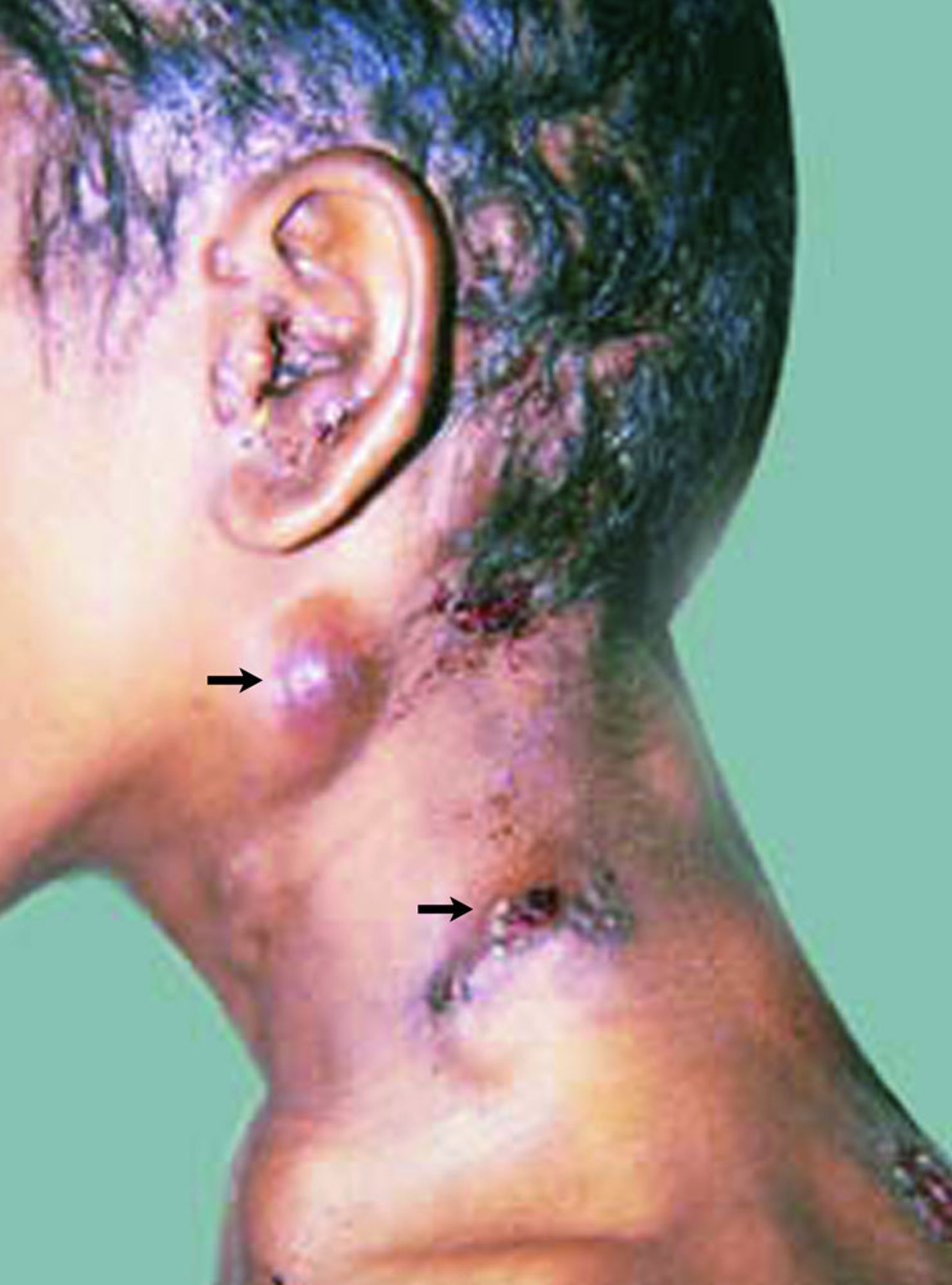
Patients with scrofuloderma have painless, firm, subcutaneous nodules (top arrow) that eventually enlarge and form ulcers and sinus tracts (bottom arrow).
© Springer Science+Business Media
Other, noninfectious causes of lymphadenitis include autoimmune disease (eg, systemic lupus erythematosus, rheumatoid arthritis), cancers (eg, lymphoma, leukemia), drug reactions (eg, to allopurinol or phenytoin), Castleman disease, and Kawasaki disease (1).
General reference
1. Gaddey HL, Riegel AM. Unexplained Lymphadenopathy: Evaluation and Differential Diagnosis. Am Fam Physician. 2016;94(11):896-903.
Symptoms and Signs of Lymphadenitis
Lymphadenitis typically causes focal erythema, pain, tenderness, and lymph node enlargement. Pain and tenderness typically distinguish lymphadenitis from lymphadenopathy. With some infections, the overlying skin is inflamed, occasionally with cellulitis. Abscesses may form, and penetration to the skin produces draining sinuses. Fever is common.


This photo shows a child with a right submandibular nontuberculous mycobacterial lymphadenitis presenting as a fluctuant swelling with extensive characteristic skin discoloration.
Diagnosis of Lymphadenitis
History and physical examination
Aspiration and culture or excisional biopsy in selected cases
The diagnosis of lymphadenitis is primarily clinical, based on suggestive history of the underlying disorder and physical examination findings of lymph node enlargement with features suggesting infection (eg, erythema, pain, sometimes purulent drainage). Enlarged lymph nodes that do not cause pain, tenderness, or erythema may raise concern for other disorders such as lymphomas.
Tissue diagnosis may be required when the etiology remains uncertain, there is concern for cancer, or if unilateral, firm, large, fixed, or matted nodes are present (1). Fine-needle aspiration and core needle biopsy are minimally invasive options; however, excisional biopsy may be required (eg, for patients with scrofula, cancer, or persistent, recalcitrant, or recurrent lesions) (2, 3). Cultures and quantitative polymerase chain reaction (PCR) technique (or other similar molecular diagnostic methods) can accurately identify the causative organism in some cases (eg, tularemia, tuberculosis).
Diagnosis references
1. Prasad R, Arthur LG. Cervical Lymphadenopathy. Fundamentals of Pediatric Surgery. 2010;213-219. Published 2010 Jul 28. doi:10.1007/978-1-4419-6643-8_28
2. Olivas-Mazón R, Blázquez-Gamero D, Alberti-Masgrau N, et al. Diagnosis of nontuberculous mycobacterial lymphadenitis: The role of fine-needle aspiration. Eur J Pediatr. 2021;180(4):1279–1286. doi:10.1007/s00431-020-03875-2
3. Falk N, Joseph R, Dieujuste M. Lymphadenopathy: Evaluation and Differential Diagnosis. Am Fam Physician. 2025;112(3):286-293.
Treatment of Lymphadenitis
Treatment of underlying cause
The treatment of lymphadenitis is directed at the underlying cause.
Many patients with infectious lymphadenitis may respond to outpatient therapy with oral antibiotics. Empiric therapy is typically directed at Staphylococcus aureus and Streptococcus pyogenes or at atypical mycobacteria. Antifungals or antiparasitics are administered depending on the suspected etiology. The use of warm compresses may be provide symptomatic pain relief, and NSAIDs can also be administered.
However, many patients also go on to form abscesses, which require surgical drainage in addition to antibiotics. In children, IV antibiotics are commonly needed, and IV antibiotics may also be required in patients with a severe bacterial infection.
Lymphadenitis usually resolves with timely treatment, but residual, persistent, nontender lymphadenopathy is common.
Drug Information for the Topic







