Retinoblastomas are cancers that grow in the retina (the light-sensing area at the back of the eye). These tumors develop during childhood. All retinoblastomas are cancerous (malignant).
Retinoblastomas can result from a genetic mutation.
The child may have a white pupil or cross-eyes or occasionally vision problems.
Doctors can often diagnose retinoblastoma by looking into the eye with a special instrument while the child is under anesthesia.
Treatment may involve surgery, chemotherapy, lasers, cryotherapy, and sometimes radiation therapy.
(See also Overview of Childhood Cancer.)
Retinoblastomas represent about 2% of childhood cancers. This cancer most commonly occurs in children under 2 years of age. Retinoblastomas typically occur only in children.
This cancer results from a mutation in certain genes that control eye development. Sometimes, the mutation is passed on (inherited) from a parent. At other times, the cancer occurs spontaneously (not inherited) very early during development of the embryo.
When the mutation is inherited, affected children may pass the mutation on to their children. There is a 50% chance that the mutation will be passed on if one parent has the mutation. If the mutation is passed on, most children with the mutation will develop retinoblastoma. Retinoblastoma is hereditary in all children who have the cancer in both eyes and in 15% of children who have the cancer in one eye.
At other times, the mutation does not occur until later in embryonic development and only in the embryo’s eye cells. In such cases, the mutation is not inherited and cannot be passed on to children.
Viewing the Retina

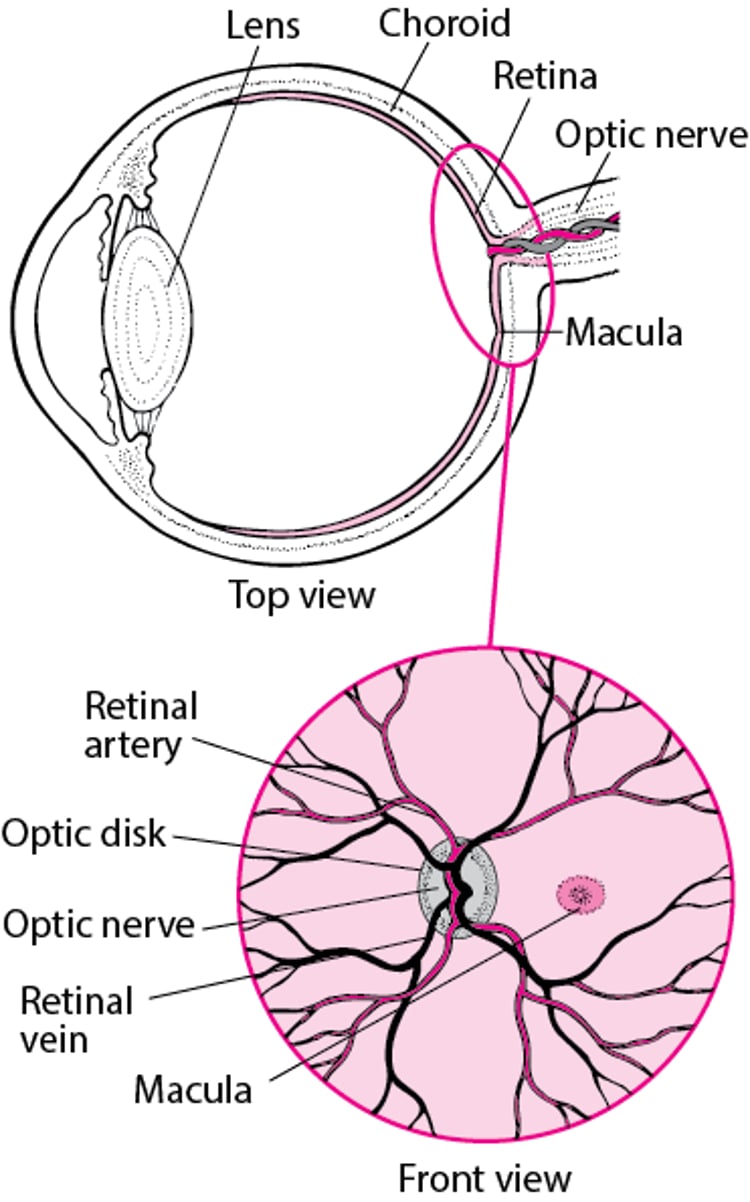
Retinoblastoma does not usually spread (metastasize) beyond the eye, but it occasionally spreads to the brain along the optic nerve (the nerve that leads from the eye to the brain). It may rarely spread to other locations, such as the bone marrow and bones.
Symptoms of Retinoblastoma
Symptoms of retinoblastoma can include a white pupil (leukocoria) or cross-eyes (strabismus).

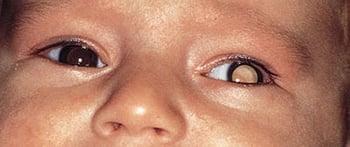
A white pupil (leukocoria) is a symptom of retinoblastoma.

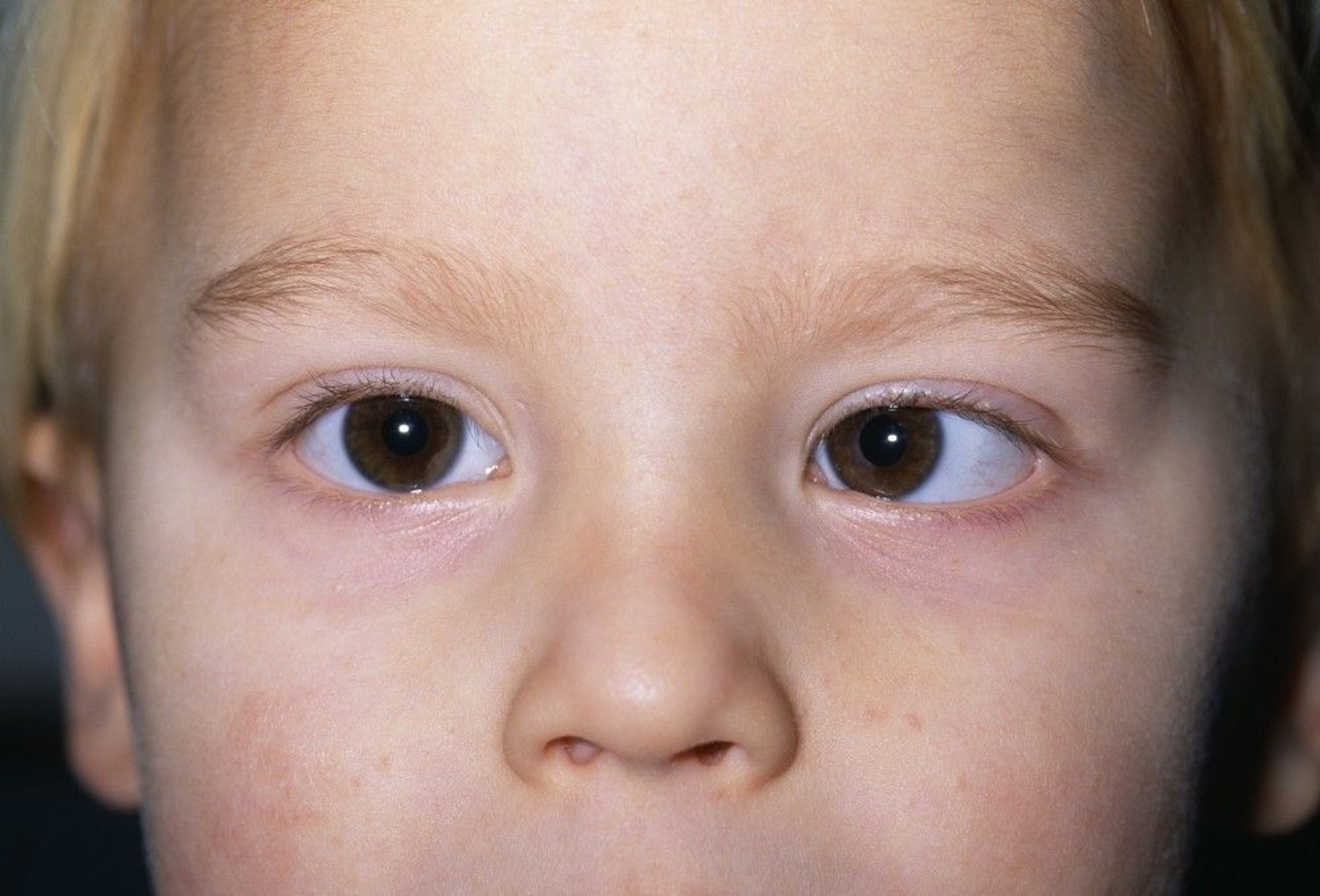
This photo shows a child who has a type of strabismus called esotropia. The child's left eye turns inward toward the right eye.
DR P. MARAZZI/SCIENCE PHOTO LIBRARY
Large retinoblastomas may affect vision but tend to cause few other symptoms.
If the cancer has spread, symptoms may include headache, loss of appetite, pain in an affected bone, or vomiting.
Diagnosis of Retinoblastoma
Doctor's eye examination using a special instrument while the child is under anesthesia
Ultrasound or magnetic resonance imaging (MRI)
Sometimes optical coherence tomography, a bone scan, examination of bone marrow, and spinal tap
Genetic testing
A doctor may detect a retinoblastoma during a routine physical examination of a child.
If a doctor suspects a retinoblastoma, the child is given a general anesthetic, which makes the child lose consciousness, and both eyes are examined. A light and a special lens (indirect ophthalmoscopy) are used to look through the child's lens and iris at the retina. A general anesthetic is necessary because small children are not able to cooperate during the careful, time-consuming examination required to diagnose retinoblastoma.
The cancer can also be identified by an ultrasound or by an MRI scan of the eyes. These tests also help determine whether the cancer has spread to the brain. Optical coherence tomography is another imaging test that sometimes is done.
Doctors may also do a spinal tap (lumbar puncture) to look for cancer cells in a sample of cerebrospinal fluid. Finding cancer cells in this fluid is further evidence that the cancer has spread to the brain. Doctors also an MRI scan of the brain to determine where the cancer has spread.
Because the cancer can occasionally spread to the bones or bone marrow, children who have bone pain or whose cancer has spread undergo a bone scan, and doctors remove a sample of bone marrow for examination.


Children who have retinoblastoma should see a genetic specialist and have genetic testing. The specialist can then advise parents whether other family members are at risk and whether other tests should be done. Typically, if children have a hereditary retinoblastoma gene, their parents and brothers and sisters should also be tested for the mutated gene. Siblings who have the mutated gene should have their eyes examined for retinoblastoma at intervals that are determined based on their age and risk of developing the cancer.
If genetic testing is not available, all children who have a parent or sibling who had retinoblastoma should have the same regular eye examinations.
Adult family members of a child with retinoblastoma should be offered genetic testing and regular eye examinations. Even though adults will not usually develop retinoblastoma, they may develop a noncancerous (benign) eye tumor called retinocytoma, which is caused by the same gene that causes retinoblastoma.
Treatment of Retinoblastoma
Sometimes surgical removal of the eye
Sometimes chemotherapy
Sometimes radiation therapy, lasers, and cryotherapy
(See also Cancer Treatment Principles and Surgery for Cancer.)
When the cancer is advanced and affects only one eye, doctors usually remove the entire eyeball along with as much of the optic nerve as possible.
When the cancer is less advanced and affects only one eye, doctors do not remove it. Instead they inject chemotherapy medications directly through the main artery that provides blood to the eye (called intra-arterial chemotherapy) or directly into the eyeball (called intravitreal chemotherapy).
When the cancer affects both eyes, doctors can usually preserve vision by treating the cancer without removing both eyeballs, although they sometimes remove the most severely affected eye. Treatment options include intra-arterial chemotherapy, intravitreal chemotherapy, radiation therapy, lasers, freezing (cryotherapy), or, for very small cancers, patches attached to the eye wall near the cancer that contain radioactive material (brachytherapy, or internal radiation therapy).


Combinations of chemotherapy given by mouth or vein (such as carboplatin, etoposide, and vincristine or cyclophosphamide plus vincristine) may be used to shrink a large tumor in one eye, shrink tumors that are in both eyes, or treat cancer that has spread beyond the eye. Chemotherapy is used with other treatments because alone it usually cannot cure this cancer.
Radiation therapy to the eye has serious consequences, such as cataracts, decreased vision, chronic dry eye, and wasting of the tissue around the eye. The bones of the face may not grow normally, resulting in a deformed appearance. Additionally, the risk of a developing a second cancer increases in the area where radiation is done.
After treatment, a doctor who specializes in treating cancer in children (pediatric oncologist) and a medical doctor who specializes in the evaluation and treatment of eye disorders (ophthalmologist) should continue to monitor the child because of the risk of the cancer returning or of a second cancer developing.
Prognosis for Retinoblastoma
With treatment, children with retinoblastoma that has not spread past the retina are cured more than 95% of the time. The prognosis is poor for children whose cancer has spread.
Children with the hereditary type of retinoblastoma have an increased risk of developing a second cancer, and about one-third to one-half of them will develop a second cancer over the next 50 years or by age 60. Second cancers include soft-tissue sarcomas, melanoma, breast cancer, and osteosarcomas.
More Information
The following English-language resource may be useful. Please note that The Manual is not responsible for the content of this resource.
American Cancer Society: How to Cope if Your Child Has Cancer
Drug Information for the Topic