Medications and other substances can cause multiple skin eruptions and reactions. The most serious of these include Stevens-Johnson syndrome and toxic epidermal necrolysis, hypersensitivity syndrome, serum sickness, exfoliative dermatitis, angioedema, anaphylaxis, and drug-induced vasculitis.
Medications can also be implicated in hair loss, lichen planus, erythema nodosum, pigmentation changes, systemic lupus erythematosus, photosensitivity reactions, and bullous disorders (eg, pemphigus vulgaris and bullous pemphigoid).
Other drug reactions are classified by lesion type.
Symptoms and Signs of Drug Eruptions and Reactions
Symptoms and signs vary based on the cause and the specific reaction (see table ).


Urticarial lesions (wheals or hives) are migratory, elevated, pruritic, erythematous plaques caused by local dermal edema.
Urticarial lesions (wheals or hives) are migratory, elevated, pruritic, erythematous plaques caused by local dermal ede
Photo provided by Thomas Habif, MD.

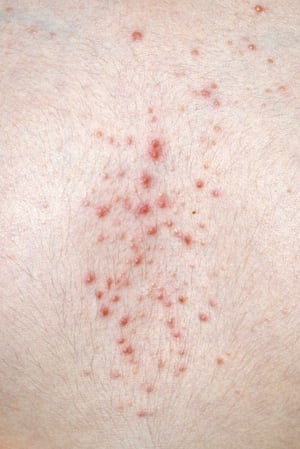
This photo shows acneiform rash on the chest caused by glucocorticoid treatment.
This photo shows acneiform rash on the chest caused by glucocorticoid treatment.
DR P. MARAZZI/SCIENCE PHOTO LIBRARY

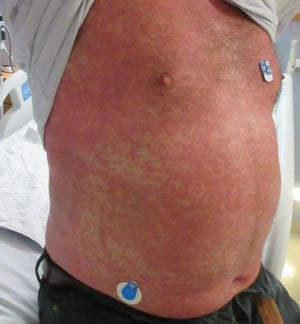
This photo shows a morbilliform eruption secondary to use of a medication.
This photo shows a morbilliform eruption secondary to use of a medication.
Photo courtesy of Anar Mikailov, MD, FAAD.

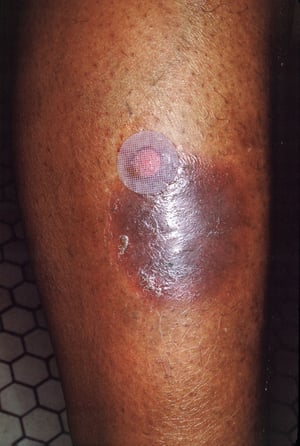
This photo shows a dusky purple plaque with slight erythema and scale at the periphery.
This photo shows a dusky purple plaque with slight erythema and scale at the periphery.
Photo courtesy of Karen McKoy, MD.
Urticarial lesions (wheals or hives) are migratory, elevated, pruritic, erythematous plaques caused by local dermal edema.
Urticarial lesions (wheals or hives) are migratory, elevated, pruritic, erythematous plaques caused by local dermal ede
Photo provided by Thomas Habif, MD.
This photo shows acneiform rash on the chest caused by glucocorticoid treatment.
This photo shows acneiform rash on the chest caused by glucocorticoid treatment.
DR P. MARAZZI/SCIENCE PHOTO LIBRARY
This photo shows a morbilliform eruption secondary to use of a medication.
This photo shows a morbilliform eruption secondary to use of a medication.
Photo courtesy of Anar Mikailov, MD, FAAD.
This photo shows a dusky purple plaque with slight erythema and scale at the periphery.
This photo shows a dusky purple plaque with slight erythema and scale at the periphery.
Photo courtesy of Karen McKoy, MD.
Types of Drug Reactions and Typical Causative Agents
Type of Reaction | Description and Comments | Typical Causative Agents |
|---|---|---|
Acneiform eruptions | Resemble acne but lack comedones and usually begin suddenly | Glucocorticoids, epidermal growth factor receptor (EGFR) and mitogen-activated protein kinase (MEK) inhibitors, halogens (eg, iodides, bromides), hydantoins, androgenic steroids, lithium, isoniazid, phenytoin, phenobarbital, vitamins B2, B6, and B12 |
Acute generalized exanthematous pustulosis | Rapidly appearing and spreading pustular eruption | Mainly antibiotics but some other medications |
Bullous eruptions | Appear with widespread vesicles and bullae | Pemphigus: Antibiotics, penicillamine, and other thiol compounds (including antihypertensives) Bullous pemphigoid: Penicillamine and furosemide (most common), immune checkpoint inhibitors (especially PD-1 inhibitors) Linear immunoglobulin A (IgA) bullous dermatosis: Vancomycin (most common) |
Cutaneous necrosis | Appears as demarcated, painful, erythematous or hemorrhagic lesions progressing to hemorrhagic bullae and full-thickness skin necrosis with eschar formation | Medications: Warfarin, heparin, barbiturates, epinephrine, norepinephrine, vasopressin, Illicit drugs: levamisole (contaminant in street preparations of cocaine), xylazine (often added to fentanyl in mixtures) |
Appears as lupus-like syndrome, although often without the rash | Procainamide, minocycline, hydralazine, tumor necrosis factor (TNF) inhibitors, penicillamine, isoniazid, quinidine, interferon, methyldopa, chlorpromazine | |
Drug reaction with eosinophilia and systemic symptoms or drug hypersensitivity syndrome | Manifests as fever, facial edema, and rash 2–6 weeks after first dose of a medication Patients may have elevated eosinophils, atypical lymphocytes, hepatitis, pneumonitis, lymphadenopathy, and myocarditis Thyroiditis can be a delayed sequela | Antiseizure medications, allopurinol, sulfonamides, minocycline, vancomycin Immune checkpoint inhibitors† |
Flagellate dermatitis | Linear erythematous wheals | Bleomycin and other antineoplastic agents |
Characterized by tender erythematous nodules, predominantly in the pretibial region, but occasionally involving the arms or other areas | Sulfonamides, oral contraceptives, penicillin, halogens (eg, bromides, iodides) | |
Exfoliative dermatitis/erythroderma | Characterized by erythema and scaling of the entire skin surface May be fatal | Antibiotics, antiseizure medications, antihypertensives, many others |
Fixed drug eruptions (FDE) | Appear as frequently isolated, well-circumscribed, circinate or ovoid dusky red or purple lesions on the skin or mucous membranes (especially of the genitals) and reappear at the same sites each time the medication is taken | Antibiotics, NSAIDs, acetaminophen, barbiturates, antimalarials, antiseizure medications |
Lichenoid or lichen planus–like eruptions | Appear as angular papules that coalesce into scaly plaques | Angiotensin-converting enzyme inhibitors, beta-blockers, methyldopa, quinidine, thiazides, penicillamine, quinacrine Immune checkpoint inhibitors† |
Morbilliform or maculopapular eruptions (exanthems) | Most common hypersensitivity drug reaction Mildly pruritic, typically appearing 3 to 7 days after start of the medication | Almost any medication (especially barbiturates, analgesics, sulfonamides, ampicillin, and other antibiotics) |
Mucocutaneous eruptions | Vary from a few small oral vesicles or urticaria–like skin lesions to painful oral ulcers with widespread bullous skin lesions (see Erythema Multiforme and Stevens-Johnson Syndrome and Toxic Epidermal Necrolysis) | Penicillin, barbiturates, antiseizure medications, sulfonamides, NSAIDs, antibiotics, allopurinol, nevirapine, vaccines |
Palpable purpura | Nonblanching purpuric papules most commonly on the lower extremities | Antibiotics, NSAIDs, antihypertensives, antiseizure medications, allopurinol |
Phototoxic reactions: Occur after direct damage of the tissue by exposure to the sunlight and medication and occur shortly after exposure and can look like a burn, including blistering; eruptions limited to sun-exposed skin Photoallergic reactions: Cell-mediated, can occur later, often with skin changes similar to those of eczema, and can spread to nonexposed skin | Medications that can cause phototoxic or photoallergic reactions: NSAIDs, chlorpromazine, phenothiazines, and sulfonamides Medications that usually cause only phototoxic reactions: Antibiotics (eg, tetracyclines, fluoroquinolones) | |
Serum sickness–type drug reaction | A type III hypersensitivity immune complex reaction Acute urticaria and angioedema more common than morbilliform or scarlatiniform eruptions Possibly polyarthritis, myalgias, polysynovitis, fever, and neuritis | Penicillin, insulin, foreign proteins |
Stevens-Johnson syndrome (SJS)/toxic epidermal necrolysis (TEN) | Characterized by focal areas of dusky red lesions, skin pain, and epidermal detachment of < 10% of BSA in SJS and > 30% of BSA in TEN Both skin and mucosa are involved; lips can develop hemorrhagic crusts and ulcerations Severe forms resemble staphylococcal scalded skin syndrome, a staphylococcal toxin–mediated disorder that occurs in infants, young children, and patients with immunosuppression May be fatal | Antiseizure medications, NSAIDs, penicillin, sulfonamides, antiretroviral therapy (ART) Immune checkpoint inhibitors† |
Common Classically but not always IgE-mediated Easily recognized by typical well-defined migratory, erythematous, pruritic wheals May be accompanied by angioedema or other manifestations of anaphylaxis Occasionally the first sign of impending serum sickness, with fever, arthralgia, and other systemic symptoms developing within days | NSAIDs can worsen urticaria (eg, aspirin) Urticaria can be a sign of many other drug reactions. | |
* When epidermal detachment occurs on 10 to 30% of BSA, the term SJS/TEN overlap is used. | ||
† Risks are highest with combinations of immune checkpoint inhibitors. When only single agents are used, risks are highest with inhibitors of CTLA-4, followed by inhibitors of PD1, then inhibitors of PD-L1. | ||
BSA = body surface area; CTLA-4 = cytotoxic T lymphocyte-associated antigen 4; NSAIDs = nonsteroidal anti-inflammatory drugs; PD-1 = programmed death receptor 1; PD-L1 = programmed cell death ligand 1; SJS = Stevens-Johnson syndrome; TEN = toxic epidermal necrolysis. | ||
Immune checkpoint inhibitors commonly cause drug eruptions or cutaneous symptoms (1). The most common are the following:
Less common examples include the following:
Urticaria
Psoriasiform dermatoses
Drug reaction with eosinophilia and systemic symptoms
Risks are highest with combinations of immune checkpoint inhibitors. When only single agents are used, risks are highest with inhibitors of cytotoxic T lymphocyte-associated antigen 4 (CTLA-4), followed by inhibitors of programmed death receptor 1 (PD1), then inhibitors of programmed cell death ligand 1 (PD-L1).
Symptoms and signs reference
1. Quach HT, Johnson DB, LeBoeuf NR, Zwerner JP, Dewan AK. Cutaneous adverse events caused by immune checkpoint inhibitors. J Am Acad Dermatol. 2021;85(4):956-966. doi:10.1016/j.jaad.2020.09.054
Diagnosis of Drug Eruptions and Reactions
History, including drug use history
Physical examination
Sometimes skin biopsy
A detailed history (typically inclusive of reaction onset, progression, triggering and relieving factors, and prior reactions) is often required for diagnosis, including recent use of over-the-counter medications and illicit drugs. Because the reaction may not occur until several days or even weeks after first exposure to a medication, it is important to consider all new medications and not only the one that has been most recently started.
No laboratory tests reliably aid diagnosis, although biopsy of affected skin is often suggestive.
Occasionally, skin tests of different kinds (eg, patch testing for fixed drug eruptions, skin prick and intradermal testing for penicillin and lidocaine) can be useful to determine if the patient is sensitized to a drug. Drug sensitization can be definitively established by rechallenge with the agent; however, this may be hazardous and unethical. Drug challenges are absolutely contraindicated in patients who have had severe cutaneous adverse reactions, including toxic epidermal necrolysis [TEN], Stevens-Johnson syndrome [SJS], acute generalized exanthematous pustulosis [AGEP], and drug reaction with eosinophilia and systemic symptoms [DRESS].
Treatment of Drug Eruptions and Reactions
Discontinuation of offending medication
Sometimes antihistamines and glucocorticoids
Most drug reactions resolve when medications are stopped and require no further therapy. Whenever possible, chemically unrelated compounds should be substituted for suspect medications to avoid possible cross-reactions. If no substitute medication is available and if the reaction is a mild one, it might be necessary to continue the treatment under careful watch despite the reaction.
Pruritus and urticaria can be controlled with oral antihistamines and topical glucocorticoids. For IgE-mediated reactions (eg, urticaria), desensitization can be considered when there is critical need for a medication.
If anaphylaxis occurs, treatment is with aqueous epinephrine (1:1000) 0.3 mL IM or subcutaneously and parenteral antihistamines.
Systemic glucocorticoids may have a role in treating some drug reactions not causing anaphylaxis (eg, T-cell mediated drug-reactions, DRESS, some maculopapular exanthems).
Key Points
Because medications and some other substances can cause a wide variety of reactions, they should be considered as causes of almost any unexplained skin reaction.
The diagnosis should be based primarily on clinical criteria, including a detailed history of prescription and over-the-counter medications.
The suspected offending agent should be discontinued and symptoms treated as needed.
Drug Information for the Topic