A dislocation is complete separation of the 2 bones that form a joint. Subluxation is partial separation. Often, a dislocated joint remains dislocated until reduced (realigned) by a clinician, but sometimes it reduces spontaneously.
Dislocations may be open (in communication with the environment via a skin wound) or closed.
Spinal trauma can cause dislocations or subluxation; nontraumatic spinal subluxation can also occur. Mandibular dislocation can occur spontaneously.
Prognosis and treatment vary greatly depending on the location and severity of the dislocation.
In addition to dislocations, musculoskeletal injuries include the following:
Musculoskeletal injuries are common and vary greatly in mechanism, severity, and treatment. The extremities, spine, and pelvis can all be affected.
Musculoskeletal injuries may occur in isolation or as part of multisystem trauma (see Approach to the Trauma Patient). Most musculoskeletal injuries result from blunt trauma, but penetrating trauma can also damage musculoskeletal structures.
Complications
Serious complications of dislocations are unusual but may threaten limb viability, cause permanent limb dysfunction, or, rarely, be life threatening. Risk of complications is high with open dislocations (which predispose to infection) and with dislocations that are associated with vascular injury, compromised tissue perfusion, and/or nerve injury. Dislocations, particularly if not rapidly reduced, tend to have a higher risk of vascular and nerve injuries than do fractures. Closed dislocations that do not impact blood vessels or nerves, particularly those that are quickly reduced, are least likely to result in serious complications.
Associated injuries and other acute complications of dislocations may include the following:
Fractures may accompany a dislocation (eg, shoulder dislocation combined with fracture of the greater tuberosity).
Bleeding accompanies all significant soft-tissue injuries.
Vascular injuries occur in association with some closed dislocations, particularly knee or hip dislocations, disrupt the vascular supply sufficiently to cause distal limb ischemia; this vascular disruption may be clinically occult for hours after the injury.
Nerve injuries associated with joint dislocations vary depending on the cause of and joint involved in the dislocation and include stretch injuries, compression injuries, and lacerations. There are several classification systems to describe the severity of peripheral nerve injury. In Seddon's classification (1), neurapraxia is a mild injury with focal demyelination or ischemia without structural damage to the axon. Following neurapraxia, there is temporary loss of motor and sensory function that typically resolves within days or weeks. Axonotmesis describes a more severe peripheral nerve injury, which includes both demyelination and axonal injury, with resultant degeneration of the distal nerve segment (Wallerian degeneration); however, the connective tissues surrounding the nerve (epineurium, perineurium, and endoneurium) remain intact. Depending on the extent of the damage, after axonotmesis, the nerve may regenerate over weeks to years. Neurotmesis, which can be associated with open dislocations, is the most severe peripheral nerve injury, with complete transection of the nerve. This type of injury may require surgical repair.
Infection can occur with any injury, but risk of infection as a complication is highest with dislocations that are open or surgically treated. Acute infection can lead to osteomyelitis.
Long-term complications of dislocations may include the following:
Instability: Various dislocations can lead to joint instability. Instability can be disabling and increases the risk of osteoarthritis.
Stiffness and impaired range of motion: Stiffness is more likely if a joint needs prolonged immobilization. The knee, elbow, and shoulder are particularly prone to posttraumatic stiffness, especially in older adults.
Osteonecrosis: Osteonecrosis occurs primarily when the vascular supply is damaged. Dislocations of a native (not prosthetic) hip are prone to osteonecrosis. The incidence of osteonecrosis after hip dislocation is related to the severity of the initial injury and is higher if the dislocation is not promptly reduced.
Osteoarthritis: Dislocations that disrupt the weight-bearing surfaces of joints or that result in joint malalignment and instability predispose to joint cartilage degeneration and osteoarthritis.
General reference
1. Seddon HJ. Three types of nerve injury. Brain. 66(4):237–288, 1942. doi.org/10.1093/brain/66.4.237
Evaluation of Dislocations
History and physical examination
Radiographs
Sometimes MRI or CT
In the emergency department, if the mechanism of injury suggests potentially severe or multiple injuries (as in a high-speed motor vehicle crash or fall from a height), patients are first evaluated from head to toe for serious injuries to all organ systems and, if needed, are resuscitated (see Approach to the Trauma Patient). Patients, especially if a hip dislocation is suspected, are evaluated for hemorrhagic shock due to occult blood loss. If a limb is injured, it is immediately evaluated for lacerations and contusions, symptoms or signs of neurovascular injury (numbness, paresis, poor perfusion), and compartment syndrome (eg, pain out of proportion to injuries, pallor, paresthesias, coolness, pulselessness).
Patients should be evaluated for fractures and other musculoskeletal injuries as well as dislocations; sometimes parts of this evaluation are deferred until fracture is excluded.
The joint above and below the dislocated joint should also be examined.
Some dislocations can be diagnosed with physical examination alone, but radiographs are usually obtained to confirm dislocation and assess for accompanying fractures.
History
The mechanism (eg, the direction and magnitude of force) may suggest whether the injury is likely a dislocation or another type of injury. However, many patients do not remember or cannot describe the exact mechanism.
If a patient reports a deformity that has resolved before the patient is medically evaluated, the deformity should be assumed to have been a dislocation that spontaneously reduced.
Physical examination
Examination includes:
Vascular and neurologic assessment, specifically distal to the injury
Inspection for open wounds, deformity, swelling, ecchymoses, and decreased or abnormal mobility
Palpation for tenderness, crepitation, and gross defects in bone or tendon
Examination of the joints above and below the injured area
Sometimes for subluxations, stress testing of the affected joints for instability is necessary
If muscle spasm and pain limit physical examination (particularly for stress testing) to determine stability of a joint, it may be appropriate to administer a local anesthetic or systemic analgesic. Or the injury can be immobilized, usually for a few days, until muscle spasm subsides, and then the patient can be reexamined.
Certain findings may indicate a dislocation versus another type of musculoskeletal injury.
If a wound is near a dislocation, the dislocation is assumed to be open.
Deformity may indicate dislocation or subluxation (partial separation of bones in a joint), but it may also indicate fracture.
Swelling commonly indicates a significant musculoskeletal injury but may require several hours to develop.
Tenderness accompanies nearly all musculoskeletal injuries, and for many patients, palpation anywhere around the injured area causes discomfort.
Gross joint instability suggests dislocation or severe ligamentous disruption.
Stress testing may be performed to evaluate the stability of an injured joint; however, if a fracture is suspected, stress testing is deferred until radiographs exclude fracture. Bedside stress testing involves passively opening the joint in a direction usually perpendicular to the normal range of motion (stressing). Because muscle spasm during acutely painful injuries may mask joint instability, the surrounding muscles are relaxed as much as possible, and examinations are begun gently, then repeated, with slightly more force each time. Findings are compared with those for the contralateral, uninjured side but can be limited by their subjective nature. For all proximal interphalangeal (PIP) joint dislocations, stress testing is performed after the dislocation is reduced.
If muscle spasm is severe despite use of analgesia or anesthetic injection to determine joint stability, the examination should be repeated a few days later, when the spasm has subsided, and immobilization of the injury should be considered to prevent potential further injury.
Attention to certain areas during examination can help detect commonly missed injuries (see table ).
Examination for Some Commonly Missed Dislocations and Upper-Extremity Musculoskeletal Injuries
Symptom | Characteristic History | Physical Finding | Injury |
|---|---|---|---|
Shoulder pain | Seizure Electric shock | Restriction of passive external rotation with the elbow flexed | Posterior shoulder (glenohumeral) dislocation, possibly bilateral |
History of shoulder dislocation, trauma, or overuse in patients > 40 | Inability to maintain a position at 90° of abduction when slight downward pressure is applied (drop-arm test) | Acute complete rotator cuff tear | |
Various mechanisms (eg, pile-on injury in football, direct blow to joint) | Tenderness over the sternoclavicular joint | Sternoclavicular joint injury | |
Most often, fall on the point of the shoulder | Tenderness over the acromioclavicular area | Acromioclavicular strain or disruption (shoulder separation) | |
Wrist pain or swelling | Fall on an outstretched hand | Tenderness over the anatomic snuffbox (located just distal to the radius, between the extensor pollicis longus, extensor pollicis brevis, and abductor pollicis longus tendons) or tenderness of the anatomic snuffbox with axial loading of the thumb | |
Various mechanisms | Tenderness over the lunate fossa (in the wrist at the base of the 3rd metacarpal) and pain with axial compression of the 3rd metacarpal | Lunate fracture | |
For other commonly missed injuries, see tables and . | |||
If physical examination is normal in a joint that patients identify as painful, the cause may be referred pain (eg, shoulder pain in patients with sternoclavicular injuries).
Imaging
Not all limb injuries require imaging. If imaging is needed, radiographs are usually performed first.
Radiographs are usually sufficient to diagnose joint dislocations and exclude fractures. They should include at least 2 views performed in different planes (usually anteroposterior and lateral views).
Additional views (eg, oblique) may be performed when:
The evaluation suggests fracture and 2 projections are negative.
They are routine for certain joints (eg, a mortise view for evaluating an ankle, an oblique view for evaluating a foot).
Certain abnormalities are suspected (eg, Y view of the shoulder when posterior dislocation is suspected).
For lateral views of digits, the digit of interest should be separated from the others.
MRI or CT may be performed to check for subtle fractures, which may accompany a dislocation.
Other tests are performed to check for related injuries:
Arteriography or CT angiography to check for suspected arterial injuries (eg, possible popliteal artery injury in patients with a knee dislocation)
Electromyography and/or nerve conduction studies to check for suspected nerve damage (usually performed as an outpatient procedure and not performed in the acute setting)
Treatment of Dislocations
Treatment of associated injuries
Reduction as indicated, splinting, and analgesia
RICE (rest, ice, compression, and elevation) or PRICE (protection, rest, ice, compression, and elevation) as indicated
Usually immobilization
Sometimes surgery
Most joint dislocations can be reduced (returned to the normal anatomic position) without surgery. Occasionally, dislocations cannot be reduced using closed manipulative techniques, and open surgery is required. Once a joint is reduced, additional surgery is often not necessary, However, surgery is sometimes required to manage associated fractures, debris in the joint, or residual instability.
Initial treatment
Serious associated injuries or complications, if present, are treated first.
Injuries to arteries are surgically repaired unless they affect only small arteries with good collateral circulation.
If compartment syndrome is suspected (eg, pain out of proportion to injuries, pallor, paresthesias, coolness, and/or pulselessness are present), compartment pressures should be measured. If compartment pressure is elevated, definitive treatment (fasciotomy) should be initiated.
Severed nerves (neurotmesis) are surgically repaired in most cases; for neuropraxia and axonotmesis, initial treatment is usually observation, supportive measures, and sometimes physical therapy.
To prevent infection, suspected open dislocations require sterile wound dressings, tetanus prophylaxis, broad-spectrum antibiotics (eg, cefazolin, or clindamycin if the patient has a penicillin allergy [1]), and surgery for irrigation and debridement.
Most moderate and severe dislocations, particularly grossly unstable ones, are immobilized immediately by splinting (immobilization with a nonrigid or noncircumferential device) to decrease pain and to prevent further injury to soft tissues by unstable injuries.
Pain is treated as soon as possible, typically with opioids and/or nonsteroidal anti-inflammatory drugs (NSAIDs).
After initial treatment, dislocations are reduced, immobilized, and treated symptomatically as indicated.
Dislocations may require surgical repair if:
Structures supporting the joint are damaged.
A joint remains unstable after reduction.
Reduction
Closed reduction (by manipulation, without the need for a skin incision) is performed when possible; sedation and/or analgesia may be required. If closed reduction is not possible or is unsuccessful, open reduction (a surgical procedure with a skin incision to manipulate the joint, usually requiring anesthesia) is required.
Dislocations typically require a cast, splint, sling, or another device (eg, external fixator for the knee) to maintain reduction.
PRICE
Patients with a joint dislocation may benefit from PRICE (protection, rest, ice, compression, elevation), although this practice is not supported by strong evidence.
Protection helps prevent further injury. It may involve limiting the use of an injured part, applying a splint or cast, or using crutches.
Rest may prevent further injury and speed healing.
Ice and compression may minimize swelling and pain. Ice is enclosed in a plastic bag or towel and applied intermittently during the first 24 to 48 hours (for 15 to 20 minutes, as often as possible). Injuries can be compressed by a splint, an elastic bandage, or, for certain injuries likely to cause severe swelling, a Jones compression dressing. The Jones dressing is 4 layers; layers 1 (the innermost) and 3 are cotton batting, and layers 2 and 4 are elastic bandages.
Elevation of the injured limb above the heart for the first 48 hours in a position that provides an uninterrupted downward path allows gravity to help drain edema fluid and minimize swelling.
After 48 hours, periodic application of warmth (eg, a heating pad) for 15 to 20 minutes may relieve pain.
Immobilization
Immobilization decreases pain and facilitates healing by preventing further injury. Joints proximal and distal to the injury should be immobilized.
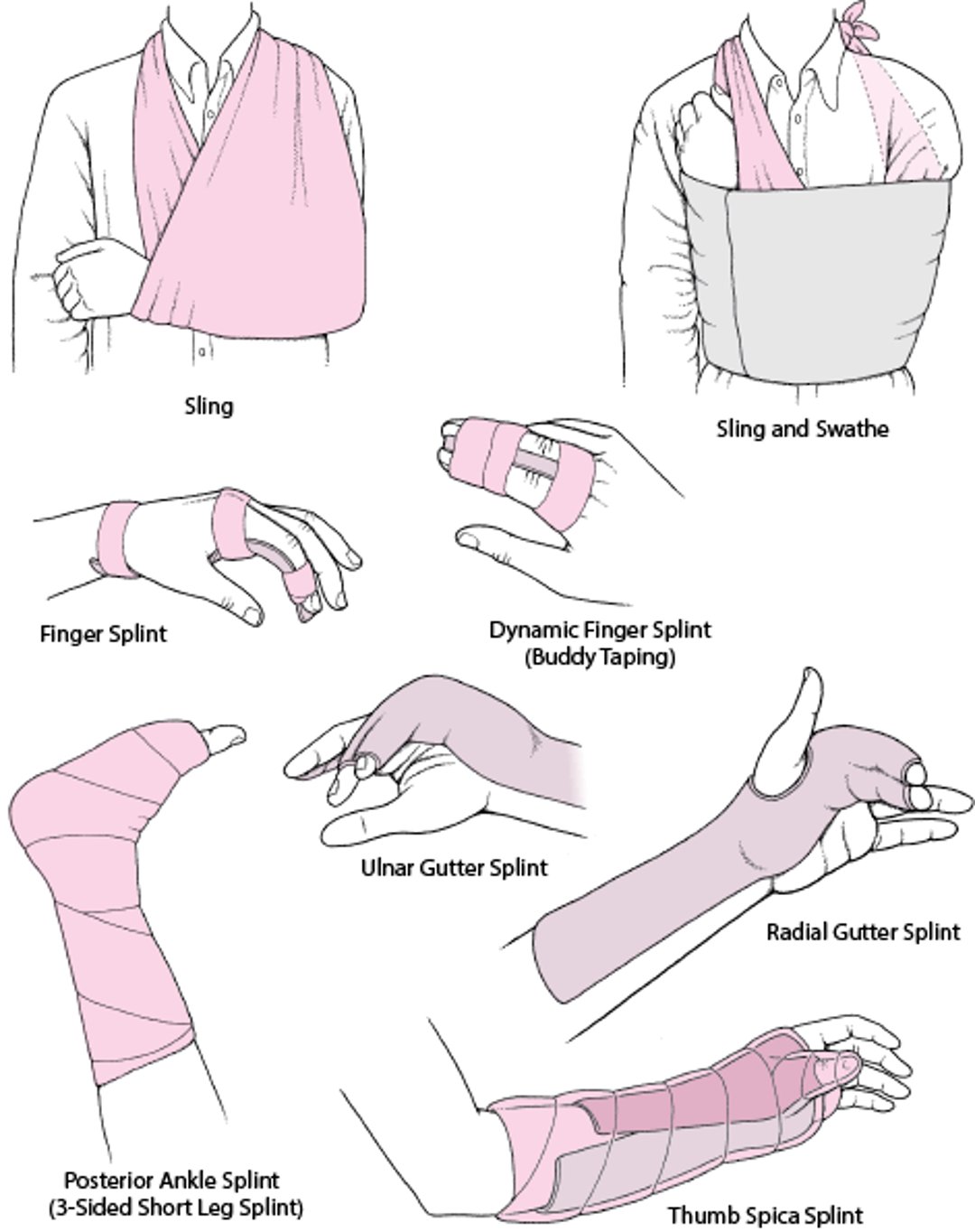
After successful reduction, the affected joint is typically immobilized for a few days or weeks until pain and swelling subside and the joint can be reexamined. This can be accomplished with a plaster or fiberglass splint or other immobilizer devices (eg, sling and swathe, shoulder immobilizer).
Joint Immobilization as Acute Treatment: Some Commonly Used Techniques



© Elsevier Inc. All Rights Reserved.
This video is for personal informational use. Users are prohibited from copying, reproducing, licensing, subscribing, selling, leasing or distributing this video.

© Elsevier Inc. All Rights Reserved.
This video is for personal informational use. Users are prohibited from copying, reproducing, licensing, subscribing, selling, leasing or distributing this video.






© Elsevier Inc. All Rights Reserved.
This video is for personal informational use. Users are prohibited from copying, reproducing, licensing, subscribing, selling, leasing or distributing this video.

© Elsevier Inc. All Rights Reserved.
This video is for personal informational use. Users are prohibited from copying, reproducing, licensing, subscribing, selling, leasing or distributing this video.





A splint (see figure ) can be used to immobilize some stable dislocations. A splint is noncircumferential; thus, it enables patients to apply ice and to move to some degree. Also, it allows for some swelling, decreasing the risk of compartment syndrome. Some dislocations that ultimately require casting are immobilized initially with a splint until most of the swelling resolves.
A sling provides some degree of support and limits mobility; it can be useful for dislocations that are adversely affected by complete immobilization (eg, for shoulder dislocations, which, if completely immobilized, can rapidly lead to adhesive capsulitis [frozen shoulder]).
A swathe (a piece of cloth or a strap) may be used with a sling to prevent the arm from swinging outward, especially at night. The swathe is wrapped around the back and over the injured part.
Dislocations typically do not require a cast after successful reduction. A cast may be required if there is an accompanying fracture or other injury that requires weeks of immobilization, but this is typically considered after the initial swelling has improved and the patient has been immobilized with a splint. Rarely, swelling under a cast is severe enough to contribute to compartment syndrome, about which patients should be educated by the clinician.
Early range of motion should be encouraged. Prolonged immobilization (>3 to 4 weeks for young adults) of a joint can cause stiffness, contractures, and muscle atrophy. These complications may develop rapidly and may be permanent, particularly in older adults. Resumption of active motion within the first few days or weeks may minimize contractures and muscle atrophy, thus accelerating functional recovery. Physical therapists can advise patients about what they can do during immobilization to maintain as much function as possible (eg, elbow, wrist, and hand range-of-motion exercises if the shoulder is immobilized). After immobilization, physical therapists can provide patients with exercises to improve range of motion and muscle strength, strengthen and stabilize the injured joint, and thus help prevent recurrence and long-term impairment.
Treatment reference
1. Goldman AH, Tetsworth K. AAOS Clinical Practice Guideline Summary: Prevention of Surgical Site Infection After Major Extremity Trauma. J Am Acad Orthop Surg. 2023;31(1):e1-e8. doi:10.5435/JAAOS-D-22-00792
Geriatrics Essentials: Dislocations
Older adults are predisposed to dislocations (and other musculoskeletal injuries) because of the following:
A tendency to fall frequently (eg, due to age-related loss of proprioception, adverse effects of medications on proprioception or postural reflexes, or orthostatic hypotension)
Impaired protective reflexes during falls
For any musculoskeletal injury in older adults, the goal of treatment is rapid return to activities of daily living.
Immobility (eg, joint immobilization) is more likely to have adverse effects in older adults. Early mobilization and physical therapy are essential to recovery of function.
Coexisting disorders (eg, arthritis) can interfere with recovery.
Key Points
Dislocations that disrupt arterial supply threaten limb viability and may ultimately threaten life. Compartment syndrome may also develop, which also threatens the limb.
Check for fractures and ligament, tendon, and muscle injuries as well as dislocations (sometimes part of this evaluation is deferred until fracture is excluded).
Examine the joints above and below the injured area.
Consider referred pain, particularly if physical findings are normal in a joint that patients identify as painful (eg, shoulder pain in patients with sternoclavicular injuries).
Perform radiographs to diagnose associated fractures as well as dislocations. Advanced imaging such as CT or MR scanning may lend further information about the injury.
Immediately treat any serious associated injuries, splint unstable dislocations, and, as soon as possible, treat pain and reduce dislocations.
Immobilize all dislocations as soon as they are reduced using a cast, splint, sling, or other device.
Provide patients with explicit, written instructions about immobilization device/cast care.
Choose treatments that make early mobilization possible, and encourage patients, especially older adults, to do the recommended exercises to improve range of motion and muscle strength and to prevent future dislocations.
Drug Information for the Topic